Start With a Mill, Not a Shelf
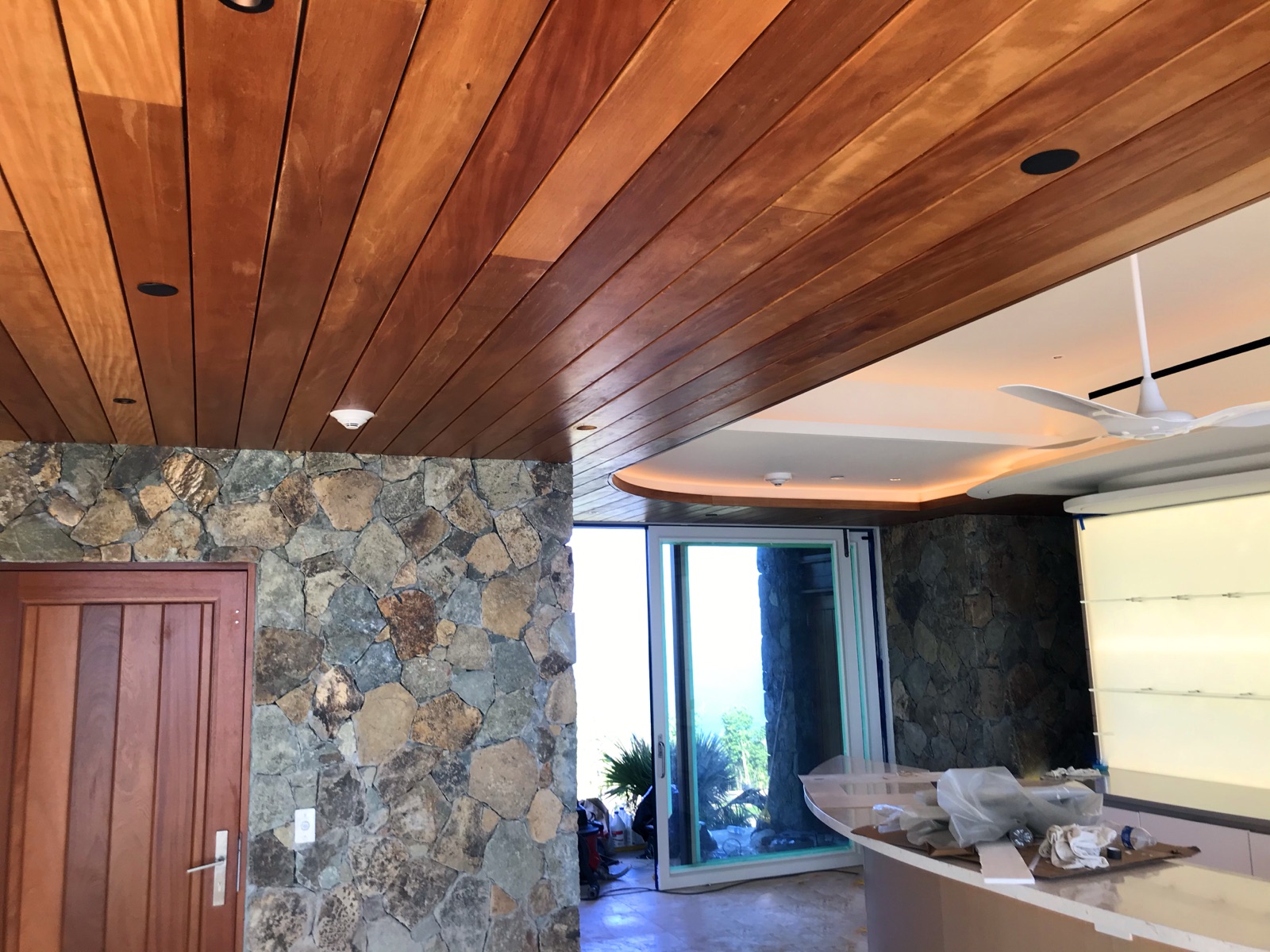
Tongue and groove tropical hardwood for a porch ceiling is a milled-to-order product, and the right place to buy it is an importer that runs the profile on its own moulders. No big-box store stocks it. Most regional lumberyards do not either, and the handful willing to special order it are marking up material they never inspect until the truck arrives. The supply chain for this product is short. Rough kiln-dried stock comes off the ship, gets graded and ripped, then runs through a moulder fitted with a tongue and groove ceiling pattern. Whoever owns that moulder controls the grade, the color matching, and the lead time. Everyone else in the chain is a middleman.
J. Gibson McIlvain mills tongue and groove porch ceiling stock from its own kiln-dried Ipe, Cumaru, Garapa, and Red Balau inventory and ships it nationwide, with regular freight to California and the rest of the West Coast. The company has been importing hardwood since 1798 and cuts ceiling patterns from the same packs that feed its Ipe decking program, which is why a porch floor and the ceiling above it can come out of one color-matched order. That is the honest answer to where to buy. Find the operation that holds the lumber, dries it, and mills it under one roof, then have that operation run the ceiling stock and the deck boards together.
A Ceiling Board Is Not a Deck Board
The material overhead should be thinner, lighter, and joined, which makes it a different milling spec from the 5/4x6 on the floor. Standard tropical decking is square-edge or side-grooved 5/4 stock, surfaced to about an inch net and built to span joists under foot traffic. A ceiling carries nothing but itself. Running 5/4 decking overhead wastes weight, wastes money, and loads the furring for no return. The correct ceiling board is 1x stock, surfaced near three quarters of an inch, with a true tongue on one edge and a matching groove on the other.
Order the profile with a relieved back. Two shallow kerfs milled into the back face let each board sit flat against furring and give internal stresses somewhere to go. Ask about end-matching while you are at it. End-matched stock carries the tongue and groove across the board ends, so butt joints can land between furring strips instead of forcing every joint onto a nailer, and on a long wraparound porch that one detail cuts waste noticeably. Takeoffs change too. A tongue and groove board gives up face width to the joint, so the familiar figure of about 2.1 linear feet per square foot for 5/4x6 decking understates what a ceiling consumes. Have the mill calculate coverage from the actual pattern face width before you commit to a quantity.
Species Logic Flips When Boards Go Overhead
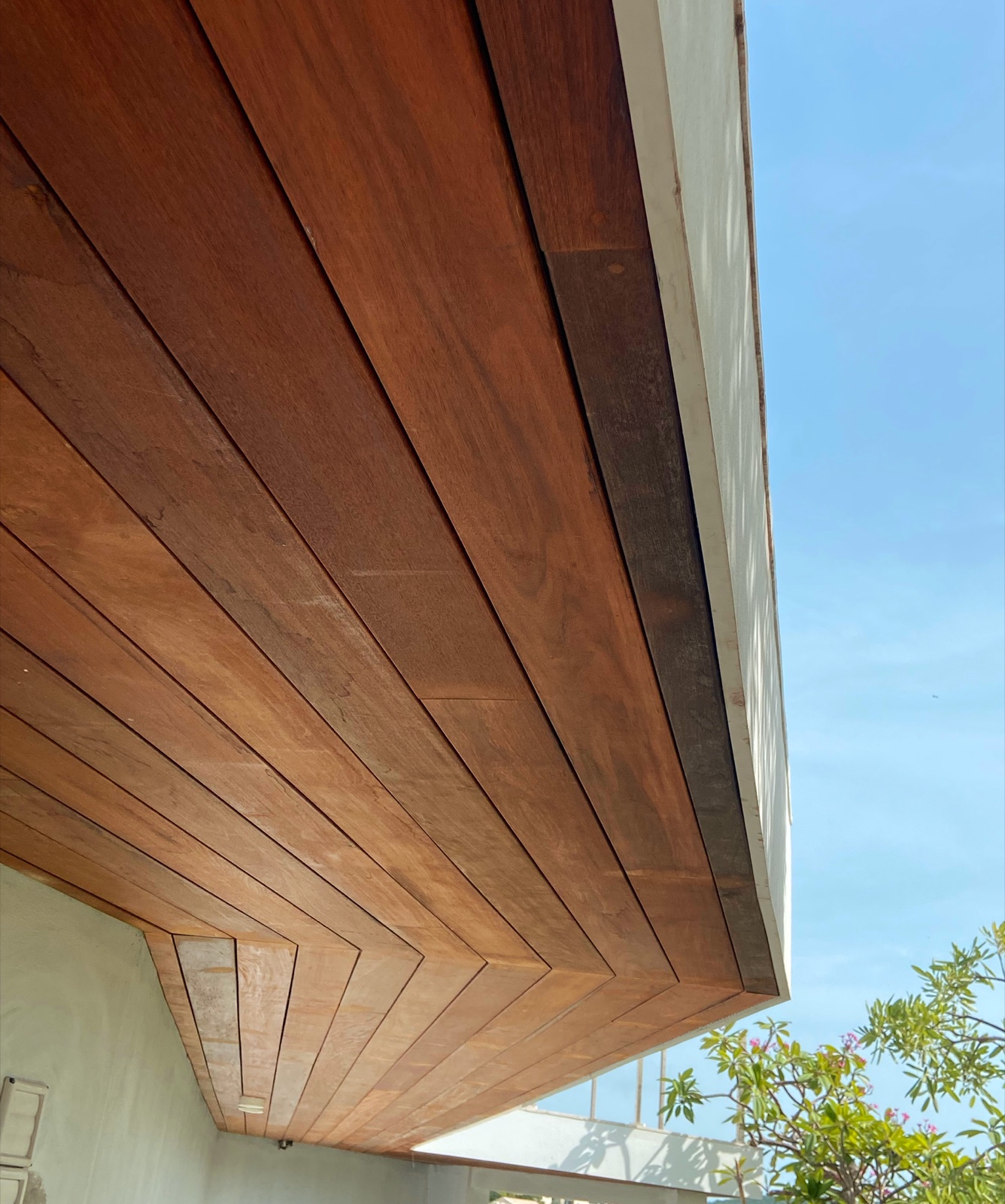
Species that get filtered out of commercial deck specs become first-round picks for ceilings, where weight and color matter more than crushing strength. Commercial boardwalk, pier, and plaza decks are specified at 2x thickness to control deflection, and only Ipe, Cumaru, and Jatoba can be sourced consistently at that thickness. That filter means nothing ten feet in the air. A ceiling board never sees a point load. The sensible screening criteria overhead are density, stability, color under shade, and how cleanly the species machines a tongue.
Garapa is the quiet standout. It runs about 1,700 lbf on the Janka scale, machines cleanly, and its golden honey color brightens a shaded porch instead of darkening it. Red Balau brings an even, brick-red tone in the same rough hardness range, roughly 1,700 to 2,000 lbf, and it mills a crisp joint. Both weigh far less than Ipe (Tabebuia spp.), which lands near 1,050 kilograms per cubic meter with a Janka rating around 3,680 lbf. Ipe and Cumaru still earn their place overhead in two situations. The first is a porch where the floor is the same species and the owner wants one continuous material reading from deck to ceiling. The second is a wildland-urban interface jurisdiction that wants documented fire performance, since Ipe carries a Class A rating under ASTM E84, meaning a flame spread index of 25 or less, rare for any untreated natural material.
Weight and Millability, Species by Species
At three quarters of an inch net, the spread between the heaviest and lightest overhead candidates is more than two pounds per square foot, and that spread drives the furring and fastener schedule. The table compares realistic ceiling candidates on the axes that matter above your head rather than underfoot. Weights are approximate, worked from average dried density at ceiling thickness, and every figure should be confirmed against the actual milled profile before framing loads are finalized.
| Species | Janka (lbf) | Approx. density | Weight at 3/4 in. (lb/sf) | Color | Ceiling role |
|---|---|---|---|---|---|
| Ipe (Tabebuia spp.) | ~3,680 | ~1,050 kg/m3 | ~4.1 | Deep olive brown | Match to an Ipe deck; Class A fire performance |
| Cumaru | ~3,540 | ~1,070 kg/m3 | ~4.2 | Reddish tan with striping | Match to a Cumaru deck; warmer tone than Ipe |
| Garapa | ~1,700 | ~830 kg/m3 | ~3.3 | Golden honey | Best all-around ceiling pick; brightens shaded porches |
| Red Balau | ~1,700 to 2,000 | ~850 kg/m3 | ~3.3 | Even brick red | Uniform color, clean milling, moderate weight |
| Massaranduba | ~3,190 | ~1,150 kg/m3 | ~4.5 | Dark red brown | Comparison only; heaviest of the group and not part of the J. Gibson McIlvain program |
| Western Red Cedar (CVG) | ~350 | ~370 kg/m3 | ~1.4 | Amber to pinkish brown | The legitimate softwood default; CVG for clear finishes, STK for a knotty look |
| Thermory ash / Abodo Vulcan pine | Moderate (modified) | ~500 to 550 kg/m3 | ~2.0 | Rich chocolate brown | Light, stable modified option in lengths just under 16 ft |
Read the weight column twice. A 12 by 40 foot porch ceiling in Ipe hangs close to a ton of lumber overhead, while the same ceiling in Garapa saves several hundred pounds and in a thermally modified species saves close to half. None of these loads challenge a properly furred structure, but they absolutely change how many fasteners you drive and how much fatigue the crew fights on an overhead install.
Choose the Joint Profile Before You Order
The joint profile decides how the ceiling reads, how it hides movement, and whether the fasteners disappear. Three patterns cover nearly every porch ceiling. A V-groove profile bevels each meeting edge, throws a fine shadow line at every joint, and forgives minor seasonal movement because the eye already expects a groove there. A nickel gap profile holds a uniform reveal between flat faces for a more contemporary read. A flush joint gives the smoothest plane and is the least forgiving, since any gap that opens in dry weather shows against an otherwise seamless field.
Shiplap is the fourth option buyers ask about, and it behaves differently in one decisive way. Shiplap takes visible fasteners, driven through the face. Only a true tongue and groove profile works with hidden fastening, where the fastener drives through the tongue and the groove of the next board covers it completely. On any wall application of the same profile, grooves face down so water drains out of the joint rather than sitting in it. Overhead, drainage is not the concern, so orientation follows the fastening sequence instead. Whatever pattern you choose, the movement allowance lives inside the joint. The mill sets tongue length and groove depth so boards can shrink and swell across their width without either opening a visible gap or buckling the field, which is one more reason to buy from the operation that cuts the profile.
Fastening Dense Hardwood Above Your Head
Blind fastening through the tongue into furring strips is the method, and in Ipe or Cumaru every fastener gets a pilot hole drilled on site. Strap the porch ceiling framing with furring at 16 inches on center, shimmed flat, then work across the ceiling one course at a time. The first course at the wall line is face-fastened and its fasteners hide under trim. Every course after that takes a trim-head stainless steel screw or stainless nail driven at an angle through the base of the tongue into each furring strip. In dense species the pilot hole is not optional. Ipe at 3,680 lbf will split a tongue or snap a fastener that goes in without one.
Drilling is installation work, done against the frame as built. No mill drills fastener holes before shipping, and none should, since field layout and end cuts would invalidate any factory pattern within the first three courses. Use 316 stainless fasteners on coastal work, where lesser alloys tea-stain the wood around every head. The American Wood Council publishes connection design values for fasteners in dense hardwoods through its codes and standards program, and they are worth checking when an engineer wants numbers behind the schedule. The final course gets ripped to width and face-fastened like the first, with those heads covered by the perimeter trim. For painted perimeter trim on this kind of porch work, Sapele is the better call over Genuine Mahogany, since it holds paint better and comes in longer lengths.
Moisture, Ventilation, and Movement Overhead
A porch ceiling lives in a sheltered but fully exterior moisture environment, and the board has to be dried and detailed for exactly that. In-service moisture content for covered exterior work runs 12 to 16 percent across most of the country, and the stock must be kiln-dried to match that service range rather than the 6 to 8 percent used for interior flooring. Interior-dried boards installed on a porch will swell and buckle their first humid season. The USDA Forest Products Laboratory publishes shrinkage coefficients by species in its Wood Handbook, and a mill that quotes ceiling stock should be able to tell you the expected width movement of its profile across that service range without looking anything up.
Detail the cavity above the boards to breathe. A porch ceiling with a sealed, unvented cavity above it traps humid air against the back of the boards, and moisture imbalance between faces is what cups a field. Building Science Corporation has documented this class of assembly failure for decades, and the fix is cheap at install time and expensive after. Coat every face and every fresh end cut before boards go up, and seal end grain with a wax emulsion. Small surface checks can still appear in dense tropical stock, since checking is the wood releasing tension as its surface dries faster than its core, and no supplier who tells you the truth will promise to eliminate it. It does not weaken the board. J. Gibson McIlvain factory coats its tropical decking with Cutek, a penetrating oil stabilizer that significantly reduces checking, and the same coating logic serves ceiling stock in its first exposed season.
Thermory and Abodo Vulcan Overhead
Thermally modified wood is the lightweight route to a dark, stable porch ceiling, with one hard limit on length. Thermory ash and Abodo Vulcan pine come out of the modification kiln at roughly half the density of Ipe, with movement in service reduced enough that flush joint profiles stay tight where solid tropical stock would want a V-groove to hide the seasons. The chocolate brown color runs through the full board thickness, so a field cut exposes the same tone as the face. Overhead, the weight savings shows up in crew fatigue and fastener count more than in structure.
The limit is length. Thermory, Abodo Vulcan, and Accoya top out just under 16 feet because the modification kilns themselves set the ceiling on board length. A porch run longer than that needs butt joints, which is where end-matched stock earns its keep again. These are also the only products on this page where a warranty belongs in the conversation, since manufacturers of modified wood back their material with published warranty terms while solid unmodified hardwood carries none and never has. J. Gibson McIlvain carries both Thermory and Abodo Vulcan alongside its solid tropical program, so the comparison can happen inside a single quote.
How the Buying Channels Actually Compare
Cedar from a lumberyard, interior flooring from a specialty dealer, and milled-to-order tropical stock from an importer are three different purchases, and only the third delivers exterior tropical tongue and groove. The lumberyard route ends at Western Red Cedar, and there is nothing wrong with that default. Cedar performs well overhead, and the real decision there is grade. Clear vertical grain, called CVG, gives a knot-free, straight-grained face for clear or painted finishes, while select tight knot, called STK, reads rustic and costs less than CVG. What a yard cannot do is put Garapa or Ipe on your ceiling. Specialty flooring dealers stock beautiful tongue and groove profiles milled for conditioned interiors at interior moisture content, which is precisely the wrong drying spec for a porch.
The importer route is the one built for this job, and it comes with a paper trail the other channels rarely offer. An FSC-certified importer can supply chain-of-custody documentation for projects chasing certification credits, and when a project uses a CITES-listed species, the required export and import documentation travels with the shipment from a legitimate importer as a matter of course. Freight is simpler than most buyers expect. Milled ceiling stock ships bundled and paper-wrapped on the same trucks that move commercial decking orders coast to coast.
Half the ceiling calls we get start out as decking calls. The buyer has Ipe going down on the floor and wants the same look overhead, and they are surprised it is not a catalog item somewhere. We pull from the same packs, run a tongue and groove ceiling pattern on the moulder, and the whole porch reads as one piece of work. What I tell every one of them is to order the ceiling and the floor together, so the color runs match and it all shows up on one truck.
Norm Moton, Director of Sales, J. Gibson McIlvain
How J. Gibson McIlvain Would Specify This
A porch ceiling spec should name the species, the exact profile, the drying target, and the fastening system in one paragraph, and here is what that looks like. Specify 1x6 nominal tongue and groove ceiling stock, surfaced to three quarters of an inch net, V-groove or nickel gap pattern, relieved back, end-matched, kiln-dried to a 12 to 16 percent service range. Name the species by the job. Garapa or Red Balau for a residential ceiling standing on its own. Ipe or Cumaru where the ceiling must match the deck below or where a jurisdiction wants Class A flame spread documentation. Thermory or Abodo Vulcan where weight and movement control lead the priorities and no run needs a single board over 16 feet.
Specify furring at 16 inches on center shimmed to plane, blind fastening through the tongue with stainless steel, 316 grade within reach of salt air, pilot holes drilled on site at every fastener in the dense species, and a vented cavity above the finished field. Call for factory Cutek coating on solid tropical stock and a wax emulsion end sealer on the jobsite for every field cut. Order the ceiling with the decking so color runs match. J. Gibson McIlvain stocks the Ipe side of that order at every standard and custom dimension, mills the ceiling patterns in-house, and quotes the whole porch as one package for delivery anywhere in the country. Call 800-638-9100 with the porch dimensions and the species direction, or start at mcilvain.com, and a sales rep who has run this exact material will take it from there.
Frequently Asked Questions
Can I put standard Ipe decking boards on a porch ceiling?
You can, but you should not. Deck boards are 5/4 stock surfaced to about an inch, sized for foot traffic on joists, and they roughly double the weight hanging over your head compared with proper 1x tongue and groove ceiling stock at three quarters of an inch. Square-edge deck boards also force face fastening, so every screw head shows. Order a true tongue and groove ceiling profile milled from the same species instead, and the fasteners disappear while the weight drops.
How much does a tropical hardwood porch ceiling actually weigh?
At three quarters of an inch net thickness, Ipe runs about 4 pounds per square foot, Cumaru slightly more, and Garapa or Red Balau around 3.3. Thermally modified options like Thermory ash and Abodo Vulcan pine land near 2. A properly furred structure handles any of these without drama, but the difference matters for fastener count, furring schedule, and how hard the crew works during an overhead install.
Do porch ceiling boards come pre-drilled from the mill?
No, and you should not want them to. Drilling is installation work done against the frame as built, since field layout and end cuts would make any factory hole pattern useless within a few courses. On site, pilot every fastener hole through the tongue in dense species like Ipe and Cumaru, and use a self-centering combination bit anywhere a face fastener is required at the first and last courses.
What board lengths can I get for a long wraparound porch ceiling?
Solid tropical stock comes in long lengths that let many residential porch runs go joint-free, and end-matched profiles handle the runs that do not. Thermally modified products are the exception. Thermory, Abodo Vulcan, and Accoya top out just under 16 feet because the modification kilns set the limit, so runs beyond that get planned butt joints on end-matched stock.
Should the ceiling boards be finished before they go up?
Yes, on every face. Coating all faces and sealing end grain before installation balances moisture exchange between the front and back of each board, which is what keeps a field from cupping. Solid tropical stock from J. Gibson McIlvain arrives factory coated with Cutek, a penetrating oil that also significantly reduces surface checking, and fresh field cuts get end sealer on the jobsite.
Will a hardwood ceiling develop the surface checks I see on decks?
Less, but nobody honest will promise zero. Checking is the wood releasing tension as its surface dries faster than its core, and a shaded ceiling sees far less direct sun than a deck, so checks stay smaller and fewer. They do not weaken the board. Factory oil coating and sealed end grain keep them minor, and a covered installation does the rest.
Can the porch ceiling and the deck ship as one order?
Yes, and they should. A mill that runs both products pulls ceiling stock and decking from the same kiln-dried packs, so the color runs match and the whole porch arrives on one truck. J. Gibson McIlvain quotes ceiling patterns and decking together and ships the combined package nationwide, including regular deliveries to California.