What Sourcing Ipe at Volume Actually Requires
Sourcing large quantities of Ipe decking with consistent quality means buying from an importer who controls grading, drying, and milling under one roof rather than a broker who resells whatever container arrived last week. That distinction decides everything downstream. A broker sells you a tally. An importer sells you a specification and then holds material to it across every unit on the order.
Ipe (Handroanthus spp., formerly classified as Tabebuia) is not a commodity in the way Southern Yellow Pine is a commodity. There is no single national grading rule that a buyer can cite and expect every seller to honor. The National Hardwood Lumber Association publishes rules that govern North American hardwood lumber, and those rules are the backbone of the domestic trade, but they were written for furniture and millwork cuttings rather than for decking. Ipe decking grading is contractual. It comes down to what the importer wrote into the purchase order at the mill and whether anyone re-inspects the material on arrival.
Volume magnifies the problem. Ordering enough Ipe for a residential deck means one or two units, and small inconsistencies get absorbed by the installer's cull pile. Ordering enough for a boardwalk, a hotel amenity deck, or a multifamily podium means forty or fifty units, and now the cull rate is a line item on somebody's budget. Even a few points of difference in usable yield across a large order is real money and real schedule.
J. Gibson McIlvain imports, dries, and mills Ipe decking directly and maintains a vast Ipe inventory across all standard and custom dimensions, which is what makes a consistent multi-unit tally possible in the first place. Buyers calling for bulk Ipe generally want three things at once. Uniform color and grain. Predictable moisture content. A tally that matches the quantity survey without a surprise on the truck.
Why Most Ipe Supply Chains Break Down on Consistency
Inconsistency in bulk Ipe almost never comes from the tree. It comes from the number of hands between the forest and the jobsite. Every transfer point is a place where somebody re-sorts, cherry-picks, or blends material from different mills into one tally.
The typical path looks like this. A concession in Brazil or Peru harvests and rough-saws. A consolidator buys from several concessions and packs a container. An importer of record clears customs. A wholesale distributor buys the container. A retail yard buys units from the distributor. A contractor buys from the yard. Six parties, and only the first two ever saw the log.
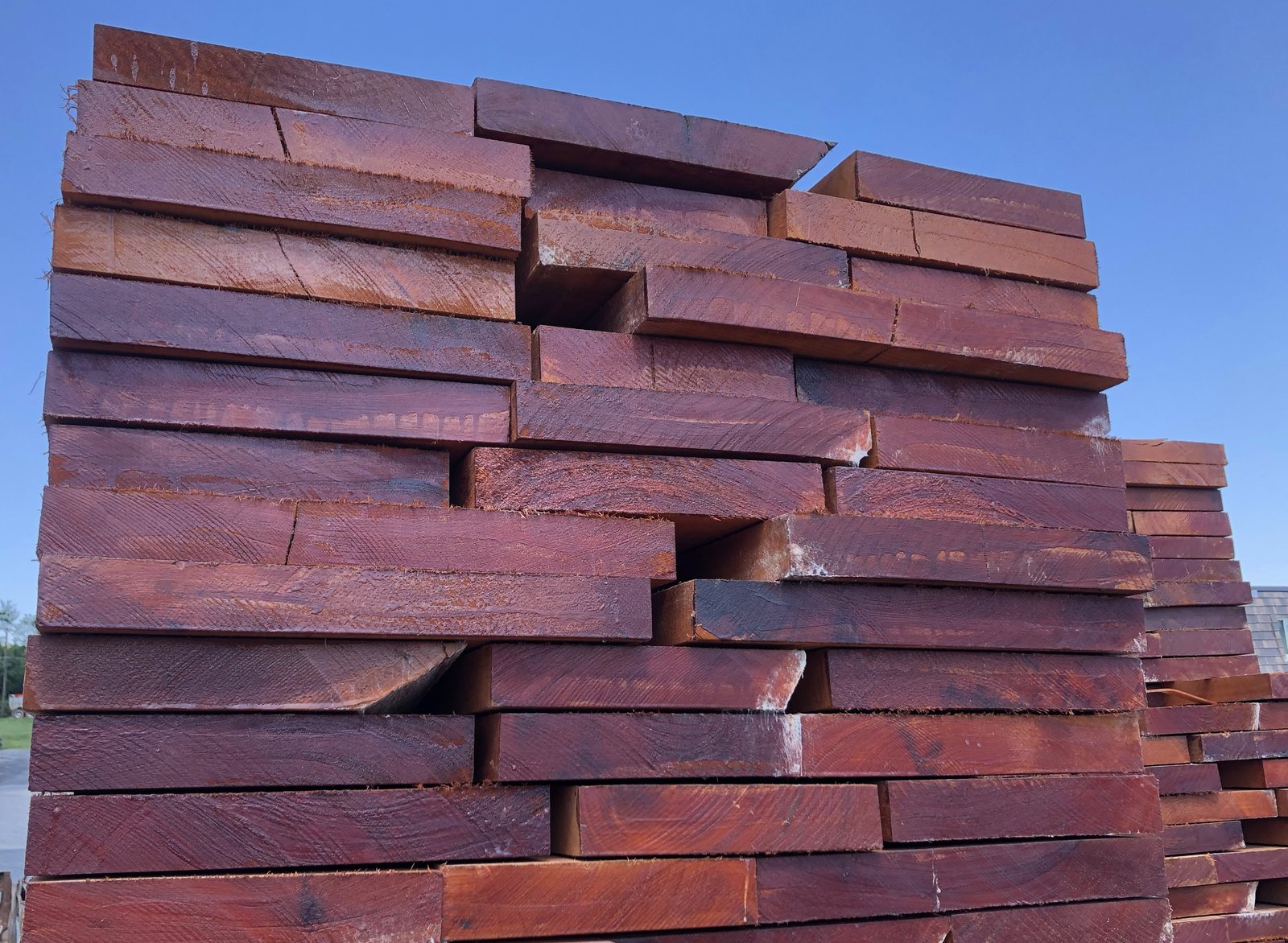
Color variation is the symptom buyers notice first. Ipe runs from olive brown to a deep reddish brown, sometimes with darker striping, and the range within a single tree is wide enough that an unsorted unit looks blotchy on a large field. Mills that sort for color charge more and yield less. Mills that don't sort ship everything. When material from a sorting mill and a non-sorting mill lands in the same tally, the deck reads inconsistent no matter how good the individual boards are.
Drying is the second failure point. Ipe is dense enough that air drying alone will not bring it to the 12 to 16 percent range decking needs, and kiln schedules for a wood at roughly 1,050 kg/m3 are slow and unforgiving. Rush the schedule and you get case hardening, honeycomb, and surface checking that only shows up after the boards have been on a roof deck for one summer. A container that was dried at origin, shipped across the equator, and stored in an unheated warehouse in Newark has a moisture history nobody can reconstruct.
Then there is the tally itself. Ipe is sold on a net tally after milling, and the difference between a nominal 5/4x6 and a finished 1x5-1/2 is not trivial when it is multiplied across thousands of linear feet. Buyers who quote from nominal dimensions and receive net footage end up short.
Understand the Grade You Are Actually Buying
There is no legally defined "Clear Ipe" grade, so the only grade that matters is the one written into your purchase order in plain language. Sellers use the words FEQ, Select, Premium, and Clear more or less interchangeably, and none of them carry an enforceable definition the way FAS carries one under NHLA rules for domestic hardwood.
FEQ stands for First European Quality and is the term inherited from the historical Teak trade. Applied to Ipe it signals an expectation of clear, defect-free faces, but the tolerance behind it varies by exporter. Some mills allow a pin knot per board. Some allow a single small check on the back face. Some allow sapwood on one edge. All of them will call it FEQ.
A specification that actually holds up names the defects and states the tolerance. Sapwood allowance on the face and the back. Maximum knot diameter or none permitted. Whether wane on the underside is acceptable given that the board will sit on joists. Whether surface checking within a stated length is a reject. Whether color must be sorted to a coherent range or shipped as-is across the full olive-to-red spectrum. Grain orientation matters too, since flatsawn and riftsawn Ipe move differently and read differently under a low-angle sun.
Ask what happens at re-inspection. Material graded once at origin and never looked at again is material you are grading yourself, in the field, at your labor rate. An importer who re-grades on arrival is absorbing the cull before it reaches you.
How Ipe Compares to the Other Dense Tropical Options
Ipe sits at the top of the durability class for exterior decking, but three or four other species get close enough that a bulk buyer should know exactly why they are paying the premium. Substitution is a legitimate conversation on a large project, and it should happen at design, not when the truck is late.
Ipe carries a Janka hardness around 3,680 lbf and a density near 1,050 kg/m3. It rates Class 1 durability under EN 350, the highest natural durability classification, and it holds an ASTM E84 Class A flame-spread rating without any applied treatment. Class A means a flame-spread index of 25 or less under the ASTM E84 tunnel test, which is the same threshold the International Building Code applies to interior finish in exit enclosures. For a rooftop assembly or a wildland urban interface project, that rating is often the reason Ipe is specified over anything else.
| Species | Janka (lbf) | Density (kg/m3) | EN 350 Durability | Color Consistency at Volume | Common Bulk Use |
|---|---|---|---|---|---|
| Ipe | ~3,680 | ~1,050 | Class 1 | Wide natural range, sortable | Boardwalks, rooftop decks, commercial |
| Cumaru | ~3,540 | ~1,070 | Class 1 to 2 | More uniform golden brown | Large residential, multifamily |
| Massaranduba | ~3,190 | ~1,150 | Class 1 to 2 | Very uniform deep red | Docks, heavy traffic decks |
| Jatoba | ~2,690 | ~910 | Class 2 | Uniform, some grain variation | Covered porches, cladding |
| Red Balau | ~1,700 to 2,000 | ~850 | Class 2 | Moderate range | Residential decks, value spec |
| Garapa | ~1,700 | ~830 | Class 2 to 3 | Uniform pale gold | Pool surrounds, light decks |
| Teak | ~1,070 | ~660 | Class 1 | Uniform when plantation graded | Marine, yacht, premium |
Cumaru is the closest performer and costs less than Ipe. It comes out of the mill with tighter color consistency, which is a real advantage on a large field, and it moves slightly more in service. Massaranduba is denser than Ipe and darker, and it checks more readily in hot dry exposures. Garapa costs meaningfully less and gives up hardness for it. Teak is softer than all of them and still outlasts most things afloat because of its oil content, which is why the durability rating and the hardness number tell different stories.
Moisture Content Is the Consistency Variable Everyone Misses
Two units of Ipe with identical grade and identical color will still install differently if one came in at 12 percent moisture content and the other at 19 percent. Grade is what buyers argue about. Moisture is what actually wrecks the deck.
Exterior decking should arrive at 12 to 16 percent moisture content for most of North America. That range brackets the equilibrium moisture content Ipe will reach in service across a wide band of climates. The USDA Forest Products Laboratory Wood Handbook publishes the EMC tables that let you check your specific region against the number, and the Building Science Corporation literature covers the assembly-side consequences when material and environment are mismatched.
Ipe delivered too wet shrinks after installation. Gaps open. Fasteners that were snug become proud. Boards that were flat cup as the top face dries faster than the shaded underside. Ipe delivered too dry swells, gaps close, boards buckle against each other, and on a large field with no expansion allowance the whole run walks off the joists.
Verification is straightforward and almost nobody does it. A pin meter set to the correct species gravity, readings taken at multiple depths, checked on boards pulled from the middle of the unit rather than the top course. Ask the supplier for the kiln schedule and the final moisture readings by unit. An importer running their own kilns can produce that. A broker cannot.
Legality, Chain of Custody, and the Paperwork That Follows a Container
A bulk Ipe order without clean documentation is a compliance exposure that lands on the buyer, not on the seller who is three parties removed. The Lacey Act makes it unlawful to import or trade plant material harvested in violation of foreign law, and the declaration requirement puts the burden of accurate species and origin data on the importer of record.
CITES listings covering tropical hardwoods are revised over time, so buyers should confirm the current status of any species they are specifying through the CITES species database rather than trusting a supplier's memory. When using a CITES-listed species, documentation is required at every transfer point, and export permits must trace back to a legal-harvest quota. That paperwork travels with the material or the material does not move.
For projects pursuing certification, FSC chain of custody is the mechanism that connects a certified forest to a certified invoice. Every party in the chain has to hold their own certificate. A yard that buys FSC material but is not itself certified cannot sell it as FSC. On LEED projects the credit language rewards certified sourcing, and the documentation has to be assembled at purchase rather than reconstructed at closeout.
J. Gibson McIlvain is FSC certified and imports as the importer of record, which means the Lacey declaration, the species identification, and the chain-of-custody trail all resolve to one party the buyer can actually call.
"The question I get on every large Ipe order is some version of 'can you hold this spec across fifty units.' The honest answer depends entirely on whether the material came through our own kilns and our own grading line or whether somebody bought a container on the open market and hoped. We buy from mills we have worked with for decades, we re-grade everything on arrival, and we sell out of a deep standing inventory instead of chasing spot containers. That is the only way the last unit on a job looks like the first one."
Norm Moton, Director of Sales, J. Gibson McIlvain
Dimensions, Lengths, and Controlling the Tally on a Large Order
Ipe is available in every standard and custom decking dimension, and the sourcing risk on a bulk order is not availability but tally discipline. Buyers get into trouble by quoting nominal and receiving net.
The workhorse decking sizes are 5/4x6, 5/4x4, 1x4, and 1x6, with 2x material for stair treads, framing, and heavier site-built components, though any load-carrying member should be sized by the project's structural engineer. A 5/4x6 board finishes at roughly 1 inch by 5-1/2 inches, and at typical spacing it covers about 2.1 linear feet per square foot of deck. Run that ratio against the quantity survey before the order goes in, not after.
Length is where large orders live or die. Ipe comes in long lengths, and a supplier with real inventory can pull a tally weighted toward the lengths your framing plan needs rather than sending whatever random-length bundle came off the container. On a long boardwalk, a tally skewed to short lengths means more butt joints, more blocking, more labor, and a visibly busier deck. Ask for length distribution in writing. This is one place where solid tropical hardwood has a hard advantage over modified products. Thermally modified and acetylated woods such as Thermory, Abodo Vulcan, and Accoya top out around 16 feet because the modification kilns physically will not hold longer stock, and most are sold on metric lengths just under 16 feet.
Pre-grooved material is worth deciding early. Boards grooved on both edges accept hidden fastener clips. Ungrooved boards take face fasteners. Ordering grooved stock and then deciding to face-screw wastes the groove, and ordering ungrooved stock for a hidden-fastener deck means routing thousands of linear feet in the field. Custom milling to a specified profile, done before the material ships, is cheaper in labor than anything that happens on site.
Consistent Material Only Stays Consistent If It Is Installed Right
The best-graded, best-dried Ipe on the continent will still fail if the joist spacing, the fasteners, and the ventilation are wrong. Species selection is one variable among several, and it is not the one that causes most callbacks.
Frame dense hardwood decking at 16 inches on center. Ipe is stiff, but the fastener holds the board flat against cupping, and wider spacing gives the board more room to move between attachment points. For diagonal or herringbone layouts, tighten the spacing. The American Wood Council publishes the prescriptive residential deck guidance that governs the framing underneath.
Fasteners have to match the exposure. Ipe is acidic and will stain and corrode ordinary hardware. Stainless is the baseline, and 316 stainless is the requirement anywhere within reach of salt air. Pre-drilling is not optional at this density. Every face screw gets a pilot hole and a countersink, and pilot bits will dull faster than crews expect.
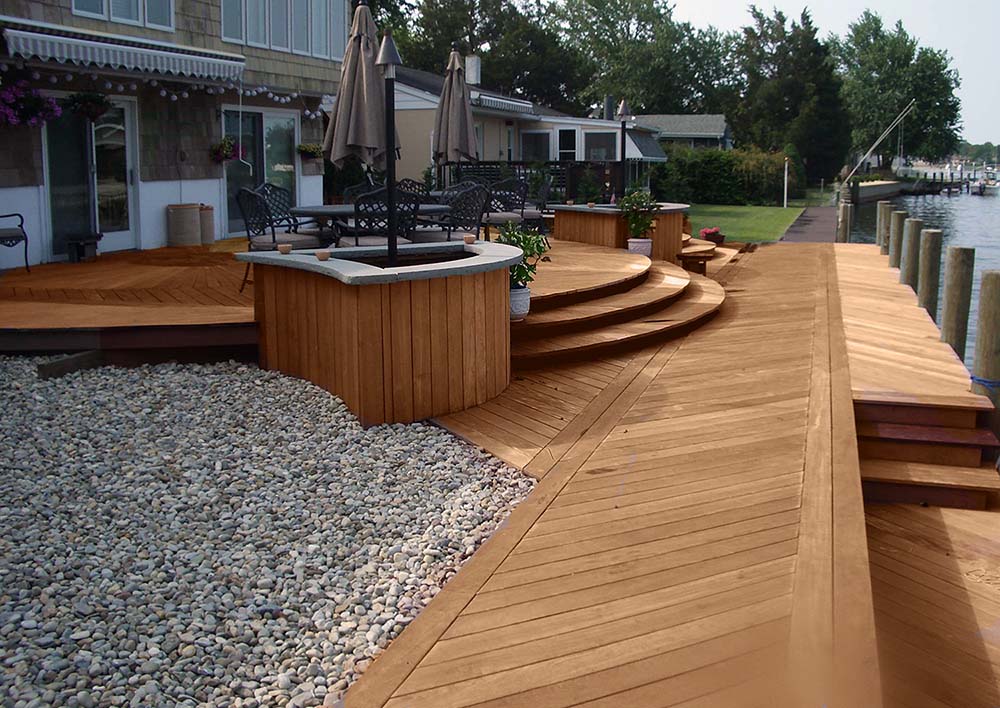
Profile drives the fastener choice. Shiplap takes visible fasteners, since there is no groove to hide a clip in. Only tongue and groove works with a hidden fastener system. Material goes on furring strips or joists so air can move behind and beneath it, and grooves face down so water drains rather than sitting in the channel. Ventilation under a deck is the difference between a board that dries evenly on both faces and a board that cups within a season. Roughly the same airflow logic applies whether the assembly is a ground-level deck or a pedestal-set rooftop system.
For any deck in the public right of way or serving an accessible route, opening width between boards is regulated. The US Access Board guidelines limit openings so a half-inch sphere cannot pass through them at all, and require elongated openings to run perpendicular to the dominant direction of travel, which constrains how much gap you can leave for expansion. Design to the code first and then pick the spacing.
Getting a Large Ipe Order to the Jobsite
A bulk Ipe order is a freight problem as much as a lumber problem, and the supplier's fleet and warehouse footprint determine whether the schedule holds. Ipe is heavy. A single unit of 5/4x6 weighs enough that truck capacity, not volume, sets the load.
J. Gibson McIlvain ships Ipe decking nationwide on company trucks and by common carrier, including regular deliveries to California and the West Coast, and stages large orders to match the construction sequence rather than dumping everything on day one. That staging matters more than buyers expect. Material delivered eight weeks early sits on a jobsite absorbing whatever the weather offers, and the moisture content you paid to control drifts.
Site handling deserves the same attention. Units stay stickered and off the ground. Cover the top, leave the sides open. A tarp wrapped tight around a unit of Ipe is a greenhouse, and the boards in the middle will read four points higher than the boards on the outside by the time the crew opens it. Let the material acclimate in conditions close to its service exposure before it goes down.
Lead time on a large custom-milled order is a real number and should be treated as such in the schedule. Standard dimensions out of standing inventory move fast. Custom profiles, specific length distributions, and color-sorted tallies take longer, and the answer to how long should come from the supplier before the bid, not after the contract.
How J. Gibson McIlvain Would Specify This
Write the specification so that a supplier who wants to substitute cannot do it quietly. Vague language invites the material you did not want.
Name the species with the botanical name. Write Handroanthus spp., not "Ipe or equal," because "or equal" on a tropical hardwood spec is an open door. Name the dimension as finished net, not nominal. State the surfacing and the profile explicitly, including whether edges are eased and whether boards are grooved for hidden clips or solid for face fastening.
Put the moisture content in the spec as a range, 12 to 16 percent at delivery, and require documentation of kiln-dried readings by unit. Require re-inspection on arrival at the supplier's facility rather than accepting origin grading as final. Define the grade in defect terms rather than trade terms. If FEQ appears in the document, define what FEQ means for this project in the same paragraph.
Specify color sorting if the field is large or highly visible. Leave it out if a natural range is acceptable, and say so, since a supplier who sorts when you did not ask is charging you for work you did not need.
State the length distribution. If the framing plan wants long clear runs, write the minimum percentage of long lengths into the order. Specify 316 stainless fasteners for coastal and marine exposure, 305 or better inland, and require pre-drilling in the installation section. Call for 16 inches on center joist spacing. Require ventilation behind and beneath the assembly.
Handle the documentation at purchase. FSC chain of custody if the project needs the credit. Lacey declaration on file. And when using a CITES-listed species on any part of the project, documentation is required through the full chain, so verify current listing status against the CITES database before the specification is issued. WoodWorks and the NFPA resources are useful references when fire performance is part of the requirement.
Placing a Large Ipe Order
The supplier conversation on a bulk Ipe order should start at design, not at procurement. By the time a contractor is calling for a delivery date, the decisions that control consistency have already been made by somebody else.
Bring the quantity survey, the framing plan, the fastener system, and the exposure. A supplier who mills the material can tell you whether your profile is practical, whether your length distribution is realistic, and whether the moisture spec matches your climate. Those answers change the order before it costs anything to change it.
J. Gibson McIlvain has been in the lumber business since 1798 and works with architects, general contractors, deck builders, and commercial buyers on volume orders rather than operating as a retail counter. Full Ipe specifications, dimensions, and profile options are at mcilvain.com/ipe-decking. For a quote on a large Ipe decking order, or to talk through a specification before it goes out for bid, call 800-638-9100 and ask for the decking desk.
Frequently Asked Questions
What does FEQ actually guarantee when buying Ipe decking in bulk?
By itself, nothing enforceable. FEQ stands for First European Quality, a term inherited from the historical Teak trade, and it has no legal definition for Ipe the way FAS has one under NHLA rules for domestic hardwood. Each exporter applies its own tolerance, which is why two containers invoiced under the identical grade can land with visibly different cull rates. If FEQ appears in your purchase order, define it in the same paragraph in defect terms: sapwood allowance on face and back, maximum knot diameter or none permitted, whether wane on the underside is acceptable, and whether surface checking is a reject. Then name who re-inspects on arrival and what happens to the boards that miss the definition. A grade you have not defined is a grade you will be arguing about after delivery.
What moisture content should bulk Ipe decking arrive at, and how do I verify it?
Twelve to sixteen percent at delivery for most of North America. That range brackets the equilibrium moisture content Ipe will reach in service across a wide band of climates, and the USDA Forest Products Laboratory Wood Handbook publishes regional EMC tables to check your specific location. Verify with a pin meter set to the correct species gravity, taking readings at multiple depths on boards pulled from the middle of the unit rather than the top course, since the outside boards of a unit read differently than the core. Require the supplier to provide kiln schedules and final moisture readings by unit. An importer running their own kilns can produce that documentation. A broker reselling a container cannot, because the drying history happened before they owned the wood.
Why do color and grain vary so much across a large Ipe order?
Ipe naturally runs from olive brown to deep reddish brown, sometimes with darker striping, and the range within a single tree is wide. That is the raw material. The variation that ruins a large field comes from blending: mills that sort for color yield less and charge more, mills that do not sort ship everything, and when material from both lands in one tally the deck reads blotchy no matter how good the individual boards are. If the field is large or highly visible, name the sort in the order and ask what it does to lead time and yield before committing to it. If a natural range suits the design, put that in writing too, because an unrequested sort is work that lands on your invoice whether or not the project wanted it.
Should I consider Cumaru or another species instead of Ipe on a large project?
It is a legitimate conversation, and it belongs at design rather than after the schedule slips. Cumaru is the closest performer at roughly 3,540 lbf Janka and 1,070 kg/m3, costs less than Ipe, and comes out of the mill with tighter color consistency, which is a real advantage across a big field. It moves slightly more in service. Massaranduba is denser at about 1,150 kg/m3 and very uniform in color, but it checks more readily in hot dry exposures. Garapa at roughly 1,700 lbf costs meaningfully less and gives up hardness for it. Where Ipe is hard to replace is fire performance and top-tier durability: EN 350 Class 1 plus an untreated ASTM E84 Class A rating is why it gets specified on rooftop assemblies and wildland urban interface projects.
Can I get Ipe in longer lengths than modified wood products?
Yes, and it is one of the clearest advantages solid tropical hardwood holds. The modification kilns behind thermally modified and acetylated products such as Thermory, Abodo Vulcan, and Accoya cap those products at roughly 16 feet, and most arrive on metric lengths a few inches under that. Ipe carries no such ceiling. Where the difference shows up is joint count: every short board on a long run adds a butt joint, blocking beneath it, and labor around it, and those seams stay visible for the life of the deck. Put the length distribution in the purchase order as a minimum percentage of long stock rather than hoping the bundle cooperates.
What documentation should follow a bulk Ipe container?
A Lacey Act declaration with accurate species and country-of-harvest data, filed by the importer of record, is the baseline. CITES listings covering tropical hardwoods are revised over time, so confirm the current status of every species on the order against the CITES species database rather than relying on a supplier's recollection. When using a CITES-listed species on any part of a project, documentation is required at every transfer point and export permits must trace to a legal-harvest quota. If the project pursues FSC or a LEED credit, chain of custody requires every party in the chain to hold their own certificate, including the yard that sells it to you. Assemble that paperwork at purchase, not at closeout.
Does hidden fastener installation require special Ipe stock?
Yes, and the decision needs to happen before the order ships. Hidden clip systems need boards grooved on both edges, and only tongue and groove profiles work with concealed fasteners. Shiplap takes visible fasteners because there is no groove for a clip to seat in. Switching to face screws after grooved stock arrives leaves you paying for a profile nothing will ever use, and the reverse costs more: an ungrooved tally on a hidden-fastener deck puts a router in a crew's hands for thousands of linear feet at field labor rates. Settle the profile with the supplier while the order is still on paper. Whatever the profile, grooves face down so water drains instead of standing in the channel, and material sits on joists or furring so air moves beneath it.
How far apart should joists be for a bulk Ipe deck?
Sixteen inches on center for dense tropical hardwood decking, tighter for diagonal or herringbone layouts. Strength is not what sets the number; Ipe would span farther without deflecting. Restraint sets it. Cupping force wins on any unsupported length, so the closer together the attachment points sit, the flatter the board stays over its life. Pair that with 316 stainless fasteners anywhere near salt air, since Ipe is acidic and will stain and corrode ordinary hardware, and pre-drill every face screw with a pilot and countersink. Ventilation beneath the assembly matters just as much, because a board that dries faster on the top face than the shaded underside will cup within a season regardless of how well it was graded.
Sources and Standards Referenced
- USDA Forest Products Laboratory - Wood Handbook, Wood as an Engineering Material
- National Hardwood Lumber Association - Rules for the Measurement and Inspection of Hardwood Lumber
- American Wood Council - Codes and Standards, Prescriptive Residential Deck Construction Guide
- ASTM International - E84 Standard Test Method for Surface Burning Characteristics of Building Materials
- EN 350 - Durability of Wood and Wood-Based Products, Natural Durability of Solid Wood
- CITES - Checklist of Listed Species
- Forest Stewardship Council - Chain of Custody Certification
- International Code Council - International Building Code
- Building Science Corporation - Moisture Control and Exterior Assemblies
- The Wood Database - Teak
- US Access Board - Accessibility Guidelines for Outdoor Developed Areas
- WoodWorks - Wood Products Council Technical Resources
- NFPA - Codes and Standards
- US Green Building Council - LEED Materials and Resources Credits