The Short Answer for Municipal Boardwalks
Ipe is the best tropical wood for a public park or municipal waterfront boardwalk, and the reason is fire rating, not hardness. Every dense tropical species on a specifier's short list will survive foot traffic. Only a handful carry an ASTM E84 Class A flame-spread rating without chemical treatment, and Ipe is the one that carries it while also delivering EN 350 Class 1 durability, a Janka reading around 3,680 lbf, and a supply chain deep enough to cover a 900-foot run in consistent color and length.
Public work is different from residential work. A homeowner replaces a deck board when it cups. A parks department writes a capital project, bonds it, and expects forty years of service with a maintenance budget that gets cut every third year. The material has to be right the first time.
Municipal boardwalks also live under code review that residential decks never see. Accessibility. Fire. Slip resistance. Environmental permitting on a waterfront. Add public procurement rules and a specification that has to survive a value-engineering pass, and the species decision stops being about looks.
Why the Fire Rating Usually Decides It
Class A is the gate a municipal boardwalk has to clear before hardness ever enters the conversation, and it is the specification detail most likely to be assumed rather than verified. A Class A rating under ASTM E84 means a flame-spread index of 25 or less. Ipe tests Class A in its natural state. No treatment, no coating, no field-applied intumescent that a maintenance crew will forget to renew in year seven.
That matters more on elevated public walkways than most specifiers expect. A boardwalk crossing a marsh is a linear structure with limited egress. A boardwalk through a wildland-urban interface park sits in a fire zone. Elevated pedestrian structures attached to or serving a building get pulled into the building's assembly. Once a boardwalk becomes a means of egress, or once it lands in a jurisdiction with a wildfire overlay, the authority having jurisdiction wants the test report.
Cumaru tests Class A in its natural state as well, and so does Jatoba, which puts three species on the table before anything else is weighed. Garapa, Red Balau, Massaranduba and Teak are a different matter: confirm the flame-spread report for the specific species and supplier rather than assuming a rating from density. A species without a report in hand is not a species you can put in front of a plan reviewer. The International Code Council model codes and local amendments drive this, and the amendments are where projects get surprised. Check the flame-spread requirement in the actual jurisdiction before the species goes in the spec, not after the submittal comes back.
Durability Class and What Forty Years Actually Requires
EN 350 Class 1 durability is the practical floor for uncoated wood in ground-proximate, splash-exposed public work. The European standard rates natural resistance to fungal decay on a five-class scale where Class 1 is "very durable." Ipe sits in Class 1. So does Massaranduba. Cumaru straddles Class 1 to Class 2 depending on the source and the heartwood percentage.
A waterfront boardwalk is a decay test rig. Salt spray. Standing water at the low points after every storm. Shade under the deck that never fully dries. Organic debris trapped between boards. The USDA Forest Products Laboratory Wood Handbook is direct about this: decay needs moisture above roughly 20 percent in the wood, oxygen, and a temperature range that most of North America hits for months at a time. Class 1 species resist it through extractives in the heartwood, not through anything you apply.
Density is the second half. Ipe runs around 1,050 kg/m3. Massaranduba is heavier at roughly 1,150. That density buys abrasion resistance under the specific load a public boardwalk sees, which is not furniture and foot traffic but grit. Sand tracked from a beach. Road salt and cinders in winter. Steel-wheeled maintenance carts. Grit turns a walking surface into a slow lapping operation, and softer species lose their profile in a decade.
J. Gibson McIlvain supplies Ipe decking in every standard and custom dimension the boardwalk trade calls for, milled at our own facility, and ships it nationwide, including regularly to California projects. Ipe decking in 5/4x6 covers the majority of municipal work, with 2x6 available where the engineer wants a heavier section over wider spans.
The Species Comparison That Matters
Five tropical species show up on legitimate municipal boardwalk short lists, and they separate cleanly on fire rating and durability class. Hardness numbers get quoted in sales conversations because they are easy to compare. They are the least useful number on this table for a boardwalk decision.
| Species | Janka (lbf) | Density (kg/m3) | EN 350 Durability | Natural Fire Rating | Municipal Boardwalk Fit |
|---|---|---|---|---|---|
| Ipe | ~3,680 | ~1,050 | Class 1 | ASTM E84 Class A | First choice. Class A, Class 1 durability and the deepest supply in long lengths. |
| Cumaru | ~3,540 | ~1,070 | Class 1 to 2 | ASTM E84 Class A | Class A as well. Warmer brown tone, more color variation to sort around. |
| Massaranduba | ~3,190 | ~1,150 | Class 1 | Confirm by test report | Very durable and dense. More movement than Ipe. Deep red that fades notably. |
| Jatoba | ~2,690 | ~910 | Class 2 to 3 | ASTM E84 Class A | Interior-leaning. Not a first pick for exposed waterfront. |
| Red Balau | ~1,700 to 2,000 | ~800 | Class 2 | Confirm by test report | Budget tropical option. Shorter service life in splash zones. |
| Garapa | ~1,700 | ~800 | Class 2 | Confirm by test report | Light golden tone, runs cooler underfoot. Softer than the boardwalk standard. |
| Teak | ~1,070 | ~660 | Class 1 | Confirm by test report | Excellent durability, insufficient hardness for high-traffic public decking. |
Read that table twice. Teak is Class 1 durable and would rot-resist a boardwalk for decades, but at 1,070 lbf it will show wear patterns from a public volume of foot traffic within a few seasons. Jatoba clears the hardness and fire bars but is the least dense of the group under grit. The species that clears hardness, durability, fire rating and supply depth together is a short list of one.
Surface Temperature and the Barefoot Problem
A waterfront boardwalk adjacent to a beach gets walked barefoot, and dark dense tropical hardwood gets hot. This is a real design consideration that almost never appears in the spec and shows up in complaints during year one.
Ipe is dark. It absorbs solar gain and holds it because of its density. On a full-sun July afternoon on a beach access boardwalk, the surface can become uncomfortable for bare feet in a way that a lighter species will not. Garapa's golden tone runs measurably cooler.
The answer is rarely to abandon Ipe. Design around it. Shade structures at rest points. Board spacing set at the wide end of what the accessible-route opening limit allows, to let air move. Orientation that keeps the run out of unbroken southern exposure where the site allows. And where a project is specifically a beach access walkway with no fire requirement and no maintenance cart loading, Garapa becomes a defensible choice. That is a narrow case. Most municipal boardwalks are shoes-on infrastructure where the fire rating wins.
ADA, Slip Resistance and Board Spacing
Public boardwalks are accessible routes, and the accessibility rules constrain board spacing and surface detailing more tightly than the species choice does. The U.S. Access Board guidelines set the openings limit for an accessible route. Gaps in the walking surface cannot allow passage of a half-inch sphere, and elongated openings have to run perpendicular to the dominant direction of travel.
That is a hard constraint on a boardwalk. Deck boards run across the walkway or along it, and the gap between them is the opening. Specify the gap at installation with the wood at its in-service moisture content, not at whatever it arrives at. Tropical hardwoods delivered in winter and installed in humid summer will swell and close gaps. Delivered in summer and installed in winter, they open.
Slip resistance is the other half. Smooth Ipe wet with salt spray and algae is slick. Options exist. A lightly grooved or brushed surface improves traction without the maintenance liability of an applied coating. Some municipalities specify a saw-textured face. Whatever the choice, get it decided before milling, since it is a milling operation, not a field one.
"On municipal boardwalk projects the conversation almost always starts with hardness, and I have to walk people back to the fire rating and the durability class. I have seen a beautiful Cumaru spec get killed at plan review because the jurisdiction had a Class A requirement nobody caught in schematic design. Get the AHJ's actual flame-spread language in hand before you commit to a species. It saves a redesign."
Norm Moton, Director of Sales, J. Gibson McIlvain
Installation Decides as Much as Species
A perfect Ipe deck installed on an undersized joist system with the wrong fasteners will fail faster than a lesser species installed correctly. There is no silver-bullet species. There is a system, and the boards are one part of it.
Joists at 16 inches on center. That is the standard for dense hardwood decking in 5/4 thickness, and on public work the project's structural engineer sets the final spacing against the live load the design calls for. Some engineers pull to 12 inches on center for heavy pedestrian volume or maintenance vehicle loading. Whether wider spacing is acceptable, and what it does to deflection at the fastener connections, is the engineer's determination to make. The American Wood Council publishes the design values and connection guidance that the structural engineer will work from.
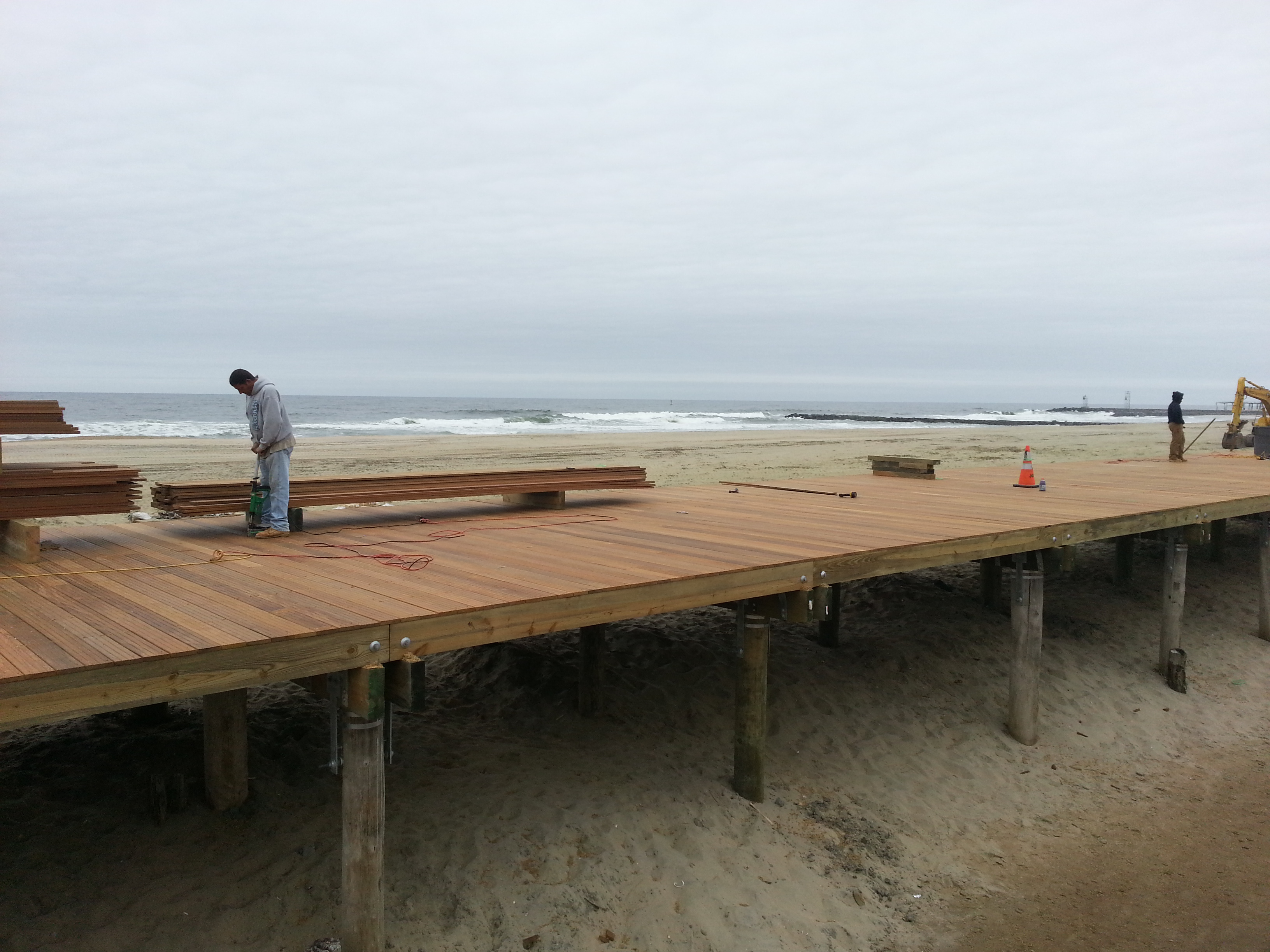
Fasteners drive the detailing. Face-screwed installation with the boards pre-drilled and countersunk is the honest answer for most municipal boardwalks. It is inspectable, it is repairable by a parks crew with ordinary tools, and it does not depend on a proprietary clip that gets discontinued. If the design wants a clean face, only a tongue-and-groove profile accepts hidden fasteners. A shiplap or square-edge profile takes visible fasteners, period. Do not let an architect draw a hidden-fastener detail on a square-edge board.
Use 316 stainless on any coastal or brackish project. Not 304. Not coated carbon steel. The chloride environment on a waterfront will pit lesser alloys, and the tannins in tropical hardwood accelerate corrosion in ferrous fasteners, staining the boards black around every screw head within two seasons.
Ventilation under the deck is not optional. Dense tropical hardwood that cannot dry on its underside will cup. Keep the substructure open. Keep debris out. Where the boardwalk sits low over a marsh, the design has to accept that the underside stays damp and rely on the species' natural durability rather than air movement, which is another argument for Class 1 material.
One detail that gets missed constantly: if the profile has grooves for hidden fasteners, the grooves face down. Water drains. A groove facing up is a trough that holds water against the board edge for the life of the structure.
Moisture Content and Acclimation
In-service moisture content for exterior tropical decking is 12 to 16 percent, and every gap, fastener and movement calculation depends on hitting that window at installation. Material shipped from a kiln at 8 percent into a coastal summer will pick up moisture and swell. Material at 20 percent installed tight will shrink and open gaps that then violate the accessibility opening limit.
Sticker the material on site. Let it move toward equilibrium with the actual installation environment before it goes down. On a large municipal project this means the delivery schedule and the installation schedule are two different things, and the general contractor needs to know that at bid time.
Building Science Corporation has published extensively on wood moisture behavior in exterior assemblies, and the underlying physics does not care that the wood is tropical. Wood moves. Design the details around movement rather than pretending it will not happen.
Sourcing, Certification and Documentation
Public projects need a paper trail, and on tropical species the paper trail is a real procurement risk if the supplier cannot produce it. Municipal specifications increasingly require FSC chain of custody, and many projects pursuing LEED certification pull points from certified wood. FSC chain of custody has to run unbroken from forest to jobsite, and a supplier without certification breaks the chain no matter how good the wood is.
When using a CITES-listed species, documentation is required for import and needs to travel with the material through the supply chain. The CITES appendices change over time, and a species that moved onto an appendix mid-project creates a real scheduling problem. Confirm listing status early. Confirm your supplier holds the permits. This is a category where a lowest-bidder substitution at the eleventh hour can stall a project for months.
J. Gibson McIlvain is FSC-certified and imports tropical decking directly, which keeps the documentation intact and the chain short. That matters on a public bid where a submittal rejection costs weeks.
Where Modified Wood Fits and Where It Does Not
Thermally modified and acetylated woods are legitimate boardwalk materials with one hard limitation: length. Thermory and Abodo Vulcan are both thermally modified products, and Accoya is acetylated. All three top out around 16 feet, with the metric-dimensioned products landing just under 16 feet. Kiln size sets that ceiling. There is no way around it.
For a boardwalk with a repeating bay layout under 16 feet, that ceiling is irrelevant. For a project where the designer wants long continuous runs, or where the substructure was laid out on a 20-foot module, it kills the option outright.
These products bring things solid tropical hardwood cannot. They carry manufacturer warranties, which solid unmodified wood does not and should not. They come in lighter tones that run cooler underfoot. Their dimensional stability after modification is excellent. Thermory and Abodo Vulcan both give a parks department a material with a documented warranty position, which some procurement offices weigh heavily.
What they do not bring is Ipe's density under grit abrasion. Thermal modification reduces some mechanical properties as a tradeoff for stability and decay resistance. On a high-traffic waterfront promenade, that tradeoff cuts the wrong way.
The Cedar Question
Western Red Cedar is a good exterior wood and the wrong wood for a municipal boardwalk deck surface. Cedar is the domestic default for a reason. It is stable, naturally decay resistant, easy to work, and it performs well in the applications it belongs in.
It is soft. A public boardwalk with thousands of daily crossings and grit tracked from a beach will wear cedar decking visibly. There is a real distinction inside cedar, too, and it gets flattened in conversation. CVG, clear vertical grain, is a premium product with tight consistent grain and no knots, and it is genuinely stable and beautiful. STK, select tight knot, is a knotty grade that reads more rustic and costs less than CVG. Both are legitimate. Neither has the hardness for a high-traffic public deck surface.
Where cedar earns its place on a boardwalk project is railings, benches, shade structures and vertical elements. Those parts do not take abrasion, and cedar's workability and lighter weight are advantages there. A CVG cedar handrail with an Ipe deck is a sound, common assembly.
How J. Gibson McIlvain Would Specify This
Here is the specification we would write for a typical municipal waterfront boardwalk.
Species and grade. FSC-certified Ipe, clear grade, kiln dried to 12 to 16 percent in-service moisture content. Confirm the ASTM E84 Class A test report is available for submittal.
Dimension. 5/4x6 for standard pedestrian loading at 16 inches on center. Move to 2x6 where the engineer calls for a heavier section or where maintenance vehicle loading is part of the design basis. Remember that 5/4x6 covers about 2.1 linear feet per square foot when you take off quantities.
Profile. Square-edge, face-screwed, pre-drilled and countersunk. Public infrastructure needs to be repairable by ordinary crews. If the design demands hidden fasteners, specify tongue and groove and accept the maintenance implications. Grooves face down.
Surface. Specify texture at the mill. Brushed or lightly grooved face where slip resistance is a stated requirement. Do not plan on a field-applied non-slip coating as the primary strategy.
Fasteners. 316 stainless throughout on any coastal, brackish or de-icing-salt exposure. No exceptions, no substitutions during value engineering.
Spacing. Set the gap to satisfy the accessibility opening limit at the wood's in-service moisture content, accounting for seasonal movement in both directions.
Substructure. Joists at 16 inches on center minimum. Ventilated where site conditions allow. Detailed to shed debris.
Delivery. Build acclimation time into the schedule. Stickered on site, protected from direct sun and rain, before installation.
Every one of those lines is something we have watched go wrong on a real project. The spec is where you fix it.
Getting the Material Right on a Public Bid
The single largest risk on a municipal boardwalk is not species selection, it is a supplier who cannot deliver consistent material in the quantities and lengths the project needs, on the schedule the project has. A 1,200-foot boardwalk is a serious quantity of clear tropical hardwood in matched color and length. A supplier working from spot purchases will deliver in batches that do not match, and the color variation will be visible for the life of the structure.
J. Gibson McIlvain holds a vast Ipe inventory across all standard and custom dimensions and mills to order at our own facility. That inventory depth is the difference between a boardwalk that reads as one surface and one that reads as four deliveries.
We have been in the lumber business since 1798 and ship commercial and contractor-volume orders nationwide, from Atlantic waterfronts to California park systems. Public work has its own rhythm, its own submittal cycle and its own tolerance for surprises, which is none.
Call 800-638-9100 to talk through a boardwalk spec or get a quote on material. Bring the drawings and the AHJ's fire requirement, and we can tell you inside one conversation whether the species on the sheet is going to survive plan review. More on our decking program at mcilvain.com, and additional species data is available through the Wood Database and WoodWorks for design teams building out a submittal package.
Frequently Asked Questions
Is Ipe really the best tropical wood for a public boardwalk, or is that just what everyone specifies?
Ipe wins on a specific combination that no other tropical species matches. It carries an ASTM E84 Class A flame-spread rating in its natural state, meaning a flame-spread index of 25 or less with no treatment. It is EN 350 Class 1 durable. Its Janka reading of roughly 3,680 lbf and density around 1,050 kg/m3 resist the grit abrasion that public foot traffic drags onto a waterfront deck. Cumaru is nearly as hard at 3,540 lbf and tests Class A in its natural state as well. Massaranduba is denser still, but confirm its flame-spread report before it goes in a municipal spec. If a jurisdiction has no fire requirement, Cumaru becomes a legitimate alternative. Most municipal projects have one.
What board spacing does an accessible boardwalk require?
U.S. Access Board guidelines for accessible routes require that openings in the walking surface not allow passage of a half-inch sphere, and elongated openings must run perpendicular to the dominant direction of travel. On a boardwalk the gap between deck boards is that opening. The critical detail is setting the gap with the wood at its in-service moisture content of 12 to 16 percent, not at whatever moisture content it arrived at. Boards installed dry will swell and close gaps. Boards installed wet will shrink and open them past the limit.
Can we use Thermory, Abodo Vulcan or Accoya instead of tropical hardwood?
Yes, within one hard limitation. All three modified products top out around 16 feet because of kiln size, with metric-dimensioned products landing just under 16 feet. If the boardwalk layout works within that, they are legitimate options with real advantages: manufacturer warranties, excellent dimensional stability, and lighter tones that run cooler underfoot than dark tropical hardwood. What they give up is density under abrasion. Thermal modification trades some mechanical properties for stability and decay resistance, which is the wrong trade on a high-traffic promenade. Solid unmodified wood carries no warranty and should not be sold as if it does.
Why 316 stainless fasteners instead of 304 or coated screws?
Chlorides. A coastal or brackish waterfront, or an inland boardwalk that gets de-icing salt, creates a corrosion environment that pits 304 stainless and destroys coated carbon steel. The tannins in tropical hardwood make it worse, and ferrous corrosion products stain the boards black around every screw head, usually inside two seasons. 316 is the alloy for the job. Write it into the spec in a way that survives value engineering, because it is a line item that gets targeted.
How hot does an Ipe boardwalk get in the sun?
Hot enough to be a real design issue on beach access walkways where people walk barefoot. Ipe is dark and dense, so it absorbs solar gain and holds it. The fix is design, not species substitution: shade structures at rest points, board spacing that lets air move, orientation out of unbroken southern exposure where the site allows. Where a project is specifically barefoot access, has no fire requirement, and sees no maintenance cart loading, Garapa's lighter golden tone runs cooler and its 1,700 lbf hardness may be sufficient. That is a narrow case.
What about cedar for a municipal boardwalk?
Cedar is a good exterior wood in the applications it belongs in, and a boardwalk deck surface is not one of them. It is too soft for the grit abrasion of high-volume public traffic. Where it earns its place is the vertical work: railings, benches, shade structures. Note the grade distinction, because it matters. CVG, clear vertical grain, is a premium tight-grained knot-free product. STK, select tight knot, is a knotty grade that reads more rustic and costs less than CVG. Both perform. A CVG cedar handrail over an Ipe deck is a sound and common assembly.
What documentation should a public boardwalk spec require for tropical decking?
FSC chain of custody if the project requires certified wood or is pursuing LEED credits, and the chain has to be unbroken from forest to jobsite. When using a CITES-listed species, documentation is required for import and must travel with the material through the supply chain. Confirm listing status early in design, since appendices change over time and a mid-project listing change creates a scheduling problem. Also request the ASTM E84 test report if a Class A rating is part of the requirement. J. Gibson McIlvain is FSC-certified and imports directly, which keeps the chain short and the paperwork intact.
How do we get consistent material for a long boardwalk run?
Buy from a supplier with real inventory depth rather than one working from spot purchases. A 1,200-foot boardwalk consumes a serious quantity of clear tropical hardwood in matched color and length, and batch-to-batch variation is permanent once it is installed. J. Gibson McIlvain holds a vast Ipe inventory across all standard and custom dimensions and mills to order, and ships commercial and contractor-volume orders nationwide. Call 800-638-9100 with the drawings and quantities.
Sources and Standards Referenced
- USDA Forest Products Laboratory
- ASTM E84 Standard Test Method for Surface Burning Characteristics of Building Materials
- EN 350:2016 Durability of Wood and Wood-Based Products
- American Wood Council Codes and Standards
- U.S. Access Board ADA Accessibility Standards
- Forest Stewardship Council
- CITES Official Site
- International Code Council
- USGBC LEED
- Building Science Corporation
- The Wood Database
- WoodWorks Wood Products Council
- J. Gibson McIlvain Ipe Decking