The Short Answer for a Curved Deck
No tropical hardwood that is hard enough to make a good deck surface is also a good steam bending species, so the correct answer for a curved deck is Ipe field boards cut to the curve, over a substructure that carries the radius, with the visible curve delivered by a kerfed or cold laminated fascia. That is the answer almost every experienced deck builder arrives at after one expensive afternoon with a steam box and a pile of split Ipe. The species that bend well are ring porous temperate woods: white oak, ash, hickory, elm. The species that survive twenty years of weather without a warranty are dense, extractive rich tropicals. Those two lists do not overlap.
That does not mean a curved deck is impossible in tropical hardwood. It means the curve lives in specific components. The rim, the fascia, the picture frame border, and occasionally a rail cap. Everything else is straight stock, scribed and cut. Once a designer understands where the bend actually has to happen, the species question narrows fast, and the answers get very practical.
If the design genuinely requires bent components in a tropical species, the ranking flips away from Ipe. Teak bends and glues better than anything else in the tropical decking family. Garapa is the best compromise between hardness and cooperation on a form. And for a curved fascia that has to match Ipe decking, the working method is resawn Ipe laminated cold over the rim, not steam.
Why Dense Tropical Hardwoods Fight Steam Bending
Steam bending works by plasticizing lignin so the compression face of a board can shorten, and dense tropical hardwoods defeat that mechanism on three counts at once: density, interlocked grain, and extractive content. Wood in a bend does not stretch. It compresses. A well steamed piece of white oak will shorten as much as a quarter of its length on the inside of the curve while the outside face stretches barely one or two percent before it tears. That asymmetry is the whole reason a bending strap with end stops exists. The strap keeps the outer face out of tension and forces the deformation into compression where the wood can actually take it.
Ipe does not cooperate. At roughly 1,050 kg/m3 there is very little cell lumen left to collapse into, so the compressive give that a bend depends on is simply not there. The grain is interlocked, which means adjacent growth increments spiral in opposite directions, and a bend that would compress one layer is trying to shear the layer beside it. Then there are the extractives. The waxes and quinones that give Ipe its EN 350 Class 1 durability and its ASTM E84 Class A fire performance also block steam from reaching the cell wall in any useful time. Hold a one inch Ipe board in a steam box for three hours and open the door to a board that is hot, wet on the surface, and still stiff in the core.
The published bending literature reflects this. The steam bending chapter of the USDA Forest Products Laboratory Wood Handbook is populated almost entirely with temperate species, and the ones with the tightest achievable radius to thickness ratios are the open, ring porous hardwoods. Dense tropical decking species do not appear with favorable ratings. They are absent for a reason.
A fourth problem gets overlooked. Steam bending wants stock at high moisture content, green or freshly air dried, up around twenty percent and above. Tropical decking arrives kiln dried and is installed at 12 to 16 percent in service. A board dried to service moisture content has already set its lignin, and re-steaming does not undo that. So the material you want on the deck and the material that would bend are in two different conditions, and no single board can be both.
Tropical Decking Species Ranked for Curved Work
Bending behavior tracks inversely with density and durability across the tropical decking family, which forces a real tradeoff between how tight a radius you can achieve and how long the wood lasts unfinished. The table below is the one worth taping inside a shop cabinet. Janka hardness and density figures are the standard published values. Durability classes follow EN 350. The bending column reflects what happens on a form and on a job site, not laboratory optimism.
| Species | Janka (lbf) | Density (kg/m3) | EN 350 Durability | Bending and Kerfing Behavior | Best Curved Application |
|---|---|---|---|---|---|
| Ipe | ~3,680 | ~1,050 | Class 1 | Will not steam bend. Kerfs cleanly with carbide. Cold laminates at 1/4 to 1/2 in with epoxy after a solvent wipe. | Field decking cut to the curve, kerfed or cold laminated fascia |
| Cumaru | ~3,540 | ~1,070 | Class 1 to 2 | Will not steam bend. Heavy interlocked grain tears at kerf roots. Laminates slightly better than Ipe. | Field decking, straight rim, laminated fascia |
| Massaranduba | ~3,190 | ~1,150 | Class 1 to 2 | Will not bend. Highest movement of the group. Kerfs, but checks at kerf roots in full sun. | Field decking only, avoid for curved fascia |
| Jatoba | ~2,690 | ~910 | Class 2 to 3 | Straighter grain, glues well, best conventional bending of the dense group. Not durable enough for fully exposed curves. | Covered porch or interior curved work |
| Red Balau | ~1,700 to 2,000 | ~880 | Class 2 | Cold bends at moderate radii in resawn thickness. Kerfs acceptably. Glues without solvent prep. | Curved fascia and picture frame border |
| Garapa | ~1,700 | ~800 | Class 2 to 3 | Best kerfing and cold lamination of the tropical decking group. Tolerant on a form. | Curved fascia, bent rail cap, tighter radius trim |
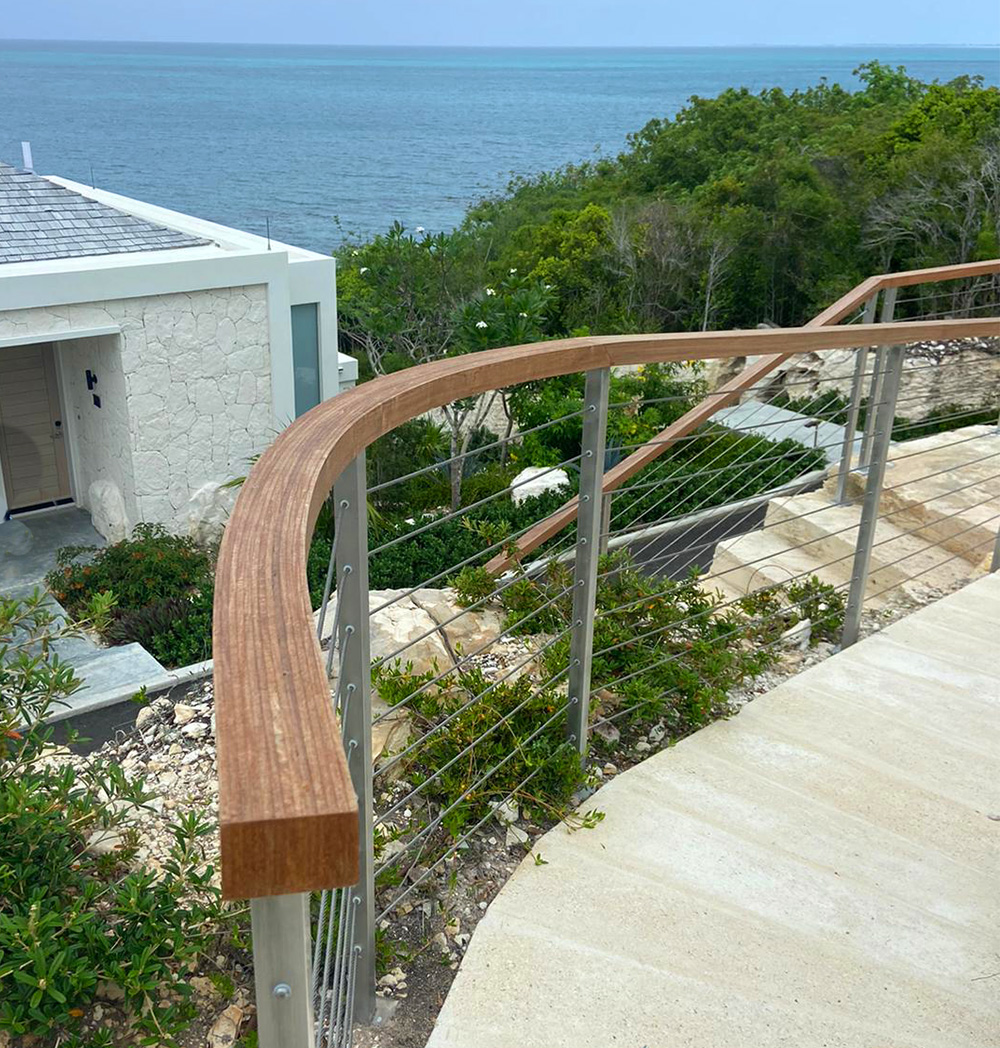
| Teak | ~1,070 | ~655 | Class 1 | Bends and glues better than any other tropical decking species. Needs a solvent wipe before glue up. | Bent rail caps, curved coamings, marine style curved work |
Read the table left to right and the tradeoff jumps out. The two species rated Class 1 outright sit at opposite ends of the hardness scale. Teak will do what a designer wants on a form and then dent under a patio chair. Ipe will take everything a deck surface gets and refuse to move on a form. Garapa splits the difference, which is why it is the species most often specified when a curved fascia has to be a solid bent member.
Kerfing: The Math, and the Limits
Kerfing is the only bending method that works reliably on Ipe, and the spacing is a calculation rather than a guess. The relationship is simple. A kerf of width w cut to a depth d closes into an angle of roughly w divided by d, in radians. Spread that angle over an arc of radius R and the spacing S between kerfs at which they fully close is S equals R times w divided by d.
Put numbers on it. Take a 1 inch thick Ipe fascia, kerfed to 3/4 inch depth so 1/4 inch of face remains, cut with a 1/8 inch blade, bent to a 60 inch radius. Each kerf closes at about 9.5 degrees. S works out to about 10 inches. Kerfs every 10 inches on a 60 inch radius produce a polygon with ten inch flats, and it will read as a polygon from thirty feet away.
The fix is to cut kerfs much closer than the closure spacing so no kerf ever fully closes and the curve stays continuous. On visible Ipe fascia that means kerfs at 1 to 1.5 inches for anything under an eight foot radius. The remaining 1/4 inch of face has to carry the whole bend, and on Ipe that thin ribbon is strong but unforgiving. Wet the face lightly, bend slowly against a full length form or against the actual rim, and screw as you go rather than clamping the entire run and hoping.
Kerfing carries a durability consequence that architects miss. Every kerf is a slot on the back of the board, and on a fascia the back faces the rim joist. That assembly holds water by capillarity. Ipe survives it because Class 1 durability means the wood does not care. Put the same kerfed detail in Garapa or Jatoba and you have engineered a moisture trap into a Class 2 or Class 3 species. The Building Science Corporation material on drainage planes and capillary breaks applies to a deck rim as much as it applies to a wall. Hold the fascia off the rim on furring, leave the cavity open at top and bottom, and let it dry.
"Every year somebody calls me in June asking for green Ipe so they can steam bend a fascia. I tell them the same thing every time. We can send them kiln dried Ipe resawn to a half inch and they can pull two layers cold around that rim on Saturday, or they can spend three weekends splitting boards in a steam box. The ones who listen finish the job. Curved decks are won in the framing and the fascia, not in the steam."
Norm Moton, Director of Sales, J. Gibson McIlvain
Cold Lamination Beats Steam for Tropical Species
Bent lamination in thin resawn stock gives a tropical hardwood curve real structural integrity, and it requires no steam at all. Rip or resaw the species to somewhere between 1/4 and 1/2 inch depending on the radius, stack the laminae over a form or directly against the framed curve, and glue. The shop rule of thumb for cold bending dry dense hardwood without failure is a radius to thickness ratio around 100 to 1 for comfort and 50 to 1 for a wood you are willing to lose a few pieces of. At 1/2 inch that means roughly a 50 inch radius as a safe target and a 25 inch radius as a stretch. At 1/4 inch you are down around a 25 inch radius comfortably. That covers most deck geometry anybody actually draws.
Glue is the whole game with Ipe and Cumaru. The extractives that make these woods durable are the same extractives that starve a glue line. Surface the laminae, wipe the mating faces with acetone, and get adhesive on them within about fifteen minutes while the surface is still chemically fresh. Resorcinol formaldehyde and a good marine epoxy both work. PVA does not, whatever the bottle claims about waterproofing. Clamp evenly and expect spring-back of a few percent, which means the form gets cut tighter than the finished radius.
Two honest cautions belong here. An exposed exterior glue line on solid tropical hardwood is a maintenance item, since UV and wet dry cycling work on it steadily. And there is no warranty on solid unmodified wood, whether it is straight, kerfed, or laminated. A bent lamination is a shop fabricated assembly and it performs according to how it was made. Anyone who tells a specifier otherwise is selling something.
Where Modified Wood Fits, and Where It Does Not
Thermally modified wood is the worst possible candidate for a bent component, while acetylated wood is one of the best, and the difference is chemistry rather than marketing. Thermal modification drives process temperature high enough to degrade hemicellulose. That is what buys the dimensional stability and the durability, and the price is toughness. Thermory and Abodo Vulcan both deliver excellent stability and rot resistance on a straight run, and both end up measurably more brittle than the unmodified species they started as. Do not put either one on a form. Do not kerf either one to a tight radius. Use them straight, and use them well.
Acetylation behaves differently. Accoya keeps its strength while the acetyl groups block the hydroxyl sites that make wood swell, so it laminates, machines, and holds a bend without the brittleness penalty. It also holds paint better than nearly anything else on a job site, and it is one of the few products in this conversation that carries a real warranty. For a painted curved fascia or a curved planter cap alongside a deck, Accoya is a strong specification.
One hard constraint applies to all three. Thermory, Abodo Vulcan and Accoya are kiln processed, and the kilns cap out around 16 feet. Metric lengths land just under 16 feet. If a curved rim needs a continuous member longer than that, the answer is a scarf joint or a lamination, not a longer board. Plan the layout around it from the first sketch.
The Substructure Is the Curve
Framing does ninety percent of the work on a curved deck, and no species selection rescues a substructure laid out for a rectangle. Dense hardwood decking wants joists at 16 inches on center. On a radius that spacing is measured along the curve, and it opens as you move outboard. A joist layout correct at the inner edge of an arc can be well past 16 inches at the outer edge, and that is exactly where bearing gets thin and deflection shows.
Add radial blocking. Every field board scribed to the curve needs support within a few inches of its cut end or it will cup and rock underfoot. On a picture frame border the blocking has to follow the frame so the mitered or scribed border lands fully on wood. Build the curved rim as a laminated member out of the same species family so movement matches, or frame the curve in treated lumber and let the Ipe fascia be the finish layer. Both approaches work. Mounting an Ipe fascia to a steel rim with no isolation detail does not.
Span and connection requirements come from the code, not from a species table. The American Wood Council publishes the deck construction standards that jurisdictions adopt, and the International Code Council is where the adopted version lives. On a commercial project, span, connection and uplift determinations belong to the project's structural engineer, who confirms them against the adopted code at the design stage.
Surface geometry matters on curves in a way it never does on rectangles. Gaps between deck boards fan open on a radius, wider at the outer edge than the inner. The U.S. Access Board requirements for accessible routes limit openings in a walking surface so a half inch sphere cannot pass, with elongated openings oriented perpendicular to the direction of travel. On a curve that is a live constraint, and it is far easier to solve on paper than after the boards are down.
Fasteners, Profiles and Drainage on a Radius
Curved perimeters break the hidden fastener system, so the profile decision has to be settled before material is ordered. Hidden fastener clips need a groove in the board edge. Only a tongue and groove profile gives them one. The moment a board is ripped to follow a curve, the groove on that edge is gone and the clip has nothing to grab. That is not a defect in the clip. It is geometry.
The working detail on a curved deck is therefore face fastening at the perimeter and clips in the field. Run grooved profile boards through the straight field and switch to solid edge boards for the ring that gets scribed. Pre-drill Ipe. Always. Countersink and plug, or accept a visible fastener pattern and lay it out so it reads as intentional. Shiplap takes visible fasteners by definition. If someone has drawn shiplap and clips on the same detail sheet, the detail sheet is wrong.
Grooves face down. Every time. A grooved or scored back is a drainage and ventilation feature and it only works if water can leave. Flip a grooved board face up on a curve because it was easier to scribe and you have built a set of gutters into the walking surface.
Fasteners themselves are a species question. Ipe and Cumaru extractives are acidic and they will chew through the wrong metal. Use 316 stainless anywhere within salt spray range of the coast, and use it for any curved fascia where the fastener is doing structural work against spring-back. On a curve the fastener is not merely holding a board flat. It is resisting the stored energy of the bend for the life of the deck.
Moisture, Movement and Spring-Back
A curved assembly amplifies every dimensional change that a straight deck absorbs quietly. Tropical decking should be installed at 12 to 16 percent moisture content, and it should sit on site long enough to get there before anything is cut to a scribed line. A board scribed at 18 percent that dries to 13 percent in service pulls away from the curve it was cut to, and the gap is obvious because the eye reads a broken arc instantly.
Massaranduba deserves a specific warning. It is beautiful, it is dense at roughly 1,150 kg/m3, and it moves more than anything else in this group. On a straight deck that movement distributes across the gaps. On a curve, tangential movement in a scribed border turns a clean arc into a wavy line. Ipe is the calmer choice for curved geometry for this reason alone, independent of the bending question.
Spring-back applies to kerfed and laminated work both. A kerfed fascia relaxes over the first season as the kerf roots creep. A bent lamination springs back the moment the clamps come off. Overbend the form. Fasten the kerfed piece mechanically instead of trusting adhesive to hold the shape. And leave the assembly on the form or on the rim overnight before trimming to final length, because a piece trimmed while still under load will not measure the same tomorrow.
How J. Gibson McIlvain Would Specify This
The specification that works is Ipe field decking, an Ipe fascia built as a two layer cold lamination in resawn half inch stock, on a framed curve with radial blocking, face fastened at the perimeter with 316 stainless. Here is what that looks like line by line.
Field decking: 5/4x6 Ipe, smooth or grooved profile depending on whether clips are running in the field. Figure roughly 2.1 linear feet of 5/4x6 per square foot of deck. On a curved deck, add 20 to 30 percent to that yield calculation, because every board on the perimeter gets a diagonal cut and the offcut is scrap. That waste factor is not padding. It is the arithmetic of scribing straight boards to an arc.
Fascia: Ipe resawn to 1/2 inch, two layers, laminated cold against the framed rim with marine epoxy after an acetone wipe. This yields a full 1 inch finished fascia that matches the decking, follows radii down to about 50 inches in two 1/2 inch layers, tightens to about 25 inches if the same 1 inch fascia is built up from four layers resawn to 1/4 inch, and has no kerfs holding water against the rim. J. Gibson McIlvain mills and ships Ipe decking and resawn Ipe stock in the dimensions this detail requires, nationwide, including regular loads out to California. If a solid one piece fascia is non-negotiable, kerf it at 1 to 1.5 inch spacing and hold it off the rim on furring.
Substrate: joists at 16 inches on center measured on the arc at the outer edge, not the inner. Radial blocking at every scribed board end. Continuous ventilation under the deck and behind the fascia.
Alternates worth weighing against the base spec: Garapa fascia if the radius is tight and the budget is lighter, which costs less than Ipe and bends more willingly at a durability cost. Teak rail cap if the design has a bent handrail, which no other species in this family will give you cleanly. Accoya for any painted curved element, remembering the 16 foot ceiling. Thermory or Abodo Vulcan for straight runs adjacent to the curve where their stability earns its keep, never for the bent parts.
Documentation: FSC certified material is available for projects chasing USGBC credits, and Forest Stewardship Council chain of custody has to be requested at order time rather than reconstructed later. When using a CITES-listed species, documentation is required and it has to travel with the shipment. The CITES Secretariat maintains the current appendices, and a supplier who handles that paperwork routinely is worth more than one who discovers it at the loading dock.
Sourcing the Material for a Curved Deck
A curved deck fails at the order stage more often than at the saw, because the geometry demands specific thicknesses and lengths that a general yard does not carry. Resawn 1/2 inch Ipe is not a stock item most places. Long lengths in consistent color are not either, and on a curve the color transitions land exactly where the eye goes. J. Gibson McIlvain carries a vast Ipe inventory across all standard and custom dimensions, which is what turns a two layer laminated fascia into a phone call rather than a project.
The company has been importing and milling hardwood since 1798 and works with architects, contractors and commercial buyers on this kind of detail, shipping nationwide from stock. Species data on the woods discussed here is public. The Wood Database entry for Ipe, its Garapa page, and the Teak page all carry the mechanical numbers. Grading conventions for the domestic hardwoods that show up in bent lamination work come from the National Hardwood Lumber Association. Fire performance claims trace back to ASTM E84, where Class A means a flame spread index of 25 or less, which Ipe achieves with no treatment at all.
To review a curved deck detail, get a takeoff on Ipe decking and resawn stock, or talk through whether Garapa, Teak or Accoya is the better fit for the bent components, call 800-638-9100 for a quote. Bring the radius, the fascia height, and the framing plan. Those three numbers settle the species conversation faster than anything else.
Frequently Asked Questions
Can Ipe be steam bent at all?
Not in any practical way. At roughly 1,050 kg/m3 there is almost no cell lumen left to compress into, the grain is interlocked so adjacent layers shear against each other, and the extractives that give Ipe its EN 350 Class 1 durability block steam from penetrating the cell wall. Long steaming times produce a board that is hot and wet on the surface and unchanged in the core. Kiln dried decking at 12 to 16 percent moisture content has also already set its lignin, which is the condition steam bending depends on being able to reverse. Kerfing and cold lamination are the methods that work on Ipe.
Which tropical hardwood bends best if a component truly has to be bent?
Teak. It has the lowest density of the tropical decking group at roughly 655 kg/m3 with a Janka of about 1,070 lbf, straighter grain than the dense species, and it still carries EN 350 Class 1 durability. It also glues better than Ipe or Cumaru, though it still wants an acetone wipe immediately before glue up. The tradeoff is hardness, so Teak belongs in rail caps, coamings and curved trim rather than in a high traffic deck surface. Garapa at roughly 1,700 lbf is the middle ground and is the usual choice for a solid bent fascia.
How far apart should kerfs be spaced on an Ipe fascia?
The spacing at which kerfs fully close is S equals R times w divided by d, where R is the radius, w is the blade kerf width and d is the kerf depth. A 1 inch fascia kerfed to 3/4 inch with a 1/8 inch blade on a 60 inch radius closes at about 10 inch spacing, which produces visible flats. For a smooth curve, cut kerfs far closer than the closure spacing so none fully closes. On visible Ipe fascia inside an eight foot radius, 1 to 1.5 inch spacing is the working range. Hold the kerfed board off the rim on furring so the kerfs can drain and dry.
Can hidden fasteners be used on a curved deck?
Only in the straight field. Hidden clips need a groove in the board edge, and only a tongue and groove profile provides one. Ripping a board to follow a curve removes the groove on that edge, so the clip has nothing to engage. The standard solution is grooved profile boards through the field with solid edge boards face fastened at the scribed perimeter. Pre-drill Ipe, countersink and plug, or lay out the visible fastener pattern deliberately. Shiplap takes visible fasteners by definition and never works with clips.
Are Thermory or Abodo Vulcan good choices for a curved deck?
Not for the bent components. Thermal modification degrades hemicellulose, which is what delivers the dimensional stability and durability, and the cost is toughness. Both Thermory and Abodo Vulcan are more brittle than the unmodified species they started from and should not go on a form or take a tight kerf. They are excellent on straight runs adjacent to the curve. Accoya is the better modified option for bent or painted curved work because acetylation preserves strength, and it carries a warranty. All three are kiln processed and top out around 16 feet, with metric lengths landing just under that.
How much extra material should be ordered for a curved deck?
Add 20 to 30 percent above the flat yield calculation. A 5/4x6 board covers about 2.1 linear feet per square foot on a rectangle. On a curve, every perimeter board takes a diagonal cut and the offcut is scrap, and the wider the arc the more of the deck is perimeter. Also budget for consistent color across the run, since color transitions on a curved border are far more visible than on a straight one. Call 800-638-9100 with the radius, fascia height and framing plan for a takeoff.
What glue works on Ipe bent laminations?
Resorcinol formaldehyde or a quality marine epoxy, applied within about fifteen minutes of surfacing and after an acetone wipe of the mating faces. The extractives migrate back to a freshly machined surface quickly and starve the glue line. PVA does not hold on Ipe regardless of what the label claims about water resistance. Expect a few percent of spring-back, so cut the form tighter than the finished radius. An exposed exterior glue line is a maintenance item, and no warranty applies to solid unmodified wood in any configuration.
Does a curved deck have to meet accessibility requirements for board gaps?
On an accessible route, yes. The U.S. Access Board limits openings in a walking surface so that a half inch sphere cannot pass through, with elongated openings oriented perpendicular to the dominant direction of travel. Gaps fan open on a radius, wider at the outer edge than the inner, so a spacing that is compliant at the inner edge can exceed the limit outboard. Solve it in the board layout at the design stage, before anything is cut.
Sources and Standards Referenced
- Wood Handbook: Wood as an Engineering Material (GTR-190), USDA Forest Products Laboratory
- Codes and Standards, American Wood Council
- ASTM E84 Standard Test Method for Surface Burning Characteristics of Building Materials
- Ipe, The Wood Database
- Teak, The Wood Database
- Garapa, The Wood Database
- ADA Accessibility Standards, U.S. Access Board
- Forest Stewardship Council
- CITES Secretariat
- National Hardwood Lumber Association
- Building Science Corporation
- WoodWorks Wood Products Council
- International Code Council