
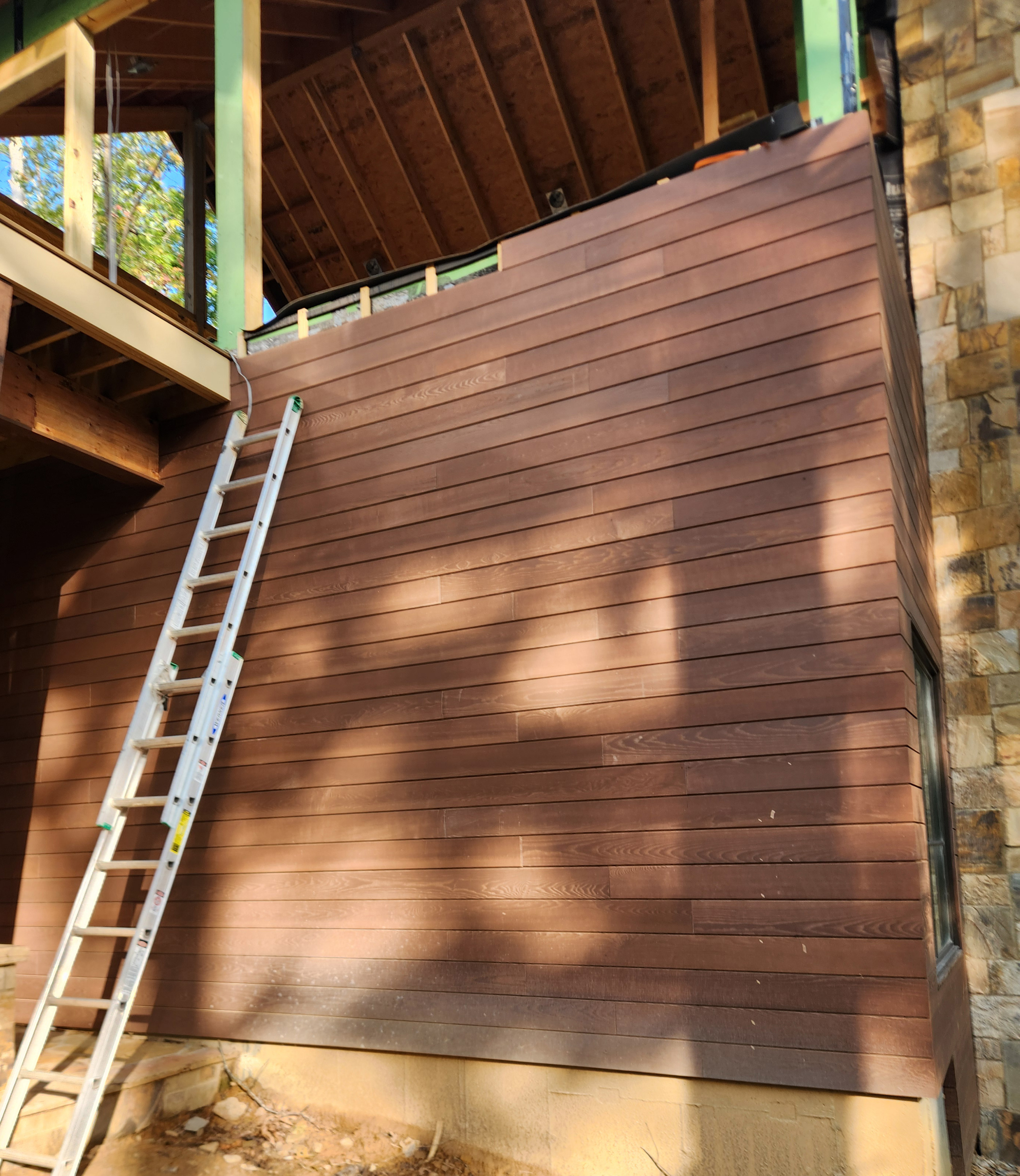
Why Tropical Decking Checks at the Ends Before It Checks Anywhere Else
End grain gives up moisture ten to fifteen times faster than face grain, so a cut end dries, shrinks, and tears open while the rest of the board is still sitting at equilibrium. That ratio is the entire reason end sealers exist. Everything else in this article is a consequence of it.
Look at what a saw actually does. Wood moves water lengthwise through vessels and tracheids, which run parallel to the grain like a bundle of drinking straws. The face of a board is the side wall of those straws, and side walls are slow. Cut across them and you have opened every vessel and fiber cavity in that cross section straight to the atmosphere. The USDA Forest Products Laboratory quantifies this directional difference in the Wood Handbook chapter on drying and control of moisture content, and the number holds across species.
Now add shrinkage. Wood only changes dimension below the fiber saturation point, around 30 percent moisture content, where water starts leaving the cell walls instead of the cell cavities. Tangential shrinkage runs roughly twice radial shrinkage in most species, and longitudinal shrinkage is close to zero. The last inch of a board is where all three of those directions meet a free surface at once. The outer shell of that inch drops to 7 or 8 percent in a single hot afternoon. The wood a half inch behind it is still at 14. The shell wants to contract and the core will not let it, so the shell ends up loaded in tension across the grain.
Tension perpendicular to grain is the weakest thing wood does. Something has to give, and what gives is the ray tissue. You get a hairline. Then a check you can catch a fingernail in. Then, if nobody intervenes, a split that runs three inches up the board and takes the fastener hole with it.
Density makes this worse rather than better. Ipe runs around 1,050 kg/m3 and Massaranduba around 1,150. The same tight cell structure that produces Ipe's Janka rating of 3,680 lbf also makes the board close to impermeable. Moisture cannot migrate through the interior fast enough to relieve the gradient the end grain is creating. So dense tropical decking does not dry evenly toward a new equilibrium the way a lower-density softwood does. It dries hard at the exposed end, stalls, and builds a steep gradient exactly where the wood is least able to carry stress.
Paraffin Wax Emulsion on Fresh Cuts, Penetrating Oil on Ends You Will See
The best end sealer for tropical hardwood decking is a paraffin wax emulsion applied to every fresh cut within minutes of the saw, with a penetrating oil end sealer substituted anywhere the end grain stays visible in the finished deck. Two products. Two different jobs. Buyers looking for one bottle that does both are chasing something that does not exist.
A wax emulsion is what sawmills and lumber yards have used on log ends and green lumber for decades. Paraffin wax is suspended in water. Brush or dip it onto the end grain, the water carries the wax a short distance into the severed vessels and then evaporates, and what remains is a wax matrix plugging the tubes. It is the closest thing the trade has to a true vapor barrier on end grain. It is also milky, it dries to a dull translucent skin, and no exterior finish will bond over it reliably.
That last property decides where it goes. Wax emulsion belongs on end grain that disappears. Butt joints landing on a doubled joist. Board ends tucked behind a fascia. Every stick in the stack while material sits on site waiting for the crew. Nobody sees it and nothing has to stick to it.
Visible ends are a different problem. A picture frame border, a mitered corner, stair tread noses, the outboard end of a cantilevered run. Wax there reads as a white smear against a chocolate brown board and the client notices on day one. For those, a penetrating oil end sealer from the same chemistry family as the specified deck finish is the right call. It soaks in, it darkens the end grain to match the face, it accepts a topcoat, and it slows moisture exchange enough to matter. It does not slow it as much as wax does. That is the trade, and it is worth making where appearance counts.
End-Check Risk Is Not the Same Across Tropical Species
The denser and less permeable the species, the steeper the moisture gradient it can build at a cut end, and the more aggressively that end needs sealing. Specifying an end sealer without knowing which species is under it is guesswork.
Massaranduba is the species that surprises people. It is not the hardest tropical on the list, but it carries the highest density of the species in the table below and shrinkage numbers to match, and it will end check on a job where the same crew got away with sloppy practice on Garapa. Ipe and Cumaru sit close behind. Garapa and Teak are more forgiving, Teak especially, because its natural oil content slows moisture exchange on its own. Forgiving is not the same as exempt. Every species in the table below still gets sealed.
| Species | Janka (lbf) | Density (kg/m3, 12% MC) | EN 350 Durability | End-Check Risk | End Seal Priority |
|---|---|---|---|---|---|
| Massaranduba | ~3,190 | ~1,150 | Class 1 to 2 | Very high | Wax emulsion at every concealed cut; oil on visible ends |
| Ipe | ~3,680 | ~1,050 | Class 1 | High | Wax emulsion at the saw; oil on visible ends |
| Cumaru | ~3,540 | ~1,070 | Class 1 to 2 | High | Wax emulsion at the saw; oil on visible ends |
| Jatoba | ~2,690 | ~910 | Class 2 to 3 | Moderate to high | Seal every cut; ASTM E84 Class A rated |
| Red Balau | ~1,700 to 2,000 | ~800 to 880 | Class 2 to 3 | Moderate | Seal every cut; oil acceptable throughout |
| Garapa | ~1,700 | ~830 | Class 2 to 3 | Moderate | Seal every cut; oil acceptable throughout |
| Teak | ~1,070 | ~655 | Class 1 to 3 by source | Low to moderate | Oil end sealer sufficient in most cases |
Species figures above are J. Gibson McIlvain's own working data, and published values move around from source to source, so treat outside references as background rather than confirmation. General species overviews sit at The Wood Database entry for Ipe and its Cumaru and Garapa entries. Teak durability spans three classes because old-growth and plantation stock behave differently, a distinction that matters more for rot resistance than for end checking.
What a Wax Emulsion Does, and the Four Ways Crews Waste It
A wax emulsion works by physically plugging severed vessels, which brings the drying rate at the end grain down toward the drying rate at the face and flattens the gradient that drives the check. It does not repel water chemically. It obstructs vapor mechanically. That distinction explains all four common failures.
Applied too late. This is the big one. The check starts forming in the first hours after the cut, sometimes the first hour on a hot open deck. Sealer brushed on at the end of the shift is sealing a check that already exists. It stops the check from growing. It never closes it.
Applied too thin. One thin pass looks like coverage and is not. The first coat mostly soaks in and disappears. The second coat is the one that builds the film. Two coats on end grain is the working standard, and the second goes on as soon as the first loses its wet sheen.
Applied cold. Wax emulsions are water-carried. Let the pail freeze, or brush it on below roughly 40 degrees Fahrenheit, and the emulsion breaks. The wax separates, the film never forms, and the crew is painting milk on a board. Winter installations need the sealer stored inside overnight and carried out in small working quantities.
Finished over. Wax is the reason your topcoat is fish-eyeing at the butt joints. Nothing bonds to a paraffin film. Wax goes only where no finish follows.
Coverage is rarely the constraint. End grain area on a whole deck is small compared with face area, and a single pail of wax emulsion goes a very long way on a residential job. Buy it once, keep it at the chop saw, and stop thinking about it.
Penetrating Oil End Sealers and How Much End Grain Actually Drinks
A penetrating oil end sealer is the only option that seals a visible end and still lets the specified finish look continuous across the board. Same resin family as the topcoat, usually a hardwood oil carrying UV inhibitor and transparent iron oxide pigment.
Application is not brushing. It is flooding. End grain on Ipe will absorb several times the finish per square inch that face grain absorbs, because you are pouring into open tubes instead of onto a closed wall. Flood the end, wait, flood again, and keep going until the wood stops taking it. Then wipe the excess before it skins over into a gummy film. Crews who treat the end like the face will put down a fifth of what the wood wanted and wonder why the miter split in July.
The honest limitation is that oil slows vapor movement without stopping it. On a species like Massaranduba, oil alone at a cut end is a compromise. That is why the mixed approach is standard practice on good crews. Wax on hidden ends. Oil on visible ends. Same board, different treatment at each end, decided by whether anyone will ever look at it.
The Forest Products Laboratory chapter on finishing of wood lays out why penetrating finishes outperform film finishes on exterior horizontal surfaces, and the reasoning applies with extra force at end grain.
Film Formers, Epoxies, and Paint: Where They Go Wrong on Oily Tropicals
Marine epoxy, spar varnish, polyurethane, and clear penetrating epoxy sealers all fail on tropical hardwood deck ends, and they fail in a way that leaves the board worse off than no sealer at all. This comes up constantly because boatbuilding forums recommend epoxy for end grain, and boatbuilding is a different problem.
Two mechanisms. First, adhesion. Ipe carries lapachol and a family of related extractives. Cumaru and Teak carry natural oils. Those compounds interfere with the cure of some epoxy systems and with adhesion of most film-forming coatings. The film reports as bonded and lets go a season later.
Second, and more damaging, is what happens after it lets go. A film former that cracks becomes a one-way valve. Water enters through the crack, reaches raw end grain, and then cannot evaporate back out through the intact film around it. The end grain sits wet. You have engineered a moisture trap into the most vulnerable inch of the board. Compare that with a wax plug, which slows vapor in both directions and has nothing to peel.
Shellac and latex paint belong to the woodshop. They are perfectly good end seals for kiln-drying furniture stock indoors. Neither survives a season of UV and freeze-thaw on a horizontal exterior surface. Aluminum-pigmented and bituminous sealers work on structural timbers and look exactly as bad as they sound on a finished deck.
The Application Window Is Measured in Minutes
Every board that gets cut to length loses the end coating the mill applied, which means the majority of boards on any deck arrive protected and go down unprotected unless the crew reseals at the saw. Mill-applied end coating is real and it works. It also lands in the offcut bin the moment somebody trims to length.
"The end sealer has to live at the chop saw. Not in the truck, not in the garage, not on the tailgate. I have walked jobs where a crew had the right product and still lost board ends, and every single time it was because someone had to walk forty feet to get it. Cut, seal, stack. If it is not part of the motion, it does not happen. And the boards that check are always the ones cut on the hottest afternoon of the job."
Norm Moton, Director of Sales, J. Gibson McIlvain
Set up accordingly. Sealer pail and a cheap disposable brush on a stand next to the miter saw. Cut, seal both fresh ends, move the board to the stack. On a 90-degree day with sun on the deck, that window is short. Fifteen minutes is a reasonable working rule and shorter is better.
One detail that catches people out on grooved profiles. When you cut a grooved board to length, you expose end grain inside the groove as well as across the face. Seal the whole cut face, groove included. The groove is the thinnest section of the board and it splits first.
No Sealer Overcomes the Wrong Moisture Content
Boards installed between 12 and 16 percent moisture content stay flat, and boards installed outside that window will check at the ends regardless of what you brushed on them. Sealer manages the rate of change. It cannot manage the destination.
Equilibrium moisture content is where a board stops trading water with the air. It shifts with temperature and relative humidity and it varies by region. A deck in coastal Northern California settles at a different EMC than the same deck outside Phoenix or Atlanta. The Wood Handbook chapter on moisture relations and physical properties of wood publishes the EMC tables, and any crew installing dense tropical decking should know roughly where their site sits.
Site handling causes more end checks than product selection does. The classic failure sequence runs like this. A bundle arrives wrapped. Somebody strips the plastic and leaves the stack flat on a driveway in full sun. The top board bakes to 6 percent while the bottom board sits at 14, and every end in the pile is losing water into still air. By the time the crew touches it, half the stack has hairline ends.
Do the opposite. Sticker the pile so air moves through it. Cover the top against direct sun and rain, and leave the sides open. Keep it off grade on blocking. Remove shipping plastic, because plastic traps moisture against the wood, but keep a breathable cover. Building Science Corporation's digest on moisture and materials covers the underlying principle better than any lumber brochure.
Installation Detailing Carries Equal Weight With the Sealer
There is no silver-bullet sealer and no silver-bullet species, because a deck that cannot dry from both faces will check at the ends no matter what is in the pail. Sealer is one line item in a system.
Start under the boards. Dense tropical decking wants joists at 16 inches on center, and closer if the run is diagonal. Air has to move under the deck and it has to move on both sides of every board, which means a real ventilated cavity, not a deck built tight to a slab. A board that can only dry from the top will cup, and a cupped board opens its own ends.
Fasteners and profile go together. Shiplap takes visible fasteners and there is no way around that. Only a tongue and groove profile works with a hidden fastener system. Where material runs over furring strips or joists on a cladding-style assembly, grooves face down so water drains out instead of collecting. Face-screwed boards need a pilot hole and a countersink, every time, and the screw needs to sit back from the end. Driving an unpiloted screw within an inch of an end on a 3,680 lbf species is a reliable way to start a split that the sealer was never going to stop.
Butt joints deserve blocking. Land each board end on a doubled or sistered joist so both ends bear fully, and seal both ends before they go down. Once the board is fastened, the end grain is gone and nothing you do afterward reaches it. That is the argument for sealing ends and underside before installation rather than after.
Coastal work takes 316 stainless fasteners. Anything less corrodes, and a corroding fastener in dense hardwood swells its hole and starts a split from the inside. The American Wood Council codes and standards library is the reference for fastener and connection requirements that carry code weight.
Re-Sealing Ends Over the Life of the Deck
Wax on a concealed end is effectively permanent, while oil on a visible end is sacrificial and needs refreshing on the same schedule as the deck finish. Plan for the second one and forget the first.
When the field coat gets refreshed, the ends get two coats where the face gets one. They drink more and they weather harder. Miters, tread noses, and any exposed end grain on a picture frame border are the first places a maintained deck starts to look tired, and they are the first places to fail if maintenance lapses.
Owners who want the silver patina rather than a maintained finish still need end sealer at installation. Letting a deck go gray is a decision about the face of the board. It changes nothing about what happens at a cut end in the first summer. Wax the hidden ends, oil the visible ones, then stop finishing the field and let it weather. The ends stay sound and the deck grays evenly.
Boards that develop a hairline end check anyway are usually not a defect. A shallow surface check on a Class 1 durable species is cosmetic, and on Ipe it does not open a path to decay in any meaningful sense. What matters is whether it is growing. A check that has stabilized can be left alone. A check that grows every season points at a ventilation or bearing problem under the deck, not at the sealer.
How J. Gibson McIlvain Would Specify This
Write end sealing into the specification as a sequenced requirement tied to the cut, not as a product line item, because the timing is what makes it work. A spec that names a sealer without naming when it goes on will be satisfied by a crew brushing wax on Friday afternoon.
The language that holds up in the field covers seven things:
- Material shall be delivered and installed at 12 to 16 percent moisture content, verified by pin meter at delivery on a random sample of the load.
- All field cuts shall receive paraffin wax emulsion end sealer, two coats, applied within 15 minutes of cutting, on all end grain that is concealed in the finished work.
- End grain remaining visible in the finished work shall receive a penetrating oil end sealer from the same manufacturer as the specified deck finish, flooded to refusal, minimum two applications.
- Film-forming coatings, including epoxy, spar varnish, and polyurethane, are not permitted on horizontal exterior end grain.
- Storage on site: stickered, blocked off grade, top covered against sun and precipitation, sides open, shipping plastic removed on arrival.
- Joists at 16 inches on center maximum for decking 5/4 and thinner in dense tropical species, with a ventilated cavity permitting air movement to both faces. Butt joints shall bear on doubled or sistered framing.
- Fasteners: 316 stainless in coastal exposure. Pilot and countersink all face fastenings. Hidden fastener systems only on tongue and groove profile. Grooves face down.
Two sourcing notes belong in the same section. Where FSC chain of custody is required, call it out and require certificates at delivery rather than at bid, and FSC publishes the certificate lookup that lets you verify it. When using a CITES-listed species, documentation is required, and legal-harvest paperwork should travel with the shipment; the CITES species database is the authority on what is listed.
Quantity takeoff affects how much sealer to order. A 5/4x6 board covers about 2.1 linear feet per square foot of deck, so a 400 square foot deck runs roughly 840 linear feet of board, and the number of cut ends scales with how the layout handles butt joints and borders. A picture frame border with mitered corners multiplies visible end grain considerably and shifts the balance toward oil sealer.
J. Gibson McIlvain mills and ships Ipe decking, Cumaru, Massaranduba, Jatoba, Garapa, Red Balau, and Teak from its own yard, holding a vast Ipe inventory across all standard and custom dimensions and moving commercial and contractor-volume orders nationwide, California included, on a routine basis. Material leaves the yard end-coated and dried into the 12 to 16 percent window. What happens at the chop saw after that is on the crew, which is exactly why the spec language above matters more than the brand on the pail.
To talk through species selection, dimensions, or sealing and installation detailing on a specific project, call 800-638-9100 or start with the Ipe wood and decking line and the full tropical decking range at mcilvain.com. Bring the deck layout and the site location. Both change the answer.
Frequently Asked Questions
What is the single best end sealer for Ipe decking?
There is no single best product, because the two locations on a deck need different chemistry. For any cut end that ends up concealed in the finished work, which is most of them, a paraffin wax emulsion is the most effective option available. It physically plugs the severed vessels and slows end grain drying toward the rate at which the face dries, which is exactly what flattens the moisture gradient that causes the check. For end grain that stays visible, such as a mitered picture frame border or a stair tread nose, use a penetrating oil end sealer from the same family as your specified deck finish. Wax dries to a milky translucent skin and no finish will bond over it, so it cannot go anywhere the deck finish has to follow.
How quickly do I have to seal a fresh cut?
Minutes, not hours. Checking begins in the first hours after the cut and can begin within the first hour on a hot deck in direct sun. Fifteen minutes is a reasonable working rule and shorter is better. The practical way to hit that window is to keep the sealer pail and a disposable brush on a stand right at the miter saw so that cut, seal, stack becomes one motion. Sealer applied at the end of the shift is sealing a check that already formed. It will stop that check from growing but it will never close it.
Can I use epoxy or marine varnish on tropical hardwood deck ends?
No. Film-forming coatings fail on tropical hardwood deck ends for two reasons. Ipe carries lapachol and related extractives, while Cumaru and Teak carry natural oils, and those compounds interfere with the cure of some epoxy systems and with the adhesion of most film formers. The coating appears bonded and releases a season later. The bigger problem is what happens next. A cracked film acts as a one-way valve, letting water reach raw end grain through the crack while blocking evaporation back out through the film around it. That traps moisture in the most vulnerable inch of the board and leaves it worse off than an unsealed end.
Does the mill-applied end coating on my delivered boards mean I do not need to seal?
It only covers the boards you never cut. Mill-applied end coating is real protection and it works while the material sits in the stack, but it lands in the offcut bin the moment anyone trims a board to length. On a typical deck the majority of boards get cut, which means the majority of ends arrive protected and go down unprotected unless the crew reseals at the saw. Treat the factory coating as storage protection, not as installed protection.
Will an end sealer stop checking if my boards are at the wrong moisture content?
No. Sealer manages the rate at which a board changes moisture content. It cannot change where the board is headed. Dense tropical decking should be installed between 12 and 16 percent moisture content. That is the window J. Gibson McIlvain dries and ships to, and it puts the board near where exterior wood settles once it has been through a full season on site. A board delivered wet will still shed water down to its regional EMC, and a board that is too dry will still take water on. Site handling causes more end checks than product selection does. Sticker the pile so air moves through it, cover the top against sun and rain while leaving the sides open, keep it off grade on blocking, and remove the shipping plastic on arrival because plastic traps moisture against the wood.
Do I need to seal the ends of grooved boards differently?
Seal the entire cut face including the groove. Cutting a grooved board to length exposes end grain inside the groove as well as across the face, and the groove is the thinnest section of the board, so it splits first. Crews that brush only the visible outer face of the cut leave the most fragile part of the board raw. Remember that grooves face down for drainage, and that only a tongue and groove profile works with a hidden fastener system. Shiplap takes visible fasteners.
How often do end sealers need to be reapplied?
Wax on a concealed end is effectively permanent once the board is installed, because nothing can reach it and nothing weathers it. Penetrating oil on a visible end is sacrificial and should be refreshed on the same schedule as the rest of the deck finish. Give the ends two coats where the field gets one. End grain absorbs several times more finish per square inch than face grain does and it weathers harder, which is why miters and tread noses are the first places a maintained deck starts to look tired.
If a board develops a small end check anyway, is it a defect?
Usually not. A shallow surface check on a Class 1 durable species is cosmetic, and on Ipe it does not open a meaningful path to decay. The question to ask is whether it is growing. A check that has stabilized can be left alone. A check that opens further every season is pointing at something structural underneath, most often a ventilation problem where the board cannot dry from its underside, or a butt joint that is not bearing fully on a doubled or sistered joist. Fix the assembly rather than the board.
Sources and Standards Referenced
- USDA Forest Products Laboratory, Wood Handbook, Chapter 13: Drying and Control of Moisture Content and Dimensional Changes
- USDA Forest Products Laboratory, Wood Handbook, Chapter 4: Moisture Relations and Physical Properties of Wood
- USDA Forest Products Laboratory, Wood Handbook, Chapter 16: Finishing of Wood
- The Wood Database: Ipe (Handroanthus spp.) Species Data
- The Wood Database: Cumaru (Dipteryx odorata) Species Data
- The Wood Database: Garapa (Apuleia leiocarpa) Species Data
- Building Science Corporation, BSD-138: Moisture and Materials
- American Wood Council, Codes and Standards
- Forest Stewardship Council, Chain of Custody Certification
- CITES, How CITES Works: Listed Species Database