
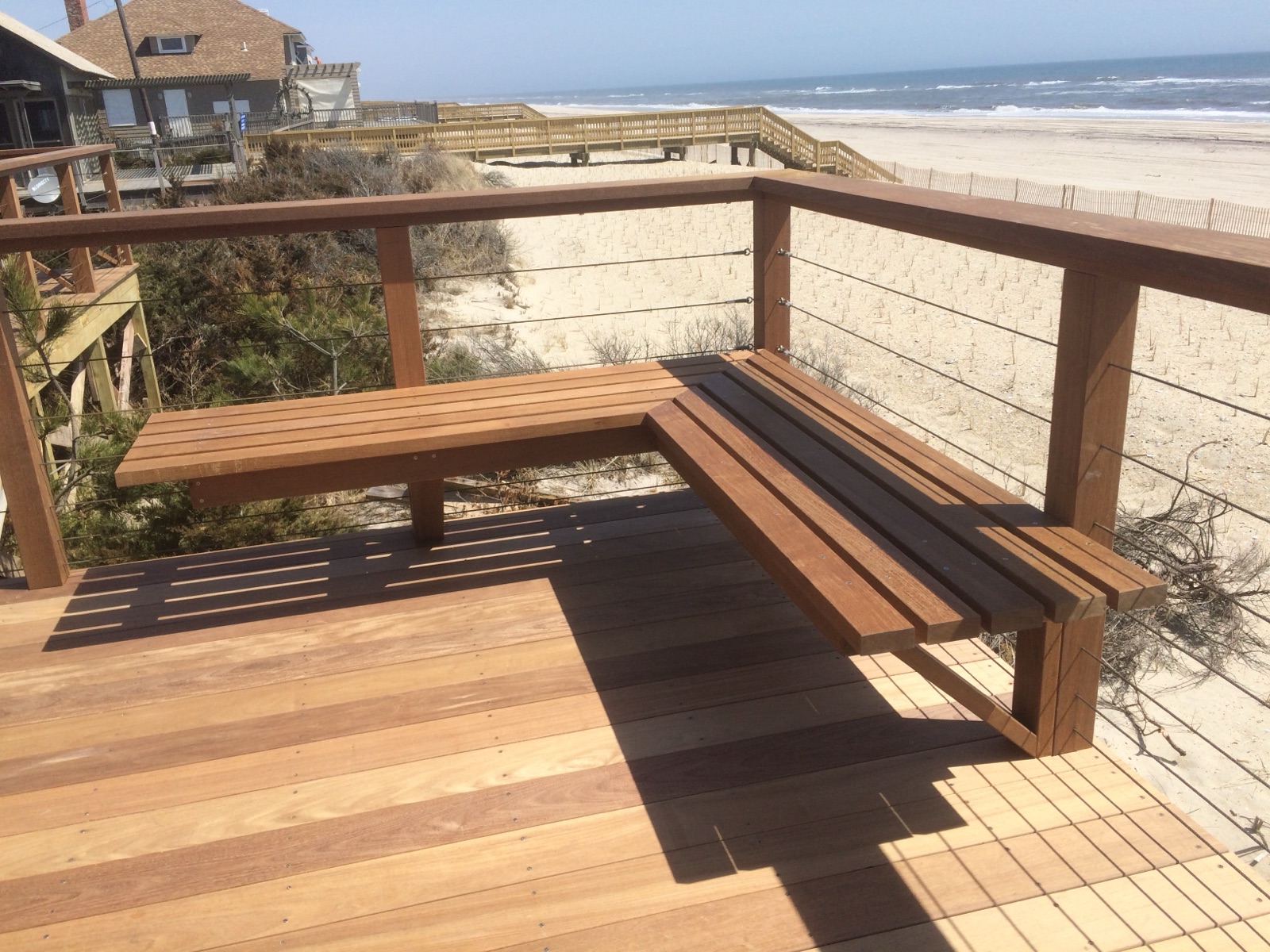
The real enemy on the oceanfront is trapped moisture and seasonal movement, not the species you pick.
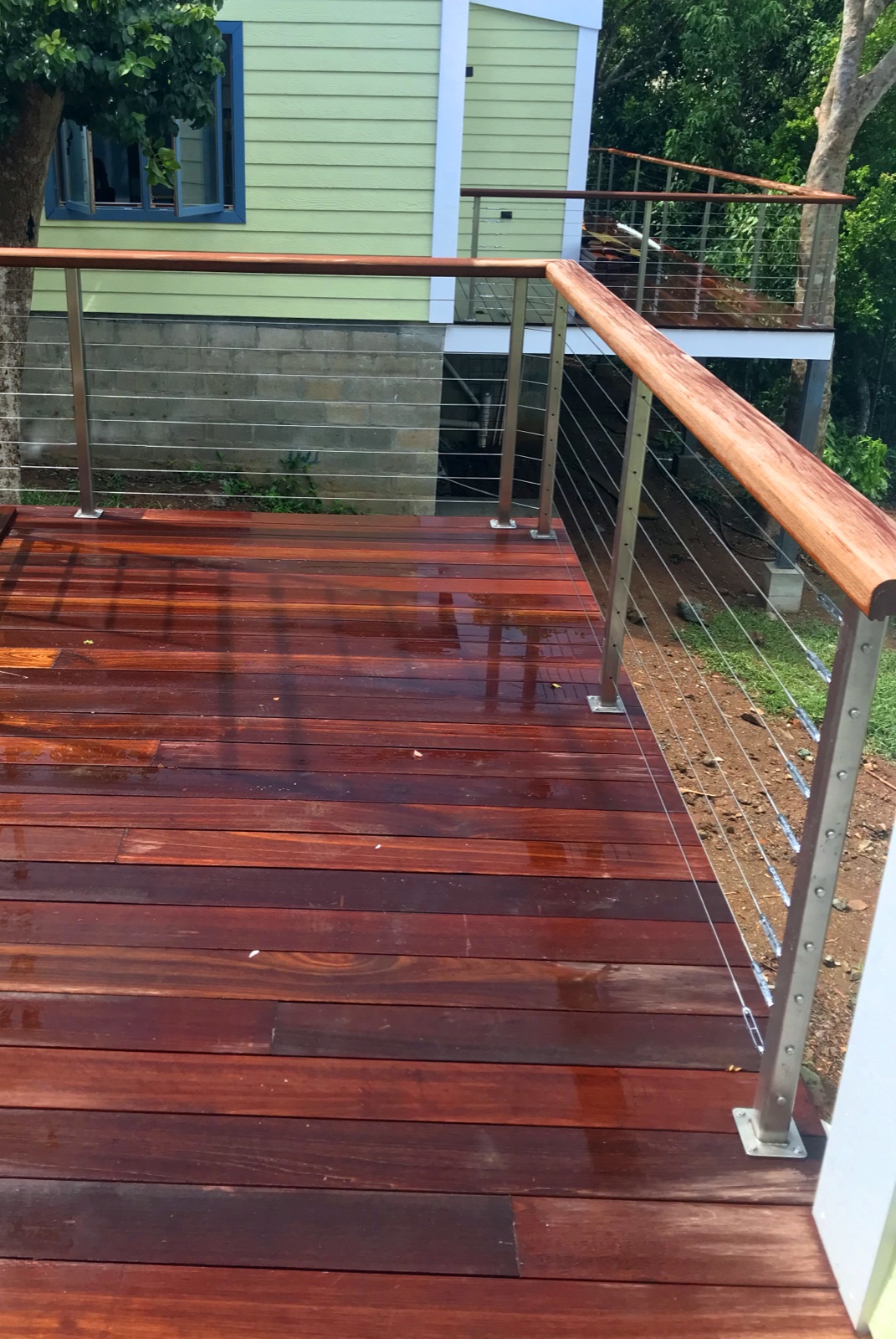
Every dense tropical hardwood in this conversation already resists salt water on a chemistry level. Ipe, Cumaru, Red Balau, Jatoba, and Garapa all carry natural extractives that make them unappetizing to fungus and marine borers. So the species question, while real, is not where beachfront decks actually fail. They fail where water sits and where wood moves.
A salt-air site keeps a deck damp longer than an inland one. Onshore wind carries humidity. Fog rolls in and does not burn off until midday. Sea spray lands on the boards and leaves hygroscopic salt behind that pulls more water out of the air. A deck that cannot shed and dry that moisture cups, checks, and traps grit against its own hardware. The winning move at the beach is a deck built to dry fast and to move predictably. That is a drainage and airflow problem first, a fastener problem second, and a species problem third.
This article treats the beachfront deck as a drying system. We will size the boards, set the gaps, ventilate the underside, detail the drainage, and only then rank the species. If you want the broad species-versus-fastener overview, that ground is covered elsewhere. Here we go deep on the parts that most oceanfront decks get wrong.
Open ocean, back bay, and rooftop terraces are three different exposures that call for three different specs.
Buyers say beachfront and mean anything within earshot of surf. The wood does not experience it that way. Direct oceanfront within the first row of dunes takes the worst of it: constant salt aerosol, wind-driven rain, and relentless ultraviolet with no tree cover. Back-bay and sound-side decks see the salt but far less mechanical spray, and they often sit in stiller, more humid air that dries slowly. Rooftop and second-story terraces get the full sun and wind load but usually sit over conditioned space, which changes how the substructure has to drain.
Read your site before you read a species chart. A first-row oceanfront deck needs the fastest-drying assembly you can build and the most corrosion-resistant metal you can source. A shaded, low, back-bay deck with poor air movement is arguably a harder drying environment even though it feels gentler, because standing humidity is what feeds surface checking and slow-motion cupping. Match the assembly to the microclimate, not to the postcard.
The coastal shortlist is Ipe, Cumaru, Red Balau, Jatoba, and Garapa, ranked by how they move as much as by how hard they are.
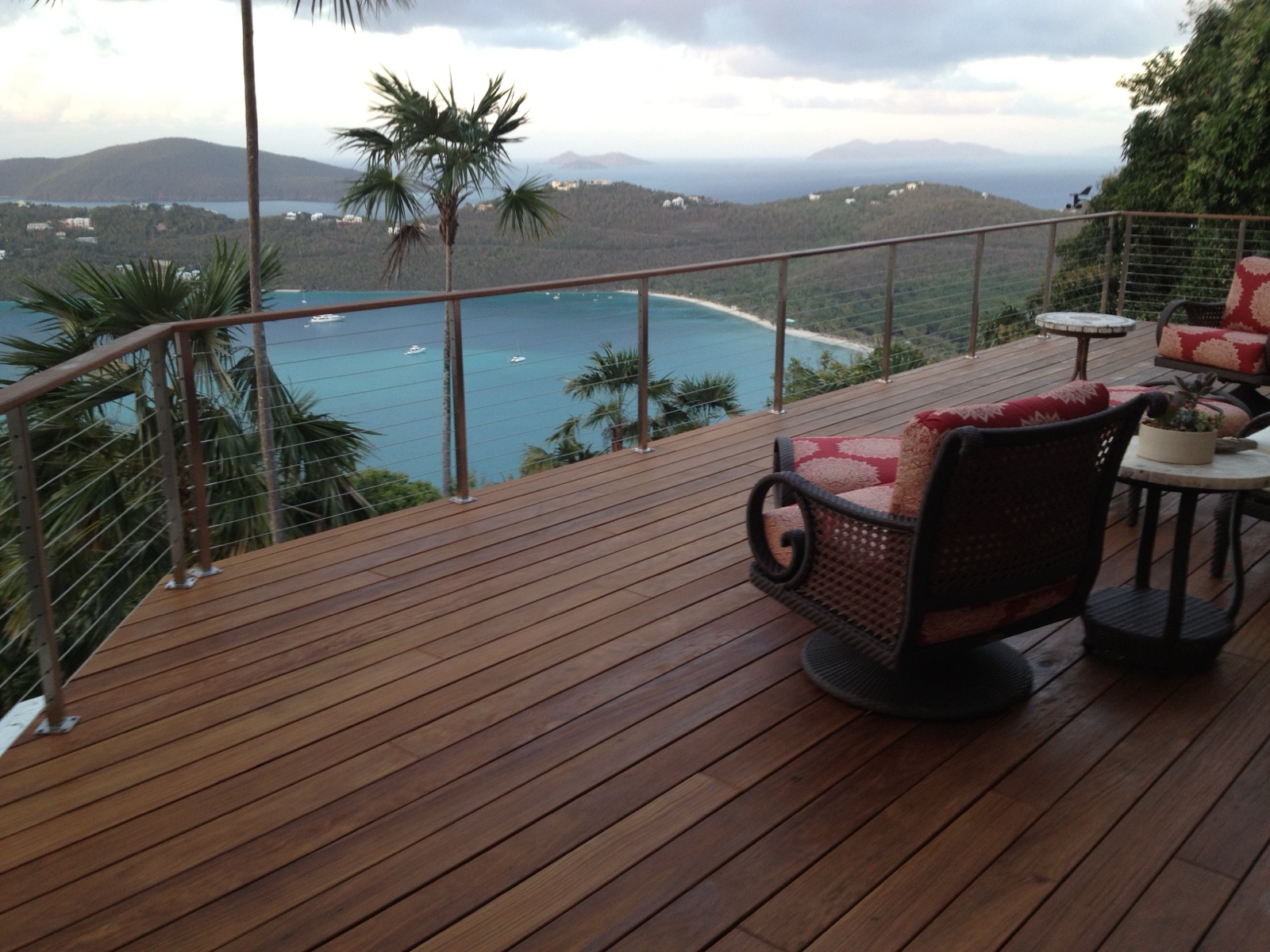
Hardness gets quoted first because it is a single number. On a beach deck, dimensional movement matters more. A board that swings hard between wet and dry seasons will open its gaps, check its surface, and stress its fasteners no matter how high its Janka reading. So read the table below on both axes. Janka tells you about dent resistance and how the board machines. The movement column tells you how much it will fight you across a humid coastal year, and the recommended width column follows directly from that.
| Species | Janka (lbf) | In-service movement | Recommended face width | EN 350 durability | Coastal notes |
|---|---|---|---|---|---|
| Ipe (Tabebuia spp.) | ~3,680 | Moderate to large | Up to 6 in with proper gapping; 4 in in harsh exposure | Class 1 | Benchmark. Tight grain sheds water and machines clean. Class A fire rating. |
| Cumaru | ~3,540 | Large | Favor 4 in; gap generously | Class 1 to 2 | Very hard, but the biggest mover here. Interlocked grain wants narrower boards at the beach. |
| Red Balau | ~1,700 to 2,000 | Moderate | Up to 6 in | Class 2 | Even reddish tone, well behaved, a calmer alternative to Cumaru near salt. |
| Jatoba | ~2,690 | Large | Favor 4 in; keep well ventilated | Class 2 to 3 | Beautiful, hard, but a strong mover and less durable outdoors. Best on covered coastal porches. |
| Garapa | ~1,700 | Moderate | Up to 6 in | Class 2 to 3 | Light golden, runs cooler underfoot in sun. Good where barefoot comfort matters. |
| Massaranduba (comparison only) | ~3,190 | Large | Favor 4 in | Class 1 to 2 | Durable but a heavy mover and prone to bleed. Listed for context, not stocked. |
Ipe is the default for direct oceanfront because it pairs top-tier durability with only moderate movement and the tightest grain of the group, which means it sheds water and dries at the surface faster than the coarser species. Cumaru and Jatoba are gorgeous and hard, but they move enough that at the beach they earn a narrower board. Garapa and Red Balau give up some hardness and buy back calm, predictable behavior, which on a slow-drying back-bay deck can matter more than raw Janka.
Dimensional movement is what actually cracks a coastal deck, so you design for the swing instead of pretending it will not happen.
Wood moves with moisture content, and a beach deck cycles its moisture content harder than most. Boards installed at a stable 12 to 16 percent in service will still take on water during a foggy, spray-heavy stretch and give it back under August sun. The board expands across its width when wet and shrinks when dry, and it does so unevenly if one face dries faster than the other. That imbalance is what lifts the edges into a cup and opens the surface into fine checks.
Two design decisions absorb that swing. The first is board width, covered in the next section. The second is gapping. Dense tropicals need a real gap between boards so an expanding board has somewhere to go and so water and grit fall through instead of bridging across. The specific gap depends on the moisture content of the boards the day you fasten them. Material delivered near equilibrium for a coastal climate needs a smaller installed gap because it will expand less. Material fastened bone-dry needs a wider one because it is going to grow. The USDA Forest Products Laboratory Wood Handbook lays out the shrinkage and swelling behavior that drives all of this, and it is the reference to hand a crew that argues about gap sizing. Get the material to a known moisture content, then gap to that number rather than to a rule of thumb someone remembers from an inland job.
Narrow boards dry faster, cup less, and hold their gaps, which is why the beach rewards a 4 inch face over a wide plank.
A wide board has more distance across its grain for movement to accumulate, so it develops more total cup and more edge lift than a narrow one cut from the same log. It also presents a bigger flat area for spray and fog to sit on. On an inland deck you can run wide boards and enjoy fewer seams. On a first-row oceanfront deck, a nominal 4 inch face width buys you a deck that dries quicker, moves less per board, and looks tight for longer.
This is a genuine tradeoff, not a rule to follow blindly. Wider boards mean fewer gaps to sweep salt out of and a cleaner look. If your exposure is mild and your air moves well, a 6 inch face is fine, and a standard 5/4 by 6 profile covers roughly 2.1 linear feet of board per square foot of deck, which makes takeoffs simple. The point is to treat width as an exposure decision. Harsh, spray-heavy, slow-drying sites want narrower material. J. Gibson McIlvain mills Ipe decking in 4 inch and 6 inch faces and in custom widths, so the width can be matched to the site instead of forced by what happened to be in a bin. Order the width your exposure calls for.
The airflow under the deck is the single most underspecified detail on the oceanfront, and it is what lets the boards dry from both faces.
A board dries from the top because sun and wind reach it. It dries from the bottom only if air moves under the deck. When the underside stays damp while the top dries, the board cups toward the dry face and checks under the stress. That one-sided drying, more than salt itself, is what ages a coastal deck prematurely. So the underside has to breathe.
Give the assembly a continuous air path. Keep the bottom of the joists well up off sand or grade so wind can sweep the cavity, and resist the urge to wrap the deck in a solid skirt that turns the underside into a stagnant box. If you skirt for looks or code, vent it generously and put openings on opposing sides so air crosses rather than sits. The Building Science Corporation literature on moisture and materials is blunt about the principle at work: assemblies that can dry survive, and assemblies that trap moisture do not. A beach deck is an outdoor assembly, and the same physics applies. Leave the underside room to breathe and the boards get a fighting chance to reach equilibrium instead of living wet on one face.
Water has to fall through and off the deck, which means grooves face down, gaps stay open, and the frame is detailed to shed.
Drainage is where profile and fastener choice stop being cosmetic. Only tongue and groove decking accepts hidden fasteners, and on a hidden-fastener deck the grooved edges must face down so water runs out of the joint instead of collecting in it. Shiplap and square-edge boards take visible fasteners driven from the top, which is a perfectly good coastal choice and often the more serviceable one because a top-screwed board can be lifted and reset. Whatever profile you run, the material sits on joists or on furring strips, never flat on a solid surface that would dam water under the board.
Then keep the water moving once it is through the gap. Cap the joists so trapped grit and salt do not sit on the bearing surface. Pitch any solid framing so it drains. Keep fasteners, flashing, and joist hardware to a corrosion class that matches the exposure, which at the coast means 316 stainless for the salt zone rather than the 304 that is fine inland. The American Wood Council codes and standards resources cover the connection and fastener provisions worth checking against your local code, and coastal jurisdictions frequently amend them. Detail the deck to shed, and salt has far less time to do harm on its way off the structure.
Modified woods and pedestal systems solve the specific coastal problems that solid tropicals do not, especially over living space.
Sometimes the coastal deck is not sitting over open air. Rooftop terraces, cabana decks, and second-story oceanfront living spaces put the deck over occupied rooms, and there the priority becomes a waterproof membrane below with a walking surface above that drains and lifts off for service. That is a pedestal or sleeper system, and it changes the material math. You want dimensional stability and light weight over the membrane more than you want maximum Janka.
This is where thermally modified and acetylated woods fit. Thermory and Abodo Vulcan thermally modified boards, and Accoya acetylated wood, are dimensionally more stable than they were before modification and are the products in this conversation that carry manufacturer warranties, which solid unmodified hardwood does not. They earn their place on rooftop decks and in trim-adjacent details where movement control is the whole game. One planning note that trips up specifiers: these modified products are kiln-processed, and kiln length caps their board length at around 16 feet, with metric runs landing just under that. Design the layout to those lengths rather than assuming you can order a modified board as long as a solid Ipe run. For the solid decking underfoot on most oceanfront jobs, Ipe remains the benchmark, and the Ipe decking line covers the widths and lengths a coastal layout needs.
"On the first-row oceanfront jobs, the crews that come back happy are the ones who let the deck breathe and matched the board width to the exposure. I have watched wide, dry-installed boards on a boxed-in frame cup within a season, and the same species run narrower over a ventilated cavity look tight years later. We push customers to get their material to a known moisture content and gap to it. That one decision outperforms almost any species upgrade." Norm Moton, Director of Sales, J. Gibson McIlvain
Finishing is optional but the maintenance cadence is not, and salt plus ultraviolet sets the schedule.
You can let a tropical hardwood deck weather to silver-gray or you can hold its color with a penetrating oil finish. At the beach that is an appearance choice, not a durability one, because the wood does not need a film to survive. What salt and sun do change is the cadence. Ultraviolet breaks down surface fibers and any pigment faster on an unshaded oceanfront deck, and salt film left on the boards holds moisture against the surface. A coastal deck therefore wants more frequent freshwater rinsing and, if you are maintaining color, a shorter reapplication interval than the same deck would need inland.
Skip film-forming finishes on a salt-air deck. A surface film on a dense, oily tropical that is also cycling moisture hard will peel, and peeled film traps water where it lifts. Penetrating oils that soak in and wear away cleanly are the coastal-friendly path if you want color. Rinse the salt off periodically with fresh water, keep the gaps swept clear of grit, and let the assembly dry. The maintenance is light. It just cannot be zero at the ocean.
Legally documented, well-dried, correctly graded material is what makes the rest of this hold up over decades.
The best drainage detailing in the world cannot fix a board that showed up green, over-wide for its exposure, or improperly documented. Coastal decks are long-term investments, and the material behind them has to be sound from the start. Ask for hardwood dried to a coastal-appropriate in-service moisture content so your gapping math is real. Ask about grade so you are not sorting defects on site. When a project calls for a CITES-listed species, documentation is required and should travel with the order, so buy from a supplier that handles that paperwork as a matter of course. For chain-of-custody claims, the Forest Stewardship Council framework is the standard architects reference, and an FSC-certified importer can supply certified stock on request.
J. Gibson McIlvain is a commercial and contractor-volume supplier that ships coastal decking packages nationwide, including regularly to California, and holds a vast Ipe inventory across every standard and custom dimension along with Cumaru, Garapa, Jatoba, and Red Balau for oceanfront work. That inventory depth is what lets you spec the exact width and length your exposure calls for instead of redesigning around what is on hand. Fire performance is often part of the coastal code conversation too. Ipe carries an ASTM E84 Class A rating, meaning a flame-spread index of 25 or less, and the ASTM E84 test method is the reference behind that claim. Species behavior data for cross-checking any of the numbers here lives at the Wood Database.
How J. Gibson McIlvain Would Specify This
Start from the exposure, not the species. For a first-row oceanfront deck, spec Ipe in a 4 inch face width for the harshest spray zones and 6 inch where air moves well, all dried to a documented 12 to 16 percent in service so the installer can gap to a real moisture number rather than a guess. For a slow-drying back-bay deck, Red Balau or Garapa in a moderate movement class often behaves better than a harder mover like Cumaru or Jatoba.
Set joists at 16 inches on center for any of these dense species. Keep the underside ventilated with a continuous cross-flow air path and no solid skirt, and hold the frame well up off sand so wind can reach the cavity. Run tongue and groove with hidden fasteners only if the grooves face down for drainage, otherwise use a top-screwed shiplap or square-edge profile that can be lifted and serviced. Specify 316 stainless fasteners and joist hardware throughout the salt zone. Cap the joists. Pitch anything solid so it drains.
For rooftop or over-living-space decks, move to a pedestal or sleeper system over a proper membrane, and consider Thermory or Abodo Vulcan thermally modified boards or Accoya where dimensional stability and a manufacturer warranty matter more than maximum hardness, designing the layout around the roughly 16 foot length cap on modified material. If you want color, use a penetrating oil and plan a shorter reapplication interval than an inland deck, with periodic freshwater rinses to clear salt. Then have the whole package cut-listed by width and length before it ships so the crew installs rather than sorts. Call J. Gibson McIlvain at 800-638-9100 to build that spec for your site.
Frequently Asked Questions
How wide should beachfront deck boards be?
Match width to exposure. On a first-row oceanfront deck with heavy spray and slow drying, a nominal 4 inch face width cups less, dries faster, and holds its gaps better than a wide plank because there is less distance across the grain for movement to accumulate. Where air moves well and exposure is milder, a 6 inch face is fine and simplifies takeoffs. Treat width as a drying decision, not a default.
Do I need to leave bigger gaps between boards at the ocean?
You need to gap to the moisture content of the boards the day you fasten them, and a coastal climate makes that swing wider. Material installed near coastal equilibrium expands less and takes a smaller gap. Material fastened dry will grow and needs a wider one. Get the wood to a known moisture content, then gap to that number rather than to an inland rule of thumb. The USDA Forest Products Laboratory Wood Handbook covers the shrinkage behavior behind the math.
How much airflow does an oceanfront deck need underneath?
Enough for continuous cross-ventilation so the boards can dry from the bottom face as well as the top. Keep the joists well up off sand or grade, avoid a solid skirt that traps stagnant air, and if you skirt for looks or code, vent it generously with openings on opposing sides so air crosses. One-sided drying, where the top dries while the underside stays damp, is what cups and checks coastal boards, so the underside has to breathe.
Why does my coastal hardwood deck cup or check after one season?
Almost always uneven drying and movement, not rot. If the top face dries under sun while the underside stays wet on a boxed-in frame, the board cups toward the dry face and checks under the stress. Wide, dry-installed boards on poorly ventilated framing are the classic failure. The fixes are narrower boards for harsh exposures, real gaps sized to the installed moisture content, and a ventilated underside that lets both faces reach equilibrium.
Can I put a hardwood deck on a rooftop or over living space at the beach?
Yes, but it becomes a pedestal or sleeper system over a waterproof membrane, with a walking surface that drains and lifts off for service. Over occupied space, dimensional stability and light weight matter more than maximum hardness, which is where thermally modified Thermory and Abodo Vulcan boards or acetylated Accoya fit, since they are more stable and carry manufacturer warranties that solid wood does not. Design the layout around the roughly 16 foot length cap on modified material.
Should the grooves in hidden-fastener decking face up or down?
Down. Only tongue and groove decking accepts hidden fasteners, and the grooved edges must face down so water drains out of the joint instead of collecting in it. Shiplap and square-edge boards take visible top-driven fasteners, which is a good coastal choice because those boards can be lifted and reset for service. Whatever the profile, the material sits on joists or furring strips, never flat on a solid surface that would dam water under the board.
How often should I refinish a salt-air deck?
More often than inland if you are holding color, though the wood does not need a finish to survive. Ultraviolet on an unshaded oceanfront deck breaks down surface pigment faster, and salt film holds moisture against the boards. Use a penetrating oil rather than a film-forming finish, which would peel on a moving tropical and trap water where it lifts. Plan a shorter reapplication interval than an inland deck, rinse salt off with fresh water periodically, and keep the gaps swept clear.
Sources and Standards Referenced
- USDA Forest Products Laboratory, Wood Handbook (Wood as an Engineering Material)
- Building Science Corporation, BSD-138: Moisture and Materials
- American Wood Council, Codes and Standards
- ASTM E84, Standard Test Method for Surface Burning Characteristics of Building Materials
- Forest Stewardship Council
- The Wood Database, Ipe


