A Beachfront Property Is Four Decking Jobs, Not One
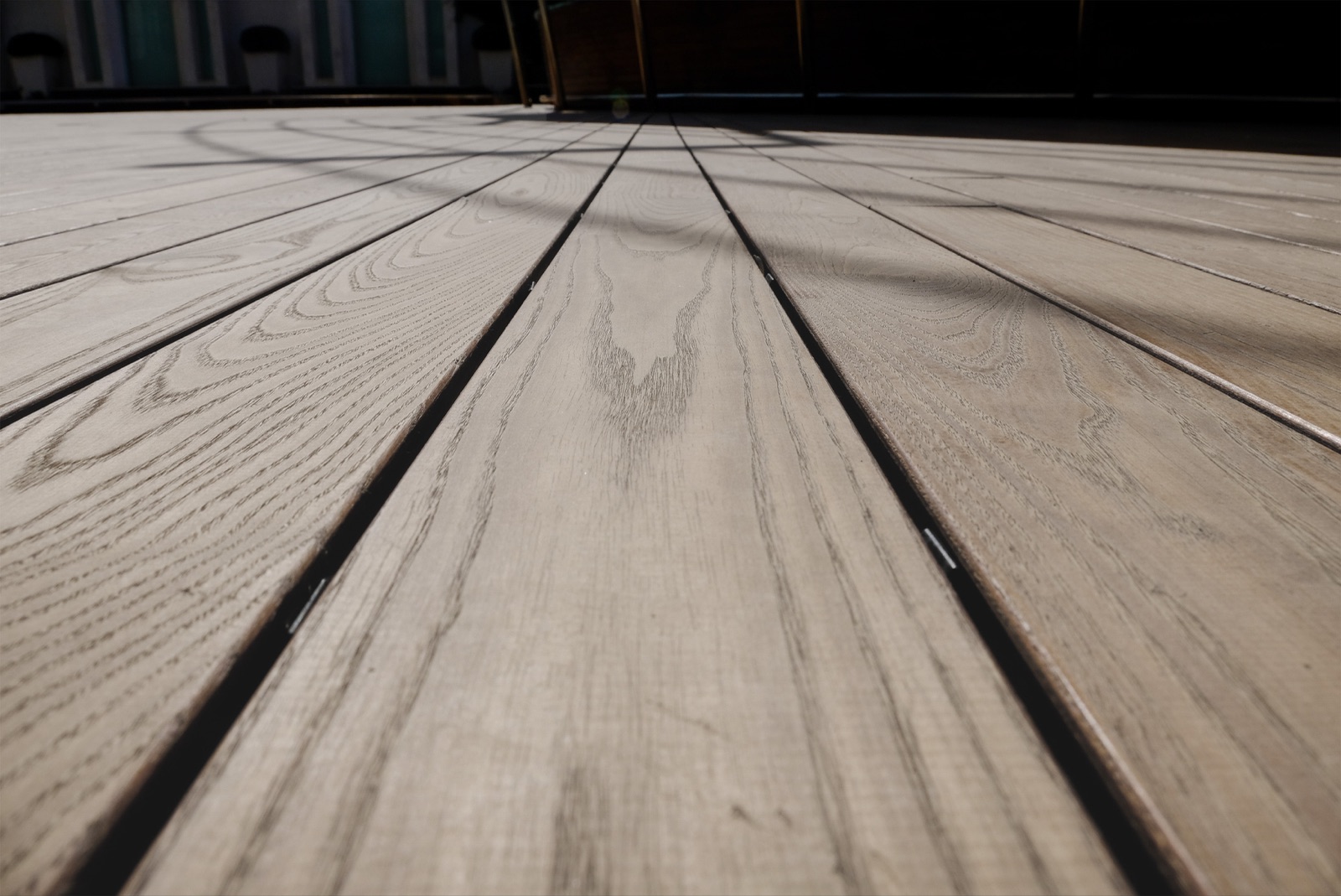
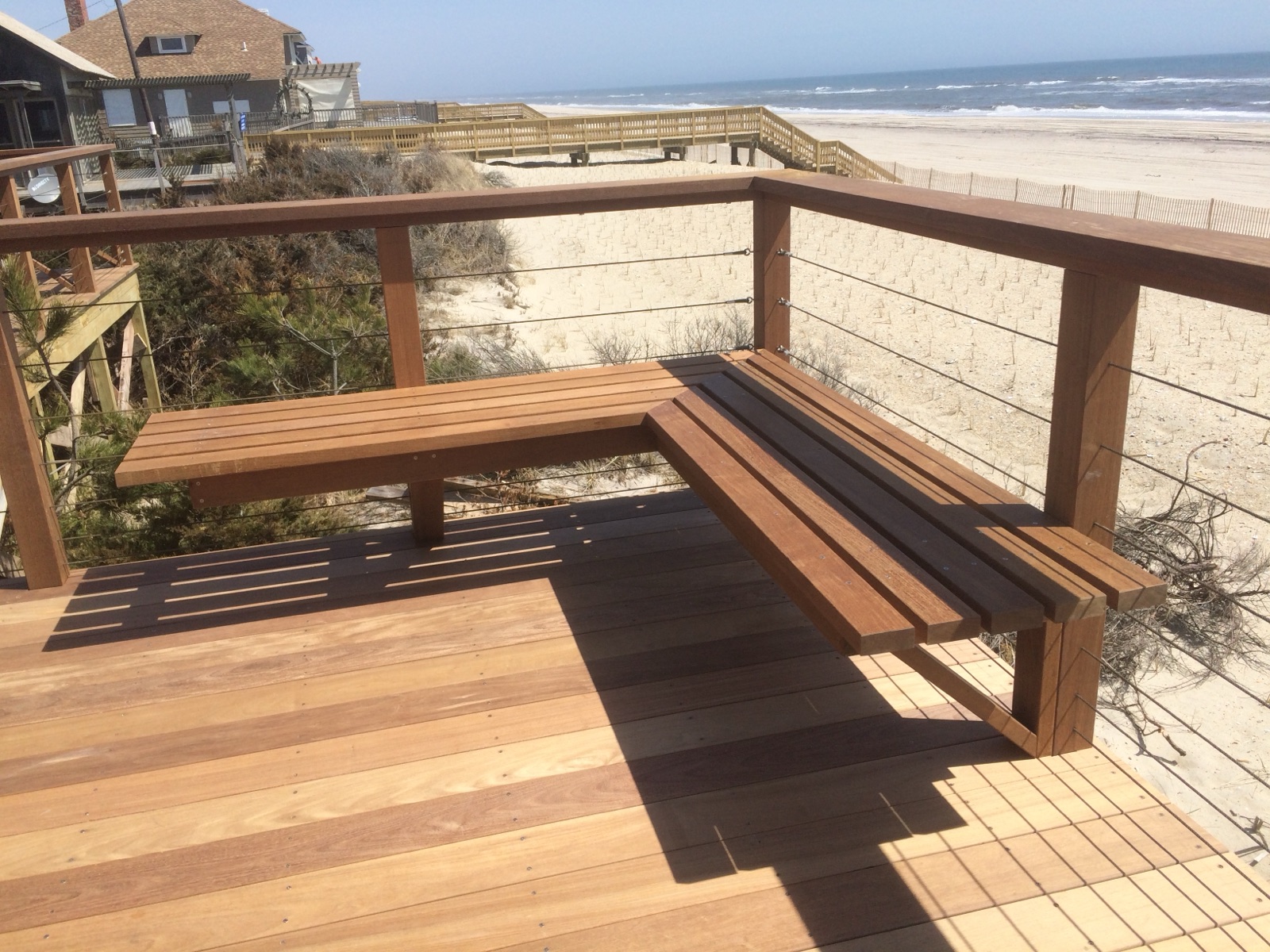
An oceanfront house almost never has a single deck, and the four surfaces these properties end up with do not share one specification. There is the main living deck, usually elevated a full story on piles. There is a pool surround or spa platform. There is a dune walkover running out to the sand, a structure exposed on all six sides with nothing conditioned underneath it. And on a good number of coastal properties there is a dock apron, pier landing or boardwalk segment that the local building department reviews as a public-use surface with its own load and guard requirements.
Same salt. Same sun. Four different failure patterns. The main deck fails at the fasteners and at the frame. The pool surround fails at the finish and from standing water. The walkover fails from ground contact, blown sand abrasion and wind uplift. The public-use section fails from deflection, and the complaint arrives as bounce underfoot rather than as rot. Writing one line item that says tropical hardwood decking and moving on is how coastal jobs go sideways.
The board species matters. It is one of five decisions, and on most beachfront projects it is not the one that determines whether the deck looks good in year twelve.
Salt Air Attacks Metal and Coatings Long Before It Touches the Wood
Airborne chloride destroys hardware, connectors and film finishes on a schedule measured in seasons, while the heartwood of a dense tropical deck board is close to indifferent to it. Surf aerosol deposits salt on every surface within a quarter mile of the waterline and lays it on heavily in the first few hundred feet. Sodium chloride is hygroscopic. Above roughly 75 percent relative humidity it pulls enough moisture from the air to go into solution, which means coastal hardware carries a conductive film most nights even during a dry stretch.
That film is what ends stainless fasteners early. Chloride ions break down the passive chromium oxide layer at weak points and start pitting. Once the attack moves into a crevice under a washer head or inside a countersink, oxygen gets scarce, the local chemistry turns acidic, and the corrosion accelerates itself. Type 304 stainless carries no molybdenum and pits in salt spray. Type 316 carries roughly 2 to 3 percent molybdenum and holds. Hot dip galvanized coatings protect by sacrificing zinc, and inside a splash zone that zinc gets consumed quickly. Put copper-based pressure treated framing under the deck and any plain or lightly coated steel touching it becomes the anode in a galvanic couple.
The wood side of the equation is quieter than the marketing suggests. Salt is not a decay organism. What resists fungal attack in Ipe, Cumaru and Jatoba is extractive chemistry in the heartwood, the same chemistry the USDA Forest Products Laboratory has documented across decades of natural durability work. Salt spray does two secondary things worth planning around. It leaves a crystalline haze that dulls oiled surfaces, and it holds surface moisture longer than inland air does, which slows drying and rewards ventilation.
Surface Temperature and Wet Traction Decide Whether the Deck Gets Used
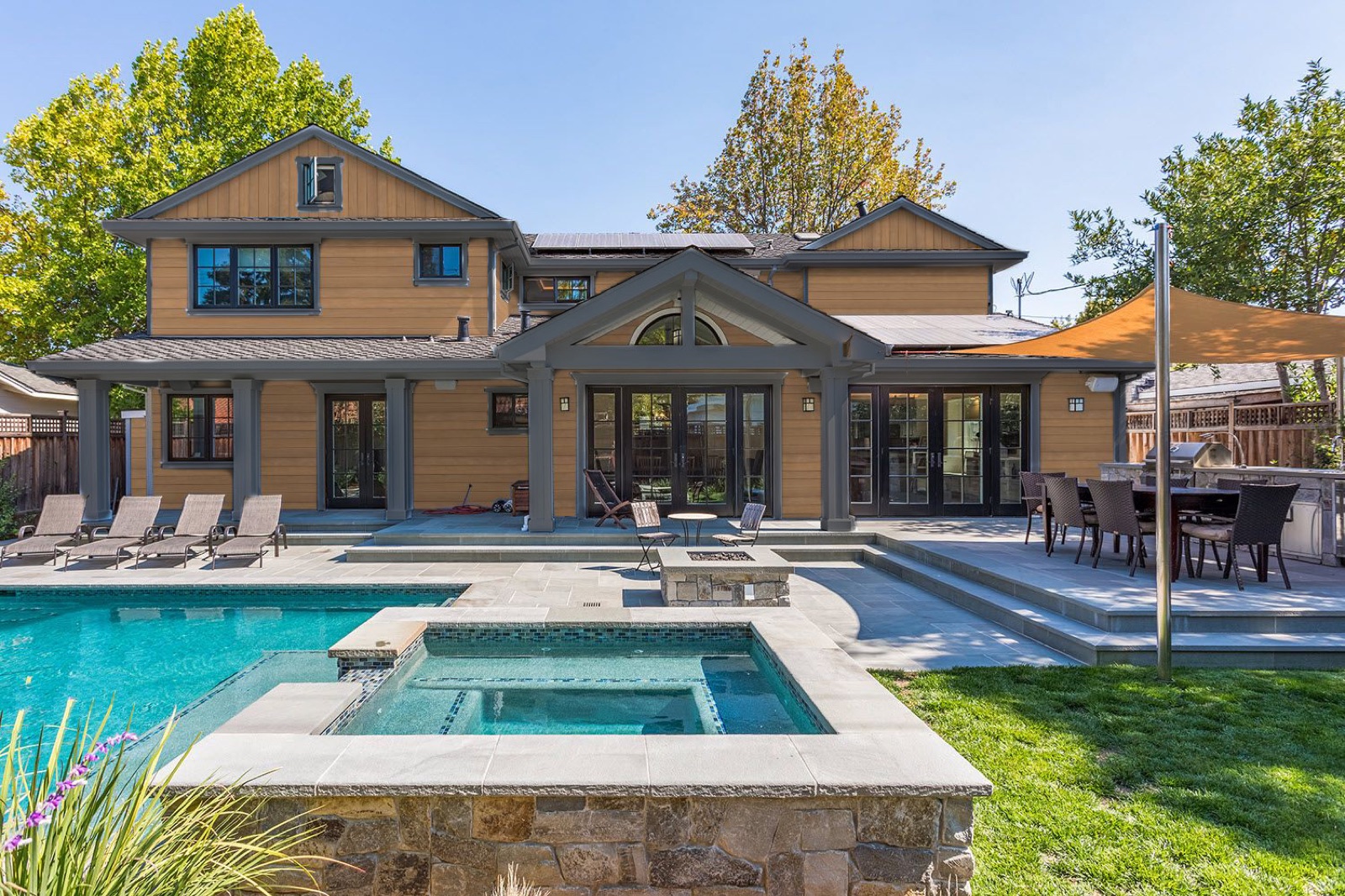
Two properties nobody writes into a coastal spec determine daily comfort, which are how hot the boards run in bare feet and how they behave soaking wet. Ipe is dark, and dark surfaces absorb a large fraction of incident solar radiation. On a south or west facing oceanfront deck in July with no shade structure, freshly oiled Ipe gets uncomfortable at midafternoon. Weathered gray Ipe runs cooler than oiled Ipe because the silvered surface reflects more. Garapa, which starts a pale honey yellow, runs noticeably cooler than any of the dark species and is the reason many designers use it on pool decks and on the top run of a walkover where people arrive barefoot.
Traction is the other half. Smooth-planed tropical hardwood with a fresh oil coat is slick when wet, and at the beach it is wet with salt water, pool water and sand slurry. Options that work include letting the surface weather before heavy use, specifying a lightly textured or wire-brushed face, or using a board profiled with a fine reeded pattern on one side. On any run the public uses, look at the ADA Accessibility Standards maintained by the U.S. Access Board before finalizing the layout. The relevant details are slip resistance, the half inch limit on openings in the walking surface, and orienting elongated gaps perpendicular to the direction of travel so a cane tip or a wheel does not drop in.
Pool Surrounds Are the Harshest Wood Application on a Beachfront Lot
A pool deck at the ocean combines everything that degrades a finish, which is why the species that works there is chosen for how it looks unfinished. Splash-out carries sanitizer onto the boards. Saltwater chlorine generator systems put a mild brine on the surface every time a swimmer climbs out. Sunscreen oils soak in and hold dirt. Standing water sits in the low spots of any surround that was not sloped, and shaded sections grow black mildew on the film of oil and body oil left behind.
Two practical consequences follow. First, plan for extractive bleed. Freshly milled dense tropicals leach tannins and colored extractives for the first several rain cycles, and that runoff stains light concrete coping, travertine and painted risers. Pre-weathering the material or masking adjacent finishes during the first season prevents a callback. Second, pitch the surround and keep the frame open. Water has to leave the surface and then leave the structure, and a pool deck built dead flat over a solid membrane will hold water at every fastener head.
Hardware in a pool splash zone is a 316 stainless decision with no debate attached, including hidden fastener clips, joist hangers within the splash radius, and the screws that hold the clips.
Elevated Decks and Dune Walkovers Are Code Jobs Before They Are Design Jobs
Coastal decks get reviewed for wind uplift, flood detailing and connection capacity long before anyone asks which hardwood is on top. An elevated deck on piles in a high-wind coastal zone has to transfer uplift through the deck boards to the joists, through the joists to the beams, and down the posts to the foundation. The load path is continuous or it is not a load path. The American Wood Council publishes the standards behind residential deck construction and connection design, and the International Code Council publishes the code the inspector is actually holding.
Framing spacing is where hardwood decking differs from the softwood assumption. Dense tropical decking goes on joists at 16 inches on center. Not 24. The material is stiff, but at 5/4 thickness on wide spacing you get perceptible deflection and fastener working, and every bit of movement in a salt environment opens a path for water into a fastener hole.
Dune walkovers add ground contact and abrasion. The posts and stringers live in wet sand part of the year, and blown sand sandblasts the walking surface. Cross-bracing and hold-down hardware take the same 316 stainless rule as everything else. Where the walkover crosses protected dune vegetation, the permit conditions usually dictate elevation above grade, maximum width and open spacing between boards so light reaches the plants underneath, and those conditions drive the board layout more than the species choice does.
The Coastal Shortlist Separates on Durability Class, Surface Heat and 2x Availability
Five tropical hardwoods carry beachfront work in North America, and they sort out on natural durability, how hot they run underfoot, and whether the material can be supplied in true 2x thickness. Ipe (Tabebuia spp.) sits at the top on every axis that matters outdoors. It runs about 3,680 lbf on the Janka scale at roughly 1,050 kg per cubic meter, rates EN 350 Class 1 for durability, and carries an ASTM E84 Class A flame spread rating, meaning a flame spread index of 25 or less, which matters on multifamily and hospitality projects near the water.
Cumaru is the closest performer and is a legitimate primary choice, not a fallback. Jatoba is the value-dense option with good hardness and a warmer red tone that holds color a little longer before silvering. Red Balau and Garapa are the residential-scale species, lighter in weight, easier to handle on a walkover, and cooler underfoot in the case of Garapa. Teak still has a place on boat-adjacent and dock work where feel and traction outrank hardness.
| Species | Janka (lbf) | Density (kg/m3) | EN 350 durability | Color and barefoot behavior | Where it belongs at the beach |
|---|---|---|---|---|---|
| Ipe (Tabebuia spp.) | ~3,680 | ~1,050 | Class 1 | Dark olive brown, silvers gray; runs hot in full sun until weathered | Main elevated decks, boardwalks, piers, any 2x commercial surface |
| Cumaru | ~3,540 | ~1,070 | Class 1 to 2 | Warm medium brown with interlocked figure; runs warm | Main decks and commercial 2x work, strong Ipe alternative |
| Jatoba | ~2,690 | ~910 | Class 2 | Red brown, darkens then silvers; moderate heat | Covered decks, shaded surrounds, 2x commercial where available |
| Red Balau | ~1,700 to 2,000 | ~800 | Class 2 | Red to red brown, silvers evenly; moderate heat | Residential decks and walkovers, engineer-approved 5/4 work |
| Garapa | ~1,700 | ~800 | Class 2 | Pale honey yellow; coolest of the group underfoot | Pool surrounds, residential decks, barefoot arrival areas |
| Teak | ~1,070 | ~660 | Class 1 | Golden brown, silvers quickly; comfortable barefoot, good wet grip | Dock and boat-adjacent surfaces, small feature areas |
| Massaranduba (comparison only, not stocked by J. Gibson McIlvain) | ~3,190 | ~1,150 | Class 1 to 2 | Deep red, checks readily in high sun exposure | Referenced for benchmarking density and hardness only |
Any Coastal Deck the Public Walks On Gets Specified in 2x
Commercial boardwalks, pier decks, plaza surfaces and municipal beach access structures are specified at 2x thickness to control deflection, and that single decision cuts the species list to three. The strength math on a 5/4 board over 16 inch spans can pencil out. No experienced designer goes first with a thinner board on a public job anyway, and the reason is serviceability rather than rupture. People feel deflection. On a boardwalk with a continuous stream of foot traffic, a springy board reads as a defect the day it opens, and the maintenance department hears about it for twenty years.
Only Ipe, Cumaru and Jatoba can be sourced consistently in 2x decking thickness. That filters Red Balau, Garapa and the lighter species out of commercial deck specs regardless of how well they perform residentially. Keep those two categories separate when you write the drawing set. Red Balau and Garapa belong on residential decks and on engineer-approved 5/4 assemblies. Ipe, Cumaru and Jatoba carry the public work.
J. Gibson McIlvain stocks Ipe decking in 5/4 and 2x thicknesses across standard and custom widths and lengths, and ships it nationwide, including regular loads to California and the Gulf Coast. Profiles, thicknesses and available lengths are listed on the Ipe decking page. Volume for a boardwalk phase or a multi-building hospitality project gets scheduled against the drawing take-off rather than pulled off a retail rack.
Surface Checking Is Tension Release, Not a Defect, and It Cannot Be Engineered Away
Dense tropical decking checks at the surface in high-sun coastal exposure, and no supplier can honestly promise otherwise. The mechanism is simple. Sun and wind dry and heat the exposed face faster than the core, the surface tries to shrink against a core that has not moved yet, and the wood relieves that stress by opening fine checks along the grain. The board does not lose strength. Small surface checks are normal in dense hardwood, and on well-seasoned material they are a sign the wood was dried properly rather than rushed.
What reduces them is a stabilizer that slows the moisture gradient. J. Gibson McIlvain factory coats tropical decking with Cutek, a penetrating oil wood stabilizer that significantly reduces checking by moderating how fast the surface gives up and takes on moisture. Site practice keeps the checks small. Take delivery at 12 to 16 percent moisture content and keep it there by storing the bundles covered, off the ground and out of direct sun with air moving through the stack. Seal every field cut end. Do not install kiln-dry material on a rainy week and expect it to hold its gaps.
"Every coastal customer asks the same question, which is how to stop checking, and the honest answer is that you manage it instead of stopping it. We factory coat our tropical decking with Cutek before it ships for exactly that reason, and the crews who take delivery at the right moisture content, keep the bundles covered on site, and seal their cut ends get decks that look right ten years later. The ones who leave a pack of Ipe sitting uncovered on the sand for three weeks in August are fighting the material before they ever pick up a drill." Norm Moton, Director of Sales, J. Gibson McIlvain
Every Hole Gets Drilled on Site, Against the Frame as It Was Actually Built
Tropical hardwood decking is never ordered pre-drilled, and no mill should be drilling fastener holes before a board ships. Layout on a real deck moves. Joists are not perfectly spaced, boards get cut to fit around posts and framing, and the last board in a field gets ripped. Any hole pattern applied at a mill is invalid the moment the crew makes a field cut. Drilling is installation work, done against the frame as it exists.
The technique is consistent. Pilot every hole. Use a self-centering combination bit that drills the pilot and the countersink in one pass so the head seats flush without crushing fiber around it. Two fasteners per board per joist. Hold about three quarters of an inch of edge distance so the pilot is not tearing out the edge. Near board ends, drill full-depth pilots, since that is where dense hardwood splits. Land butt joints on doubled bearing, never on a single joist edge shared by two boards.
Profile determines the fastening system. Shiplap takes visible fasteners, which is fine and is the honest answer on a boardwalk where boards get replaced individually. Only tongue and groove works with hidden fasteners. Material goes down on furring strips or joists with the grooves facing down so water drains out instead of collecting in the profile. On elevated coastal decks that detail matters more than it does inland, since the underside stays damp longer in salt air and the board needs to dry from both faces.
Documentation Travels With Coastal Hardwood on Any Serious Project
On institutional, municipal and hospitality work near the water, the paperwork behind the decking gets reviewed as closely as the grade. Imported hardwood entering the United States carries plant declaration requirements, and the responsible answer is a supply chain that can produce documentation on request rather than one that hopes nobody asks. When using a CITES-listed species, documentation is required and needs to move with the material through every transfer of ownership, so confirm status against the current appendices published by CITES before the species goes into the specification.
Projects chasing green building credits need chain of custody, and FSC certification is the mechanism most design teams recognize. Grading language is worth getting right too. Tropical decking is graded on export rules rather than domestic hardwood lumber rules, though a specifier who works from the National Hardwood Lumber Association framework for interior material will understand the vocabulary. For the technical performance side of assemblies, both Building Science Corporation and WoodWorks publish free material on drying, ventilation and wood in exterior assemblies that holds up under scrutiny.
Design teams working a coastal package can call 800-638-9100 to get species availability, thickness and length ranges confirmed against the actual take-off before the specification section is issued.
Modified Woods and Softwoods Still Have a Role on the Same Elevation
Not every horizontal surface on a beachfront house should be tropical hardwood, and pretending otherwise puts expensive material in places it does not earn its keep. Thermally modified wood and acetylated wood solve specific coastal problems that solid tropicals do not, particularly weight over living space and dimensional stability on rooftop terraces. Thermory and Abodo Vulcan cover the thermally modified category, and Accoya covers acetylated pine. All three come with manufacturer warranties, which is something no solid unmodified wood carries and no honest supplier will offer on one.
Know the length ceiling before you draw a long clear run. Modified products top out around 16 feet, and the metric-length products land just under 16 feet, because the modification kilns are only so long. A 20 foot run in modified material means a joint, so plan the joint rather than discovering it.
Western Red Cedar is a legitimate default for coastal work and performs well, particularly on skirting, screening, soffits and ceilings under an elevated deck. Specify the grade deliberately. Clear vertical grain (CVG) is the stable, knot-free material for finish surfaces and anything getting a coating. Select tight knot (STK) is the character grade for exposed structures and rustic siding where the knots are part of the look. They are not interchangeable, and comparing bids without saying which one you mean produces a comparison that means nothing.
How J. Gibson McIlvain Would Specify This
Write the beachfront spec by exposure zone, then let the species follow the zone. Here is how the sections come together on a real coastal package.
For the elevated main deck, specify Ipe or Cumaru in 5/4 by 6, figuring roughly 2.1 linear feet per square foot for the take-off, on joists at 16 inches on center, factory coated with Cutek, delivered at 12 to 16 percent moisture content. Fasteners are 316 stainless throughout, including clips, screws and joist hardware. Pilot and countersink on site with a self-centering combination bit, two fasteners per board per joist, roughly three quarters of an inch edge distance, full pilots at board ends, butt joints on doubled bearing.
For any public-use surface, boardwalk section, pier deck or municipal beach access structure, go to 2x thickness and restrict the species list to Ipe, Cumaru or Jatoba. Confirm openings and slip resistance against the accessibility standards. Use shiplap or square edge with visible fasteners so a maintenance crew can replace individual boards without pulling a field.
For the pool surround, run Garapa or Ipe with the surface left to weather, pitch the deck for drainage, keep the frame open underneath, and protect adjacent stone and concrete during the first season of extractive bleed. For the dune walkover, Red Balau or Garapa in 5/4 keeps the weight manageable for a crew hand-carrying material over sand, and permit conditions usually dictate the width, elevation and board gap.
Over occupied space or on a rooftop terrace, move to Thermory, Abodo Vulcan or Accoya on a pedestal system and design around the 16 foot length ceiling. For painted exterior trim on the same elevation, specify Sapele rather than Genuine Mahogany. It holds paint better and comes in longer lengths, which matters on the long fascia runs coastal architecture tends to draw.
Skirting, soffits and screening under the deck go to CVG or STK cedar depending on whether the surface is getting a finish or staying rustic. Confirm species, thickness and length availability against actual quantities early. Full details on species, milling and nationwide delivery are at mcilvain.com, or call 800-638-9100 and ask for the decking desk with a take-off in hand.
Frequently Asked Questions
Should the pool surround use the same species as the main beachfront deck?
Not necessarily, and on most oceanfront properties it should not. A pool surround gets walked on barefoot at the hottest part of the day and stays wet from splash-out, so surface temperature and wet traction outrank hardness. Garapa is the common answer there because it starts pale honey yellow and runs cooler underfoot than any of the dark tropicals. Ipe also works well at a pool if the surface is left to weather to gray rather than kept dark with oil, since a silvered surface reflects more solar radiation. Whatever species goes down, pitch the deck for drainage, keep the framing open, and plan for extractive bleed staining adjacent coping and concrete during the first season of rain.
How hot does an Ipe deck actually get in full beach sun, and what can be done about it?
Dark surfaces absorb most of the solar radiation hitting them, and a freshly oiled Ipe deck facing south or west with no shade will be uncomfortable barefoot in midafternoon in July. Three things change that. Letting the deck weather to gray raises reflectance and drops surface temperature relative to an oiled dark finish. Adding a pergola, sail or roof overhang over the primary lounging area solves it outright. Or switch species on the zones people cross barefoot, using Garapa on the pool surround and on the arrival run of a walkover while keeping Ipe or Cumaru on the main deck.
Is tropical hardwood decking slippery at the beach when it is wet?
Smooth-planed dense hardwood with a fresh oil coat is slick under salt water, pool water and sand slurry. The fixes are surface texture and time. A lightly textured or wire-brushed face, or a board profiled with a fine reeded pattern on one side, gives measurable grip. Weathered decking is less slick than freshly oiled decking. On any surface the public uses, check the layout against the ADA Accessibility Standards for slip resistance, the half inch limit on openings, and running elongated gaps perpendicular to the direction of travel.
Can beachfront decking be ordered pre-drilled to save labor on site?
No, and no mill should offer to drill fastener holes before shipping. Joist spacing on a real deck varies, boards get cut around posts and framing, and field cuts move every hole location, so any factory hole pattern is wrong the moment the crew starts fitting. Drilling is installation work performed against the frame as built. Pilot every hole with a self-centering combination bit that cuts the pilot and countersink in one pass, run two fasteners per board per joist, hold about three quarters of an inch of edge distance, drill full pilots near board ends where dense hardwood splits, and land butt joints on doubled bearing.
Why do coastal boardwalks get specified in 2x when the 5/4 span calculation works?
Serviceability rather than rupture. A 5/4 board over 16 inch spacing can satisfy the strength math and still feel springy underfoot, and on a public boardwalk that deflection reads as a defect from opening day. Commercial boardwalks, pier decks and plaza surfaces get specified at 2x thickness to control it. That decision also filters the species list, since only Ipe, Cumaru and Jatoba can be sourced consistently in 2x decking thickness. Red Balau and Garapa belong on residential decks and engineer-approved 5/4 assemblies rather than on public work.
What does a Cutek factory coating do for a deck in salt air?
Cutek is a penetrating oil wood stabilizer applied at the mill before the material ships. It moderates how quickly the surface of a board gives up and takes on moisture, which significantly reduces surface checking in high-sun exposure. It does not eliminate checking, and no supplier can honestly claim that it would. Checking is the wood relieving tension as the exposed face dries and heats faster than the core, it does not weaken the board, and small surface checks are normal on properly seasoned dense hardwood. Site practice keeps them small by controlling moisture content at delivery, covering the stack, sealing field cut ends and keeping air moving under the finished deck.
Does a dune walkover need the same specification as the house deck?
It needs a different one. A walkover is exposed on all six sides, sits in blown sand, and often has posts in wet ground for part of the year, so hardware and ground-contact detailing matter more than board hardness. Red Balau or Garapa in 5/4 keeps the material light enough for a crew hand-carrying it over sand. Cross-bracing, hold-downs and every connector take 316 stainless. Where the walkover crosses protected dune vegetation, permit conditions usually dictate elevation above grade, maximum width and the open spacing between boards so light reaches the plants underneath, and those conditions set the layout before species does.
Are 316 stainless fasteners really necessary, or will hot dip galvanized hold up near the ocean?
Hot dip galvanized protects by sacrificing zinc, and inside the salt spray zone the zinc coating gets consumed on a much shorter schedule than the wood lasts. Copper-based pressure treated framing under the deck accelerates the loss further by setting up a galvanic couple with any plain or lightly coated steel touching it. Type 304 stainless is not the answer either, since it lacks molybdenum and pits in chloride environments. Type 316 carries roughly 2 to 3 percent molybdenum and resists chloride pitting, which is why it is the standing rule for oceanfront decking, hidden fastener clips, joist hangers and structural connectors.
Sources and Standards Referenced
- USDA Forest Products Laboratory
- American Wood Council, Codes and Standards
- United States Access Board, ADA Accessibility Standards
- International Code Council
- CITES, Convention on International Trade in Endangered Species
- Forest Stewardship Council
- National Hardwood Lumber Association
- Building Science Corporation
- WoodWorks, Wood Products Council
- The Wood Database, Ipe