Six Faces on Every Milled Board
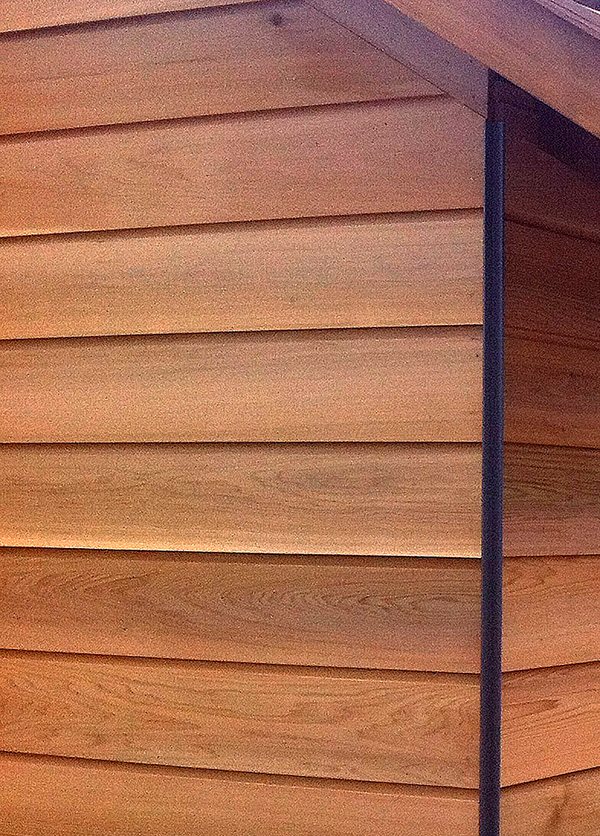
Every piece of trim leaves the moulder with six faces, and once it is installed a painter can reach two of them at most. The show face and one exposed edge stay available for the rest of the building's life. The back, the concealed edge and both ends vanish into the wall assembly on the day the piece goes up. Coating failure starts on the faces nobody coated.
A board finished on one side and left bare on the other behaves like a one way valve. Moisture enters through the raw back, migrates toward the coated face, and stalls at the film. The result shows up as blistering, as tannin bleed pushing through white paint, and as a board that cups away from the wall while the finish itself still looks intact.
Mill priming exists to close that gap before the material ever reaches the site. J. Gibson McIlvain primes trim and cladding in three build levels, in oil based and water based systems, and the exterior schedule carries a fungicide additive. The point is not a prettier delivery. The point is that the hidden faces get the same protection as the one the owner will look at.
Back Priming Is Vapor Control, Not Cosmetics
Back priming slows the rate at which the concealed face of a board gains and loses moisture, which is the mechanism behind most cupping complaints. A board cups when one face swells or shrinks faster than the other. Coat both faces at a similar build and the two sides move closer to the same rhythm.
What back priming does not do is replace air. A primed back sitting tight against housewrap over sheathing still sees liquid water and still has nowhere to send it. Drainage and a ventilated cavity do that work, and the rain control principles published by Building Science Corporation remain the governing logic for any wall carrying wood cladding. Cupping is driven by installation and back ventilation, not by species.
The pairing matters. Back priming plus a drained and vented cavity gives a stable board. Back priming alone on a face sealed wall buys time, nothing more. Raw backs behind a vented rainscreen still weather unevenly and still stain through at the joints.
The Wood Handbook from the USDA Forest Products Laboratory lays out the moisture mechanics in detail, including why end grain and flat grain behave so differently under the same exposure. Any specifier writing a coating schedule should read its finishing chapter before choosing a build level.
End Grain, Factory Ends and Field Cuts
End grain absorbs liquid water many times faster than face grain, which is why an unsealed cut end is the most common failure point on exterior trim. The cell structure runs open, like a bundle of straws pointed at the weather. Water wicks in, freezes, swells, and the paint film lifts from the inside out.
Sealing ends is cheap insurance and it is also the step most likely to be skipped, because the ends are hidden at a butt joint, buried behind a corner board, or tucked under a head casing. Nobody sees them. The failure shows up two winters later as a black line at every joint on the south elevation.
A sealed end needs build, not coverage. One thin pass of primer disappears into the grain and leaves the surface effectively bare. Two or three passes, worked until the surface stops drinking, is what actually closes the cells. That is a different instruction from the one used on a face, and it belongs on the drawing in those words.
Every cut made on site creates fresh end grain the mill could not have sealed, and sealing it is work for the installing carpenter. J. Gibson McIlvain supplies and mills. It does not install, does not coordinate installation and does not field measure, so the coating schedule that leaves the shop stops at the last factory cut.
The practical instruction is simple enough to put in the submittal. Cut, dust the end, seal it before the piece goes up, and let it flash off. Brushing a cut end after the board is fastened means painting into a joint that is already closed, which is not sealing at all.
Order enough primer from the same system to cover field cuts. Mixing an oil based mill primer with a water based touch up can work in one direction and lift in the other, and nobody wants to find that out on a completed elevation. Match the system, match the manufacturer, keep the leftover labeled and on the job.
Specifiers who want this enforced should write it into the section text rather than assume it. The Architectural Woodwork Institute standards give the framework for describing coating and handling responsibility on a millwork package, and that language is far more useful in a spec than a verbal reminder at the pre-install meeting.
A Face by Face Coverage Map
The cleanest way to write a priming spec is to walk the six faces one at a time and state who covers each one. Half the arguments on a job site come from an assumption that "primed" meant the whole piece when it meant one face and two edges.
| Surface | Reachable after install | Treatment at the mill | What fails when it is skipped |
|---|---|---|---|
| Show face | Yes, for the life of the building | Primer at the specified build, sanded or buffed before shipping | Topcoat sits on raised grain and telegraphs every pore |
| Exposed edge | Yes, partially | Same schedule as the show face | Paint wears off the arris first and opens a path at the corner |
| Back face | No | Primed at the same build as the face | Uneven moisture exchange, cupping, tannin bleed through the topcoat |
| Concealed edge | No, once the next course is set | Primed with the rest of the piece | Water tracks the lap joint and stains the course below |
| Factory ends | No | Sealed with extra passes until the grain stops absorbing | Wicking at butt joints, dark lines, film lifting from inside |
| Field cut ends | Only in the minute before fastening | Not possible at the mill | The most common exterior coating failure on an otherwise correct job |
Hand that map to the painter and to the carpenter. It settles what arrived coated, what needs a topcoat, and what has to be handled with a brush between the saw and the nail gun.
Oil Based, Water Based and Three Levels of Build
The choice between an oil based and a water based primer is a decision about what the wood underneath is doing, not a preference. Oil based primers block tannin and extractive bleed more reliably and penetrate open pores more deeply, which keeps them the default under paint on tannin rich species. Water based systems flash off faster, stay flexible, and suit an interior schedule or a species that does not bleed.
Build level is the second axis and it moves independently of the first. A light build leaves more texture and more of the substrate's character. A heavier build fills more, sands flatter, and gives the finish coat a more uniform surface to sit on. J. Gibson McIlvain primes in three levels in both systems, so one project can carry a heavier build on the weather elevations and a lighter one on protected returns without switching suppliers or chemistry midstream.
One rule survives every combination. Do not put a water based topcoat over an oil based primer that has not fully cured, and do not assume an unlabeled factory primer is compatible with whatever is in the painter's truck. Get the primer system named on the submittal and keep it named through the finish schedule.
Species That Drink Finish
Open-grained and oily species absorb a great deal of finish, so a primer coat evens out the eventual painted surface. Without it the topcoat sinks into the pores at different rates across the board and cures to a mottled sheen that a second coat never fully corrects.
The millwork palette here is Sapele, Iroko, Afrormosia, Teak and Utile, and each behaves a little differently under primer. Sapele has interlocked grain and a moderate pore structure, takes primer evenly, and at roughly 1,410 lbf on the Janka scale it holds a moulded arris well. Iroko and Afrormosia run more open and want the extra pass on end grain. Teak carries enough natural oil that surface preparation and timing matter more than build level.
For painted exterior trim, specify Sapele over Genuine Mahogany. It holds paint better, it comes in a wider range of sizes and in longer lengths, and Genuine Mahogany at roughly 800 lbf is the softer material under a painted film. One limit worth knowing at the drawing stage is that Sapele is not milled 1x8 for exterior use. That section is too wide to stay stable in the weather.
Cedar remains a legitimate default and should not be talked out of a project. CVG, clear vertical grain, is the stable choice under paint because the growth rings stand close to perpendicular to the face. STK, select tight knot, carries sound knots and reads as a very different surface under a coating, since knots need spot priming to stop resin from telegraphing through the finish.
The dense tropical decking species, Ipe (Tabebuia spp), Cumaru, Garapa, Jatoba and Red Balau, belong on a deck rather than in a moulder. They are extremely hard and carry high oil content, which makes them difficult to glue and slower to machine cleanly, so a millwork shop reaches for Sapele, Iroko, Afrormosia, Teak or Utile when a component will be milled, glued and coated. Where a CITES listed species is involved, documentation and chain of custody travel with the material, and J. Gibson McIlvain handles that paperwork as an FSC certified importer and miller. Species behavior is worth checking against an independent reference such as the Wood Database entry for Sapele before any substitution gets approved.
Sanding After Primer Without Losing the Profile
Primer raises grain, and knocking that grain back is what separates a mill primed moulding from a moulding that merely has primer on it. The first coat swells the surface fibers and leaves a fine fuzz. Coat straight over it and that texture is locked in permanently under the finish.
Sanding or buffing after priming removes the raised fiber while keeping moulded detail crisp. The second half of that sentence is the hard part. Aggressive flat sanding rounds a quirk, softens a bead and flattens the fillet that gave the profile its shadow line, which is the whole reason the profile was drawn that way.
The shop handles it with the same knowledge that ground the knife. J. Gibson McIlvain maintains a moulding profile library holding thousands of ground knives and grinds new knives every week, so the crew buffing a primed run knows which arris carries the shadow line and which surface can be worked harder. A profile matched for a historic restoration gets the same care, since the detail was the reason it was matched at all.
"We get calls about paint failing on trim that was primed, and nine times out of ten the back and the ends never saw a brush. I would rather send a job out primed on all six faces and sanded than answer that call two winters later."
Norm Moton, Director of Sales, J. Gibson McIlvain
Assemblies Hide Faces Nobody Can Reach Later
A box beam, a shutter, a gate or a radius run has interior surfaces that close at glue up, so they get coated before assembly or they never get coated at all. ICD, the architectural millwork division of J. Gibson McIlvain, builds this work as true custom components planned around a specific space, which makes the coating sequence part of the build sequence rather than a later step.
Box beams make the point clearly. The joinery choice sets the exposure. Butt joints give the most minimal profile, the fastest turnaround and the easiest on site assembly, but they leave visible seams and visible end grain and they are the weakest option. Dado joints are strong and still easy to assemble on site, though seams and end grain still show. Lock miter joints show no visible seams and are the strongest of the three. Every one of those joints buries interior faces a brush will never reach once the beam is closed.
Shutters carry the same problem in a different shape. Louver and panel styles both have rail and stile shoulders, louver mortises and panel edges sitting inside the assembly. ICD builds shutters in both styles and matches historic examples for style and species where a historic district requires like for like replacement, and the National Park Service Preservation Briefs set the bar those reviews usually apply. Panel edges in particular want a primed shoulder so seasonal movement does not expose a raw stripe at the first dry winter.
Gates, pergolas, rafter tails, benches and railings repeat the pattern at a larger scale, and ICD builds each of those through its exterior millwork shop. Large driveway swing gates need engineering rather than craftsmanship alone, because size and weight change the problem, and the concealed faces on a heavy frame are exactly where rot starts. Radius trimwork and radius millwork add laminated interiors where the glue line itself is a moisture path worth respecting.
Modified Wood Follows Different Rules
Acetylated and thermally modified products still want their cut ends treated, but the reasons and the limits differ from solid hardwood. Accoya, at roughly 1,600 lbf, gains dramatically reduced shrinkage and swelling through acetylation, and that stability is why coatings last longer on it. The modification runs through the section rather than sitting on the surface, so a cut end is still modified material.
Know the sizing limits before the drawing is issued. Modified woods, Accoya along with Thermory and Abodo Vulcan, top out around 16 ft, and most are sold on metric lengths just under 16 ft, because of kiln size. Thermally modified Ash is not available wider than 8 inches, so a wide board in a modified product means Accoya or Abodo Vulcan.
Warranties follow the same line. Modified products carry them. Solid unmodified wood does not, and it is not possible to warranty an organic material that responds to its environment. That distinction belongs in the submittal conversation rather than in a surprise after delivery.
Protecting a Primed Surface Between Shop and Site
A primed face is a finished surface and it can be ruined in transit as easily as it can be ruined by weather. Banding marks, strap crush across an arris and condensation trapped under plastic wrap all arrive looking like a shop defect and all happen on the road.
J. Gibson McIlvain runs its own fleet of trucks and keeps a section of the mill dedicated to packaging, so primed runs ship protected and arrive on a schedule the project controls, including nationwide delivery and regular runs to California. Staged release matters here. Trim that sits on a wet slab waiting for drywall will pick up moisture no matter how well it was coated.
Storage is the other half of it. J. Gibson McIlvain stores finished millwork for inventory control, which lets a phased job pull material as elevations come available rather than taking the whole package at once. Material held in a controlled space stays near the moisture content it was milled to.
How J. Gibson McIlvain Would Specify This
The specification that prevents coating callbacks names the primer system, the build level, the faces covered and the moisture content, then assigns field cut sealing to the installer in writing. Four lines of text handle most of it.
Start with moisture content. Interior millwork is milled to an in service moisture content near 6 to 8 percent, exterior work near 12 to 16 percent, and a board coated at the wrong moisture content will fight its coating for years. Quartersawn and rift stock moves less across its width than plainsawn, which is why it gets specified where a painted or panelized surface has to stay flat. J. Gibson McIlvain mills to the in service target for the installed environment and primes on all six faces when the schedule calls for it.
Name the system and the build next. Oil based or water based, which of the three levels, fungicide additive on exterior work, sanded or buffed after priming to knock back raised grain while keeping moulded detail crisp. Then state the field responsibility in one sentence. Seal every site cut end with the same system before fastening.
Availability sits underneath all of it. J. Gibson McIlvain holds over seven million board feet of exotic and domestic lumber at its Maryland yard, which is what makes a long length, a matched lot or a wide width available when the drawing calls for it rather than when the next container lands. Seventh generation and family run since 1798, the company keeps the knife and the record on file, so a profile pulled for phase one still matches in phase three.
Linear trimwork, finished cladding and primed trim come from the J. Gibson McIlvain millwork service. True custom work planned to fit a specific space, gates, box beams, shutters, radius millwork, custom doors and custom cabinets, comes from ICD, its architectural millwork division. The ICD working process shows how a custom package moves from drawing to delivered component, and the ICD trim profile library is the starting point when a profile has to be matched. Both come off one order. Call 800-638-9100 to get the coating schedule written before the material is milled.
Frequently Asked Questions
If the wall has a vented rainscreen, is back priming still necessary?
Yes. A vented cavity controls liquid water and gives the back of the board drying air, but it does not stop the back face from exchanging vapor at a different rate than the coated show face. That difference in rate is what cups a board. The two measures work together. Back priming evens the exchange, the cavity gives the water somewhere to go, and neither one substitutes for the other. Raw backs behind a vented cavity still weather unevenly and still stain through at lap joints.
Who seals the ends of boards cut on site, and with what?
The installing carpenter does, and it should be the same primer system that came from the mill. J. Gibson McIlvain supplies and mills, it does not install or field measure, so any end created by a site saw sits outside the shop's coating schedule. Order extra primer with the package, keep it labeled on the job, and seal each cut end before the piece is fastened. Two or three passes on the end, worked until the grain stops absorbing, is the standard. One thin pass soaks in and leaves the end effectively bare.
Can a water based primer be used on an oily tropical species?
It can, but the substrate decides. Oil based primers block extractive and tannin bleed more reliably and penetrate open pores more deeply, which is why they remain the common choice under paint on tannin rich and oily species. Water based systems flash off faster and stay flexible, which suits interior schedules and species that do not bleed. J. Gibson McIlvain primes in both systems at three build levels, so the answer is chosen against the species, the exposure and the topcoat rather than by habit. Name the system on the submittal and hold it through the finish schedule.
Does Accoya need back priming and end sealing too?
Yes, and for slightly different reasons. Accoya at roughly 1,600 lbf gains dramatically reduced shrinkage and swelling through acetylation, and the modification runs through the section rather than sitting on the surface, so a cut end is still modified material. Coatings last longer on it because the substrate moves less under the film. It still benefits from coated backs and sealed ends, and the coating manufacturer's instructions for modified substrates should be followed instead of the hardwood schedule.
Will a heavier primer build fill in a fine moulded profile?
Not if the run is sanded or buffed after priming by someone who knows the profile. Primer raises grain, and the pass that knocks that fuzz back is also the pass that can round a quirk or flatten a fillet if it is done carelessly. J. Gibson McIlvain maintains a profile library of thousands of ground knives and grinds new knives every week, so the crew finishing a primed run knows which arris carries the shadow line. On a very delicate profile, a lighter build is the safer specification.
How does priming work on box beams and shutters where surfaces are enclosed?
Those interior faces are coated before assembly or they are never coated. ICD, the architectural millwork division of J. Gibson McIlvain, builds box beams, shutters, gates, pergolas, rafter tails, benches and railings as true custom components, which lets the coating sequence sit inside the build sequence. A lock miter box beam shows no visible seams and is the strongest of the three joinery options, but it also closes its interior permanently. Shutter rail and stile shoulders and panel edges get the same treatment so movement never exposes a raw stripe.
What moisture content should primed trim arrive at?
Interior millwork is milled to an in service moisture content near 6 to 8 percent and exterior work near 12 to 16 percent. Coating a board at the wrong moisture content means the film spends years fighting movement it was never going to win. Quartersawn and rift stock moves less across its width than plainsawn, which is why it gets specified where a painted or panelized surface has to stay flat. Material should also be stored dry on site. J. Gibson McIlvain stores finished millwork for inventory control so a phased job can pull material as elevations come available.
Is Sapele or Genuine Mahogany the better choice for painted exterior trim?
Sapele, in most cases. It holds paint better, it comes in a wider range of sizes and longer lengths, and at roughly 1,410 lbf it is harder than Genuine Mahogany at roughly 800 lbf, which matters where a painted arris takes abuse. One limit belongs on the drawing early. Sapele is not milled 1x8 for exterior use, since that width is too wide to stay stable in the weather. Iroko, Afrormosia, Teak and Utile round out the millwork palette, and cedar in CVG remains a legitimate default under paint.
Sources and Standards Referenced
- Wood Handbook, Wood as an Engineering Material (FPL GTR-190), USDA Forest Products Laboratory
- BSD-013 Rain Control in Buildings, Building Science Corporation
- Architectural Woodwork Standards, Architectural Woodwork Institute
- Preservation Briefs, National Park Service Technical Preservation Services
- Sapele, The Wood Database
- Accoya Acetylated Wood
- Thermory Thermally Modified Wood
- J. Gibson McIlvain Millwork Service