Read the Document at Quote Time
A warranty on acetylated or thermally modified wood is a conditional instrument, and nearly every condition inside it is work somebody other than the manufacturer has to perform. The page arrives looking like a guarantee. It reads better as a checklist. One part describes what the manufacturer will stand behind in its own production. The rest describes, at length, the conditions that keep that promise alive once the material leaves the kiln.
Claims fail in the second part. A buyer calls after a board has moved and wants to talk about the wood. The manufacturer asks about the coating system that went on it, the interval it went on by, and who cut the end now sitting against a sill. None of those questions are about the mill run.
That is why the document belongs in the submittal, not the claim file. Ask for the manufacturer's current published warranty and its installation literature while the coating is still being selected and the shop drawings are still open. Once the material is on the wall, the answer to every question is whatever the installer already did.
What the Document Is Actually Insuring
A modified wood warranty insures the manufacturer's own process, not the assembly the material ends up in. The modification happens in a controlled plant under measured conditions. That is the part the manufacturer controls, and that is the part it will stand behind.
Everything downstream belongs to other parties. The architect draws the detail. The general contractor buys the fasteners. The installer sets the rainscreen gap and seals the cut ends. The owner books the recoat. The supplier mills, primes and delivers. Five different hands touch the material between the kiln and the first winter, and the document names conditions that land on four of them.
Who issues it matters too. It comes from the manufacturer, which for Accoya means the acetylation licensor and for Thermory and Abodo Vulcan means the respective producer. A distributor or a lumber dealer does not write it, cannot amend it and cannot widen it. What a good supplier does is hand the current version over, unaltered, with the quote.
The Coating System Carries the Most Conditions
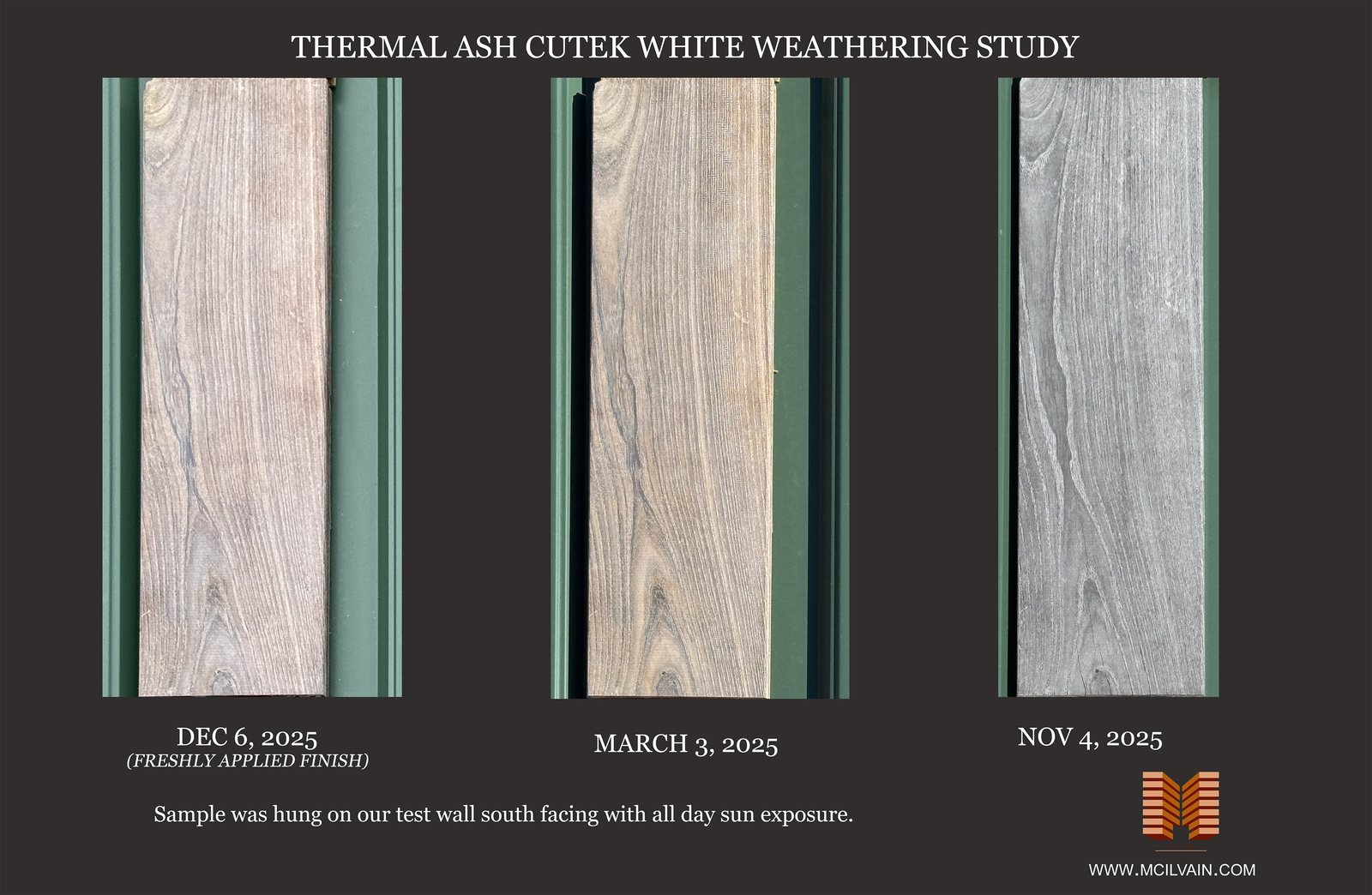
More modified wood claims die on the coating condition than on any other category in the document. Manufacturers publish coating guidance because film behavior on a modified substrate is not identical to film behavior on untreated stock, and the published guidance is what the warranty points back to.
The conditions in this category tend to cover which classes of product qualify, how many coats the system requires, whether all faces and all edges get covered before the board is installed, and how often the film has to be renewed. None of that is the manufacturer's labor. A painter does it, on a schedule somebody has to keep.
Priming before delivery removes a large share of the risk, since a board primed in the shop gets covered on faces and edges under controlled conditions instead of on a rack in the weather. J. Gibson McIlvain primes in three levels, in oil based and water based systems, with a fungicide additive on exterior work. Open-grained and oily species absorb a great deal of finish, which is the same reason an exterior Teak or Iroko detail reads unevenly under paint when it goes up raw, and a primer coat evens out the eventual painted surface. Sanding or buffing after priming knocks back grain raising while keeping moulded detail crisp.
What a shop cannot do is pick the topcoat for a project it is not installing. For the qualifying product list and the recoat language, go to the manufacturer. Accoya, Thermory and Abodo each publish their own coating and warranty literature, and those documents govern.
End Grain, Field Cuts and the Cut List
Every cut made after the material leaves the shop creates a new surface the warranty expects somebody to treat. A factory end and a field end are not the same condition. One was sealed under a controlled process. The other was made with a circular saw on a sawhorse in the middle of the afternoon.
This is where the cut list quietly becomes a warranty question. All of the modified products top out around 16 ft, and most are sold on metric lengths that land just under 16 ft, which is a function of kiln size. A long elevation therefore gets joints. Each joint is a pair of fresh ends, and each fresh end is an obligation sitting with whoever makes the cut.
Planning the run against those lengths reduces the count. So does ordering components cut to length by the mill rather than on site. J. Gibson McIlvain mills modified stock into linear trimwork, finished cladding and primed trim, and a package that arrives at or near final length leaves the installer fewer ends to seal and fewer chances to skip one.
Width constrains the same decision. Thermally modified Ash is not available wider than 8 inches, so a wide board detail moves the order to Accoya or Abodo Vulcan, which changes which manufacturer's document governs the job and which coating literature the painter has to follow.
Fasteners, Flashing and Contact Metals
Fastener and hardware conditions are written into modified wood warranties, and the buyer's hardware package decides whether they are met. The document names which fastener classes qualify and what it expects of metal in direct contact with the board. It does not supply any of it.
That matters on a job where fasteners are bought on price, where a trim screw comes from a different vendor than the cladding clip, or where a flashing detail puts an unrelated metal against the back of a board. A substitution made in a purchasing office can land outside the published condition without anybody on the drawing side ever seeing it.
Read the fastener section against the actual submittal rather than against habit. General practice around fasteners in treated and modified wood is documented by bodies such as the American Wood Protection Association, and material compatibility standards sit with ASTM, but the governing text for a claim is the manufacturer's own published list.
Ventilation and the Installer's Share
The largest single block of conditions in a modified wood warranty describes installation, and no supplier can satisfy any of it. Back ventilation, drainage, clearances, fastening pattern and board orientation are all installer decisions, and they are all referenced in the document.
Cupping is the clearest example of why. Cupping is driven by installation and back ventilation, not by species. A board that cannot dry from both faces behaves differently than the same board on a drained and vented assembly, and the manufacturer will look at the assembly before it looks at the board. The physics behind that is laid out in the Building Science Corporation digest on rain control.
J. Gibson McIlvain supplies and mills. It does not install, coordinate installation or field measure. That boundary is worth stating plainly in a warranty discussion, because it tells a buyer exactly where responsibility transfers and who has to be held to the installation conditions on the schedule. The installer, or the general contractor who hired the installer, owns that block.
Maintenance Intervals Are a Records Obligation
A maintenance condition is not satisfied by doing the maintenance, it is satisfied by being able to prove it was done. Inspection and recoat conditions run for the life of the document, and the party holding the warranty is the party who has to produce the evidence.
On a commercial building that means somebody in facilities needs the product data sheets, the coating records, the dates and the photographs in a file that survives staff turnover. On a residence it means the homeowner keeps a folder. Neither happens automatically, and neither is the supplier's job.
Set the obligation at closeout rather than discovering it late in the building's life. Ask the manufacturer's literature what evidence a claim requires, then write that list into the operations and maintenance package while the project team is still assembled. Historic properties carry a parallel habit worth copying, since the National Park Service technical preservation program treats documentation of what was done to a building as part of the work itself.
It helps to know what a claim looks like before one is needed, because the shape of it explains why the records matter. A claim opens with the manufacturer, not with the supplier and not with the installer. The first request is almost always for evidence that the conditions were met: the product identification, the coating system and its application record, the fastener submittal, photographs of the cavity and the fastening, and the dates. Only after that does anyone look at the board.
Two practical consequences follow. The first is that a claim made by a party who was not keeping records is a claim made without evidence, and the manufacturer is entitled to say so. The second is that the evidence has to be gathered by people who are usually gone by the time it is wanted. A photograph of an open cavity exists for about a week on most jobs, and nobody can reconstruct it later.
Transfer is worth settling at the same time. Whether a document follows the building to a new owner or stays with the party who bought the material is something the manufacturer's text answers, and it is a question that surfaces on resale rather than at handover. Read it while the project team is still assembled and record the answer in the closeout package next to the maintenance interval.
Warranty Conditions Sorted by Who Owns Them
Sorting the document by responsible party, rather than reading it top to bottom, shows how little of it the manufacturer or the supplier controls. The categories below are the ones a modified wood warranty actually contains. What each one says belongs to the manufacturer's published text and should be read there.
| Condition category | What the document asks for | Who owns it on the project | When the evidence has to exist |
|---|---|---|---|
| Material identity | That the product installed is the warranted product, in the warranted grade and form | Specifier and supplier | At order and at delivery |
| Coating system | A qualifying product class, applied to the required faces and edges, renewed on the published interval | Painter, with the shop covering the primer stage | Before installation, then at every recoat |
| End grain and field cuts | Treatment of every surface created after the material leaves the shop | Installer | At the moment of each cut |
| Fasteners and contact metals | Fastener classes and metals permitted in contact with the board | Purchasing and installer | At hardware submittal |
| Installation detail | Back ventilation, drainage, clearance and fastening pattern | Installer and general contractor | During installation, documented on site |
| Site handling before install | Protection of the material between delivery and installation | General contractor | From delivery to install |
| Maintenance and inspection | Inspection and recoat on the published interval, with records | Owner or facilities | Continuously, for the life of the document |
| Use limitations | The applications and exposures the product is warranted for | Specifier | At design, before the order is placed |
What the Supplier Hands Over, and When to Ask
A supplier cannot write a warranty, but it can put the right document and the right production record in a buyer's hands before the order ships. J. Gibson McIlvain hands the manufacturer paperwork over with the quote rather than after the truck leaves, and there are three things worth asking for.
The first is the manufacturer's current published warranty and installation literature for the exact product being quoted. Versions change. The copy saved in a project folder two years ago may not be the copy that governs this order.
The second is documentation tying the delivered material to that product, which means the species, the modification process and the sourcing record. J. Gibson McIlvain keeps the species, the modification process and the sourcing record against the order, and as an FSC certified importer and miller it sends chain of custody documentation with the material as a matter of routine rather than as a favor. The rules behind that paperwork are published by the Forest Stewardship Council.
The third is a record of what the shop did to the board. J. Gibson McIlvain stocks Accoya, Thermory and Abodo Vulcan at its Maryland yard, mills them to profile, primes them and ships nationwide, and each of those steps is a fact a manufacturer may ask about later. The company's millwork services run on the same order as the lumber, and its architectural millwork division, ICD, builds custom components from the same stock, including the exterior millwork that tends to carry the hardest exposure on a building.
"Half the warranty questions I get come in after the material is already on the wall, and by then the answer is whatever the installer did. The ones that go well start at the quote, when somebody asks me for the manufacturer's current document and reads it before the coating gets picked."
Norm Moton, Director of Sales, J. Gibson McIlvain
Why Solid Unmodified Wood Carries No Warranty
Warranties exist on modified products and on nothing else, because it is not possible to warranty solid unmodified wood, an organic material responding to its environment. No reputable supplier will write one. A board that has not been through a modification process keeps answering to moisture, and nobody controls the weather on the far end of a delivery.
That does not make unmodified species the weaker choice. It moves the control from a document to the specification. Grade, sawing pattern, moisture content at delivery and a written description on the order are what govern performance on an unmodified package, and they do it before the material ships rather than after a failure. A specification written that carefully is doing the same job a warranty does, with the difference that it is enforced at the receiving dock instead of in correspondence two winters later.
Cedar deserves the same reading. It is the default cladding species for most contractors and it rarely fails, and the decision that matters there is the grade call rather than the species call. CVG, clear vertical grain, and STK, select tight knot, are different products with different expectations, and the Western Red Cedar Lumber Association publishes the grade definitions.
Most buildings carry both instruments at once. The modified cladding has a document behind it. The unmodified sills, the interior trim and the hardwood components do not, and nothing is wrong with that. What causes trouble is a submittal that does not say which elements fall under which, so a question about a piece of trim gets routed to a manufacturer who never made it. Mark the warranted items on the schedule. Comparative density and movement figures for the unwarranted species are collected at the Wood Database, and the underlying wood science is published by the USDA Forest Products Laboratory.
How J. Gibson McIlvain Would Specify This
Put the warranty into the submittal process as a document to be reviewed, not as a certificate to be filed. Request the manufacturer's current published warranty and installation literature with the quote, read the conditions by category, and assign each category to a named party in the project record before the order is released.
Specify the coating decision early enough that the shop can prime to it. Exterior work is milled near 12 to 16 percent in-service moisture content and interior millwork near 6 to 8 percent, and a board primed on all faces and edges in the shop arrives having already satisfied the part of the coating condition that is hardest to control in the field.
Plan the elevation against the available lengths so the field cut count drops, and confirm the width requirement before the species is locked, since that one dimension can decide whether Accoya, Thermory or Abodo Vulcan is the product the warranty is written against. Then write the maintenance evidence requirement into the closeout package while the team still exists.
To get the quote, the milling, the priming and the manufacturer paperwork moving on the same order, call J. Gibson McIlvain at 800-638-9100 or reach the company through mcilvain.com.
Frequently Asked Questions
Who actually issues the warranty on Accoya, Thermory or Abodo Vulcan, and can my supplier change it?
The manufacturer issues it. For Accoya that is the acetylation licensor, and for Thermory and Abodo Vulcan it is the respective producer. A lumber supplier or distributor cannot write, amend, extend or narrow the document. What a supplier can do is hand over the manufacturer's current published version with the quote, along with the installation literature it references, so the project team reads the governing text rather than a summary of it. J. Gibson McIlvain stocks Accoya, Thermory and Abodo Vulcan and passes the manufacturer paperwork along with the order.
When in the project should I request the warranty paperwork?
At quote, while the coating is still being selected and the shop drawings are still open. Published versions change, so a copy saved in a project folder from an earlier job may not be the one that governs the current order. Reading it at that point lets the specifier assign each category of condition to a named party before material is released, which is the only moment when the coating choice, the fastener package, the ventilation detail and the maintenance record obligation can all still be adjusted.
Which warranty conditions are the ones claims usually fail on?
The coating system and the installation detail. Coating conditions cover which product classes qualify, how many coats go on, whether all faces and edges are covered before the board is installed, and how often the film is renewed. Installation conditions cover back ventilation, drainage, clearances and fastening. None of that work belongs to the manufacturer, which is why a claim conversation turns into a conversation about the painter and the installer long before anybody examines the board itself.
Does buying modified wood primed in the shop help with the warranty?
It removes the part of the coating condition that is hardest to control on a job site. A board primed in a shop gets its faces and edges covered under controlled conditions rather than on a rack in the weather. J. Gibson McIlvain primes in three levels, in oil based and water based systems, with a fungicide additive on exterior work. The topcoat and the recoat schedule still belong to the project, and both have to follow the manufacturer's published coating literature.
Why do field cuts matter so much in a modified wood warranty?
A cut made after the material leaves the shop creates a surface nobody has treated yet, and the document expects it to be handled. Since all of the modified products top out around 16 ft, and most are sold on metric lengths just under 16 ft because of kiln size, a long elevation gets joints and every joint is a pair of fresh ends. Planning the run against the available lengths and ordering components cut to length at the mill reduces how many of those ends the installer has to seal.
Is there any warranty on solid unmodified wood such as Sapele or cedar?
No. Warranties exist on modified products and on nothing else, because it is not possible to warranty solid unmodified wood, an organic material responding to its environment. The control on unmodified species is the specification itself. That means species from the millwork palette of Sapele, Iroko, Afrormosia, Teak and Utile, the correct grade, quartersawn or rift stock where a painted or panelized surface has to stay flat, and an in-service moisture content near 12 to 16 percent for exterior work or 6 to 8 percent for interior millwork.
Does the width of a board change which warranty applies?
It can. Thermally modified Ash is not available wider than 8 inches, so a detail that calls for a wide board moves the order to Accoya or Abodo Vulcan. That changes which manufacturer's document governs the job and which coating and installation literature the painter and installer have to follow. Confirming the width requirement before the species is locked avoids rewriting the submittal after the fact.
Who keeps the maintenance records a warranty claim depends on?
The party holding the warranty. On a commercial building that is usually facilities, which needs the product data sheets, coating records, dates and photographs in a file that survives staff turnover. On a residence it is the homeowner. Neither happens by default, so the practical move is to write the evidence requirement into the operations and maintenance package at closeout, while the project team is still assembled, instead of trying to reconstruct it years later.
Sources and Standards Referenced
- Accoya Modified Wood: product, coating and warranty literature
- Thermory: thermally modified wood product documentation
- Abodo Wood: Vulcan cladding and coating guidance
- Building Science Corporation, BSD-013: Rain Control in Buildings
- American Wood Protection Association: standards for treated wood practice
- ASTM International: materials and compatibility standards
- Forest Stewardship Council: certification and chain of custody
- National Park Service, Technical Preservation Services
- Western Red Cedar Lumber Association: grades and specification
- USDA Forest Products Laboratory: wood science research
- The Wood Database: species density and movement data
- J. Gibson McIlvain Millwork Services