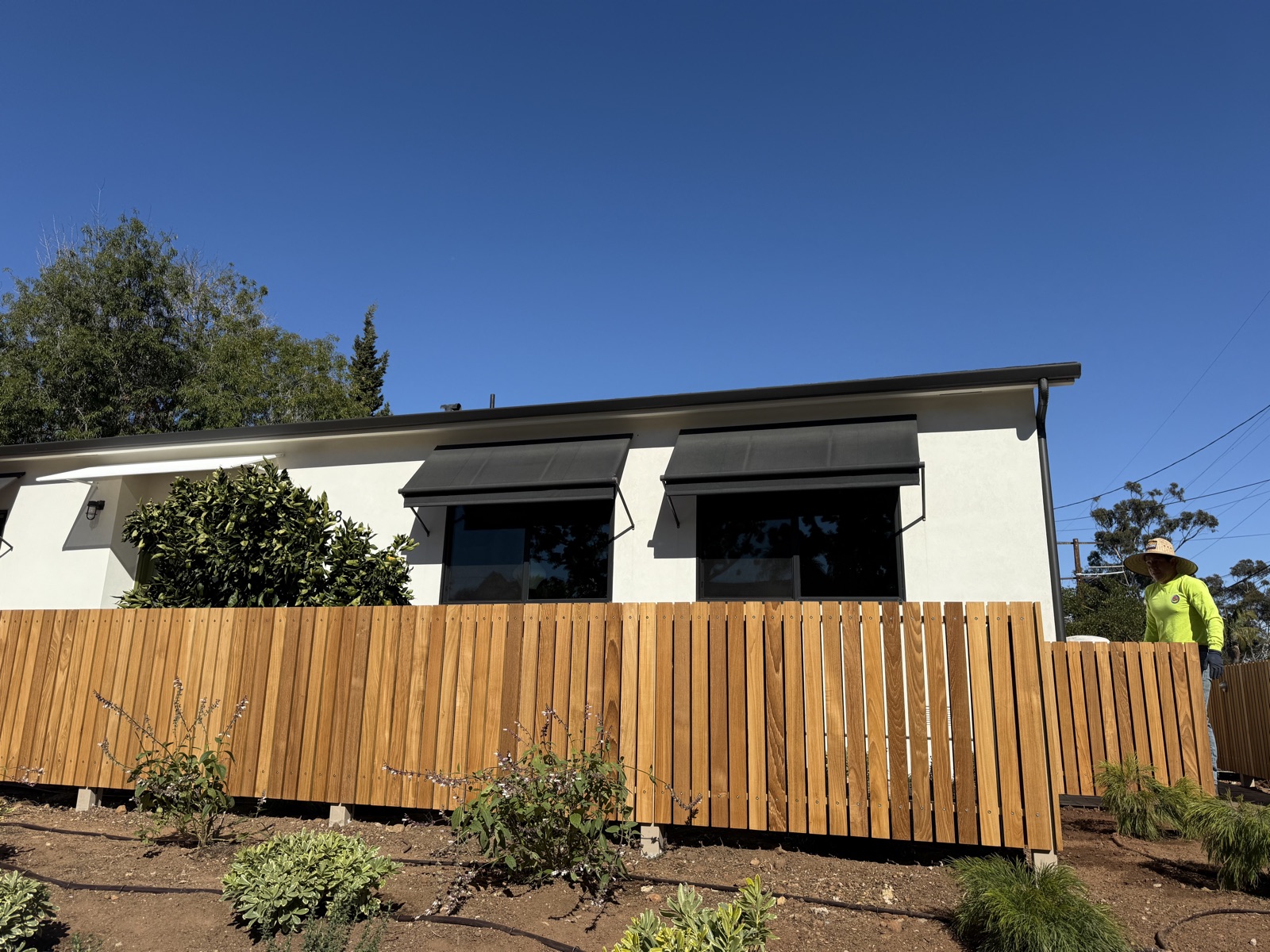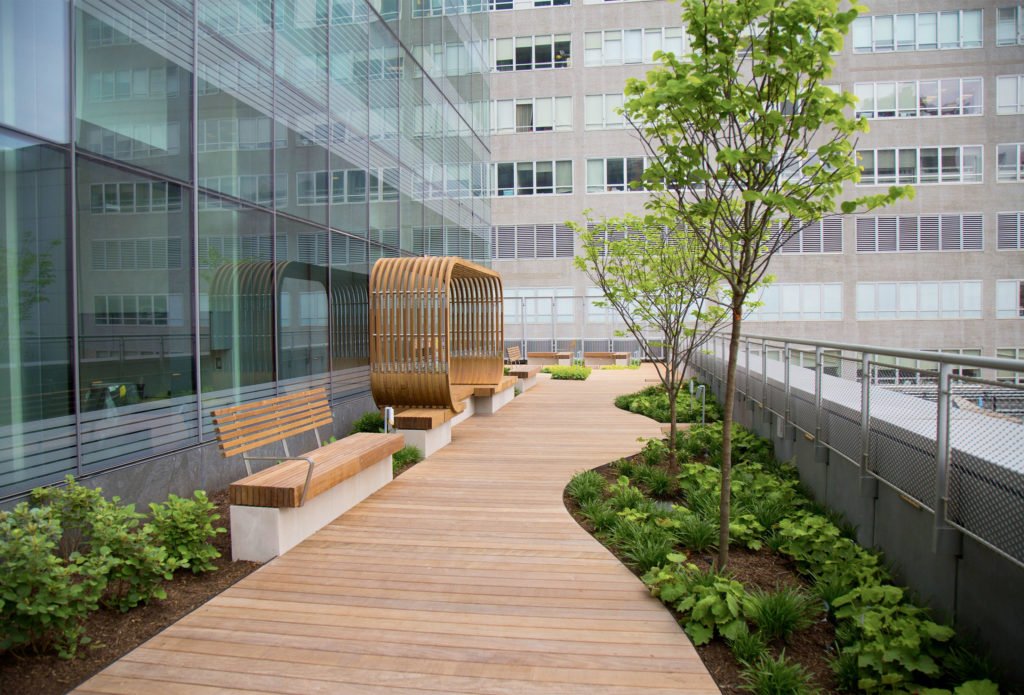
The short answer on modified wood pergola stock
Accoya is the correct default for pergola posts, rafters and beams that have to stay straight and hold a light coating, thermally modified wood belongs in the trellis lath and purlins that carry nothing but their own weight, and any beam longer than roughly sixteen feet stops being a solid modified member and becomes a wood box wrapped around a core. That single set of rules settles most of the questions that come in on pergola packages. A pergola is the hardest assignment in exterior millwork. It gets full sun on the top face and shade on the bottom face of the same beam, it has no roof to shed water, it has horizontal surfaces that hold standing water after every storm, and nobody ever looks at it from more than fifteen feet away. Anything that cups, checks or opens a joint is visible from the patio.
J. Gibson McIlvain supplies Accoya along with Sapele, Iroko, Afrormosia, Teak and Utile for exterior millwork, and ICD, the company's architectural millwork division, mills the pergola as a set of specific parts planned around the specific structure rather than as a kit of stock lengths. The rest of this piece walks the frame part by part, from the post base to the last rafter tail, and explains what each part does across a full year of weather.
What a pergola frame actually does across a year
A pergola does not move as one object, it moves as a stack of parts with different exposures, and the joints fail where two parts move in opposite directions at the same time. The top face of a beam in July sits in direct sun and can run far above ambient temperature while the underside stays shaded and damp. That gradient drives a cupping force across the width of the member every single day, and it reverses at night. Add a rain event and the top face takes on moisture while the bottom face does not. Over a season that differential is what opens a mitered corner and lifts a coating off an edge.
Wood responds to relative humidity, not to calendar dates, and the Forest Products Laboratory Wood Handbook documents the shrinkage coefficients that make this predictable rather than mysterious. Tangential shrinkage runs roughly twice radial shrinkage in most species, which is why a plainsawn beam cups and a quartersawn one mostly does not. Exterior millwork is milled to an in service moisture content near 12 to 16 percent, and J. Gibson McIlvain mills pergola stock into that band rather than to the 6 to 8 percent band that interior trim needs, because an exterior member conditioned to interior moisture content will swell hard in its first spring.
Modification changes the size of the swing, not the direction of it. Acetylated wood and thermally modified wood both reach a lower equilibrium moisture content than unmodified stock and both move less when humidity changes. Neither one stops moving. Good pergola detailing assumes movement and gives it somewhere to go.
Posts, and why the section size decides the species before anything else
The post is the one pergola part where the required section size eliminates most of the species list before the designer has said a word about appearance. A pergola post is usually specified somewhere between a nominal six by six and a nominal ten by ten, sometimes with a plinth and a cap. Solid stock at that section in any species is a problem. Heart center is almost unavoidable in a large solid square, and heart center in an exposed exterior post means a check that runs the full height within two summers. That is not a defect, it is the way a large solid section dries.
Built up posts solve it. A four sided lock miter post over a hollow core, or over a structural column supplied by the project's engineer, has no heart center, no radial check path and a stable wall thickness. Accoya, the acetylated product, is the strongest candidate for that wall stock. Its Janka hardness runs roughly 1,600 lbf, acetylation gives dramatically reduced shrinkage and swelling, and the material is sold in board and dimension sizes that laminate and glue cleanly with exterior adhesives. ICD builds post shells in lock miter because the lock miter shows no visible seam and is the strongest of the three joinery options, where a butt joint gives the most minimal profile and the fastest turnaround but leaves visible seams and visible end grain, and a dado sits between the two.
Where the post has to be solid, the hardwood palette takes over. Sapele at roughly 1,410 lbf, Iroko, Afrormosia, Teak and Utile all mill well at large sections and all glue predictably, which matters because a laminated solid post is still a glued assembly. The tropical decking species, Ipe, Cumaru, Garapa, Jatoba and Red Balau, are extremely hard and carry high oil content, which makes them difficult to glue, so a millwork house reaches for Sapele or Iroko for a glued post and leaves the decking species to the deck itself.
Beams and headers, where thermal modification stops being the right answer
Thermally modified wood is the wrong choice for a pergola beam that carries load, and that is a property of the process rather than a knock on the product. Thermal modification drives the wood to high temperature in a controlled low oxygen kiln, which degrades the hemicellulose that feeds decay organisms and pulls the equilibrium moisture content down. It also reduces bending strength and increases brittleness relative to the unmodified species. Thermory and Abodo Vulcan, both carried here, are excellent cladding, decking, lath and screen materials for exactly that reason and are not marketed as structural members. Put a thermally modified board in a spanning beam and the failure mode is sudden rather than gradual.
Acetylation behaves differently. The process bulks the cell wall chemically without cooking the structure, so Accoya retains the strength characteristics of its base timber while gaining the stability. It still is not a graded structural product in the way a glulam is, and span sizing belongs to the project's engineer working from the load path and the local code. The American Wood Council publishes the design standards that engineer will reference, and the local authority having jurisdiction applies the International Code Council family of codes to the permit.
The practical answer on long spans is the box beam. A steel tube or an engineered core carries the load, and the visible member is a four sided wood box built around it. ICD builds those boxes in lock miter so no seam and no end grain shows on the finished beam, which is the whole point when the underside of that beam is at eye level from a seating area.
Rafters, purlins and trellis lath, and the two hard ceilings
Modified wood tops out at around sixteen feet, most of it sold on metric lengths just under sixteen feet because of kiln size, and thermally modified Ash is not available wider than eight inches. Those two numbers decide more pergola layouts than any aesthetic preference. A drawing that shows a twenty two foot continuous rafter in a modified product is a drawing that has to change, either to a spliced detail over an intermediate beam, to a box assembly, or to an unmodified hardwood that J. Gibson McIlvain can pull in long lengths from over seven million board feet of exotic and domestic lumber held at the Maryland yard.
The width rule matters just as much. A designer who wants a ten inch or twelve inch deep rafter in a modified product is looking at Accoya or Abodo Vulcan, not at thermally modified Ash. Wide boards in a modified product means one of those two. Getting that settled at the drawing stage saves a redesign after the order is placed.
Trellis lath and the upper purlin layer are the easiest parts of the job and the ones most often over specified. Lath carries nothing, sees the most sun and the least inspection, and is the single best use for thermally modified stock on the whole structure. Run it in a modified product, back ventilate it, and it will outlast the fasteners.
| Component | Stock form milled | Species direction | Size ceiling to respect | Seasonal behavior to detail for |
|---|---|---|---|---|
| Post, six by six and larger | Four sided lock miter shell over a hollow or structural core | Accoya wall stock, or Sapele, Iroko or Utile where solid is required | Governed by shell wall stock, not by post height | Heart center checking in solid sections, water entry at the base |
| Primary beam or header | Solid where the span allows, otherwise a lock miter box around an engineered core | Accoya or unmodified hardwood, never thermally modified for load | Just under sixteen feet in any modified product | Sun on top face against shade below, daily cupping cycle |
| Rafter | Solid stock, quartersawn or rift where flatness is critical | Accoya or Abodo Vulcan when depth exceeds eight inches | Thermally modified Ash not available over eight inches wide | Crown orientation, end grain wicking at both ends |
| Purlin and trellis lath | Light solid sections, edges eased on the moulder | Thermory or Abodo Vulcan, both carried, or Accoya | Metric lengths just under sixteen feet | Highest UV load on the structure, coating chalk and fade |
| Rafter tail | Pattern cut tail with a moulded or chamfered edge run on the moulder | Matches the rafter it terminates | Profile depth limited by knife and cutterhead | Exposed end grain, the first point of coating failure |
| Railing and top rail | Milled rail with a weathered or sloped top face | Sapele, Iroko, Afrormosia, Teak or Accoya | Continuous rail lengths drive the species choice | Standing water on a flat top rail, joint opening at posts |
| Bench seat and apron | Narrow slats rather than wide boards, gapped for drainage | Teak, Iroko or Accoya | Slat width kept narrow to limit cupping force | Wet and dry cycling on the seating face |
Rafter tails, the profile library and matching what is already there
The rafter tail is the part of a pergola that a professional judges the whole structure by, and it is the part most likely to need a profile that does not exist in any catalog. A tail on a new build follows the architect's drawing. A tail on an addition has to match the tails on the existing house, which were cut by somebody in 1926 with a template that is long gone. Both jobs come down to the same shop capability.
J. Gibson McIlvain keeps a moulding profile library holding thousands of ground knives and grinds new knives every week, so a tail profile that is already on file gets run from the existing knife and one that is not gets ground to match from a rubbing, a photograph with a scale, or a sample piece. The tail pattern itself is cut from a template, and the edge treatment, whether that is a simple chamfer, a bead, a cyma or an ogee, runs on the moulder. Custom knife grinders sit on the floor next to the moulders for exactly this reason.
End grain on a tail is the weak point on the entire structure. It wicks water at many times the rate of face grain, and it is the first place a coating lets go. The fix is an end seal on every cut end plus a tail profile that sheds rather than collects. A tail that terminates in a flat vertical cut holds a bead of water at the bottom corner after every rain. A tail cut with a slight undercut or a drip does not.
"The pergola drawings that come to us almost always show a beam length that no modified product is made in. We would rather have that conversation at the drawing stage than after the order is cut. Once we know the real span we can tell you whether it is a solid hardwood member, a box beam around a core, or a splice detail, and we can grind the tail profile to whatever is already on the house."
Norm Moton, Director of Sales, J. Gibson McIlvain
Coating and priming, and what arrives ready to hang
Priming before the parts leave the shop is worth more on a pergola than on almost any other exterior assembly, because half the surfaces on a pergola are unreachable once it is assembled. Nobody paints the top of a beam under a rafter after the fact. Nobody coats the inside face of a post shell. Those surfaces are coated in the shop or they are never coated at all.
J. Gibson McIlvain primes in three levels, in both oil based and water based systems, and adds a fungicide additive on exterior primed trim. Open-grained and oily species absorb a great deal of finish, so a primer coat evens out the eventual painted surface. Sanding or buffing after priming knocks back the grain raising that water based systems cause while keeping moulded detail crisp, which matters on a tail profile where a heavy coat would fill a quirk and soften the shadow line.
Coating behavior across seasons is mostly a stability story. Acetylated wood holds a coating far longer than unmodified softwood does, for the simple reason that the substrate underneath the film is not swelling and shrinking enough to break it. That is also why light colors work on Accoya in full sun where they would fail on other stock. Thermally modified wood takes coatings well but comes through the process darkened, so a clear or light finish over it reads as the modified color rather than as the original species, and it will silver under UV like anything else left uncoated. The Building Science Corporation material on rain control covers the drainage and drying logic that decides whether a coating survives.
Fasteners, joinery and hardware that survives the chemistry
Acetylated wood requires stainless steel fasteners and stainless or otherwise compatible hardware, and that requirement is not optional. The acetylation process leaves residual acetic acid in the wood, which attacks ordinary galvanized and plain steel over time. Stainless fasteners, stainless connectors, stainless post bases. The same discipline applies to any hardware buried in the assembly where a corroding fastener would stain the face or fail unseen.
Joinery choice on a pergola follows the same logic as on a box beam. A butt joint is the fastest and the most minimal but it shows a seam and end grain and it is the weakest of the three. A dado joint is strong and still straightforward to assemble on site, and it still shows the seam. A lock miter shows no visible seam and is the strongest. On a pergola post shell that is inspected from three feet away, the lock miter is usually the only acceptable answer, and ICD mills the lock miter members so they register square during on site assembly.
One point on responsibility. J. Gibson McIlvain supplies and mills, and it does not install. Fastener selection in the field, flashing at the post base, the structural connection to the deck or slab and the anchoring detail all belong to the installer and the engineer of record. What comes off the order is stock milled to the right dimension, in the right moisture content band, with the profiles run and the priming done.
Railings, benches and the rest of the package on one order
The reason to buy the pergola, the adjacent railing, the built in bench and the surrounding trim on a single order is grain and color continuity, not convenience. Two Sapele orders placed four months apart will not match, and on a structure where a railing meets a post at eye level that difference is visible. Lot matching across the whole package is a function of yard depth, and J. Gibson McIlvain holds over seven million board feet of exotic and domestic lumber at the Maryland yard, which is what makes pulling a matched run across multiple part families possible in the first place.
Railing top rails deserve one specific note. A flat top rail holds water. A rail with a weathered top face, even a few degrees, sheds it, and that single detail does more for the life of a railing than any species upgrade. Bench slats follow the opposite rule from beams, keep them narrow and gapped so that the cupping force across any one piece stays small and the assembly drains.
Railing geometry on anything that qualifies as a guard is a code matter rather than a shop matter. Height, opening limits and load are set by the applicable code and, where accessibility applies, by the United States Access Board guidelines. The shop mills to the dimensions the drawing carries.
Where unmodified hardwood is still the better call
Modified wood is not automatically the right answer, and there are pergola conditions where Sapele, Iroko, Afrormosia, Teak or Utile beats it outright. Long members are the obvious one. The moment a design needs a clear member past the sixteen foot modified ceiling, the conversation moves to hardwood. Large solid sections are the second. Deep color and visible figure are the third, since a naturally durable hardwood left to weather or kept under a penetrating oil gives a look that a modified product does not.
For painted exterior work, Sapele is the better pick over Genuine Mahogany. It holds paint better and it comes in a wider range of sizes and longer lengths. Sapele is not milled 1x8 for exterior use, that is too wide to stay stable in that thickness. Cupping in the field is driven by installation and back ventilation rather than by species, so a board that cups in service usually tells you something about the fastening pattern and the air path behind it. Reference data on these species is published at The Wood Database, and the National Hardwood Lumber Association grading rules govern how the lumber is sorted before it reaches the mill.
Cedar stays a legitimate default for pergola work and is not a lesser material. The distinction that matters is grade. Clear vertical grain, CVG, gives a quiet, uniform, quartersawn face that stays flat and takes a coating evenly, which is what a painted or stained pergola beam wants. Select tight knot, STK, carries sound knots and reads as a rustic surface, which is exactly right on a rough timber pergola and wrong on a painted one. Choosing between them is a design decision, not a quality ranking.
Two commercial realities travel with the species choice. There are no warranties on solid unmodified wood, and there cannot be, since it is an organic material responding to its environment. Warranties exist only on modified products. And where a specification lands on a CITES listed species, documentation and chain of custody travel with the material. J. Gibson McIlvain is an FSC certified importer and miller, so a project carrying sourcing requirements under the Forest Stewardship Council or documentation obligations under CITES gets the paperwork with the lumber rather than as a scramble at closeout.
How J. Gibson McIlvain Would Specify This
Start from the longest clear member on the drawing, settle the species question there, and let every other part follow from it. That one dimension decides whether the frame is solid modified stock, a hardwood, or a box assembly, and it is the single most common reason a pergola package gets redrawn after it should have been settled.
From there the sequence is straightforward. Confirm every rafter depth against the eight inch ceiling on thermally modified Ash and move anything deeper to Accoya or Abodo Vulcan. Specify posts as lock miter shells rather than solid squares at any section above a nominal six by six. Send the tail profile as a rubbing or a sample if it has to match existing work, because a knife gets ground to match it either way. Decide the coating system before the parts are milled, since primed and unprimed parts are different products leaving the shop. Put the railing, the benches and any surrounding trim on the same order so the lot matches.
Everything on a pergola package comes off the same set of capabilities. J. Gibson McIlvain runs a millwork shop on site at the lumber yard for linear runs, finished cladding and primed trim, and ICD, the architectural millwork division, handles the true custom work planned to fit a specific structure, which on a pergola means the rafter tails, the box beams, the post shells, the railings, the benches and the gates and shutters that frequently come with them. Seventh generation and family run since 1798, J. Gibson McIlvain keeps the knife and the record on file, so phase two of a project three years later runs off the same profile rather than off a fresh interpretation of it. Finished millwork is held in storage for inventory control until the site is ready, and the company ships nationwide on its own fleet of trucks with a section of the mill dedicated to packaging, regularly out to California, which is what keeps a primed and profiled tail from arriving with a crushed edge.
Details on the milling and priming services are at the J. Gibson McIlvain millwork service page, and the custom exterior work, including pergolas, rafter tails, gates, railings and benches, is at ICD exterior millwork, with the shop sequence laid out at the ICD working process page. Bring the drawing, the longest member and the tail profile to the conversation and call 800-638-9100.
Frequently Asked Questions
Can I get a twenty foot Accoya pergola beam in one piece?
No. Every modified wood product, Accoya included, is limited by the kiln or reactor it is processed in, so lengths top out around sixteen feet and most material is sold on metric lengths just under sixteen feet. A twenty foot clear span in a modified product does not exist. The three honest answers are an unmodified hardwood such as Sapele, Iroko or Afrormosia in a long length, a spliced detail located over an intermediate support, or a lock miter box beam built around a steel or engineered core. J. Gibson McIlvain can pull long hardwood members from the Maryland yard, and ICD, the architectural millwork division, builds the box beam version where the span is beyond what any solid stock will do.
Why should a pergola post be a hollow lock miter shell instead of a solid timber?
A large solid square almost always contains heart center, and heart center in an exposed exterior post produces a check that runs most of the post height within a couple of summers. It is normal drying behavior, not a defect, and no species prevents it. A four sided shell removes the problem entirely because there is no pith and no radial path for the check to follow. The shell also lets the post go over a structural column or a steel post supplied by the engineer. Lock miter is the joinery to ask for since it shows no visible seam and is the strongest of the three options, where a butt joint is fastest and most minimal but shows seams and end grain.
Is thermally modified wood acceptable anywhere on a pergola?
Yes, in the parts that carry nothing. Thermal modification lowers equilibrium moisture content and improves decay resistance, but it also reduces bending strength and makes the material more brittle, so it does not belong in a beam or a header that carries load. Trellis lath, the upper purlin layer, screens and adjacent cladding are ideal uses. Thermory and Abodo Vulcan are both carried. Keep in mind that thermally modified Ash is not available wider than eight inches, so a deeper member in a modified product has to be Accoya or Abodo Vulcan.
What moisture content should pergola stock arrive at?
Exterior millwork is milled to an in service moisture content near 12 to 16 percent, not to the 6 to 8 percent band used for interior trim. A member dried to interior moisture content and then installed outdoors will take on moisture through its first spring and swell hard, which opens joints and stresses fasteners. Modified products sit lower and more stably than unmodified stock because the process reduces how much water the cell wall can hold, but the same principle applies. Ask what band the material is being milled into before the order is cut.
Do I need special fasteners with Accoya?
Yes. Acetylated wood retains residual acetic acid, which corrodes ordinary galvanized and plain steel over time. Stainless fasteners, stainless connectors and stainless post bases are required, including for hardware that ends up concealed inside a post shell or a box beam where a failing fastener would not be visible until it stained the face or let go. Fastener selection and the structural connections are the installer's and the engineer of record's call. J. Gibson McIlvain supplies and mills the wood components and does not install.
Can a rafter tail profile be matched to an existing house?
Yes, and it is routine work. J. Gibson McIlvain keeps a profile library holding thousands of ground knives and grinds new knives every week, so a profile already on file runs off the existing knife and anything else gets ground to match. Send a rubbing, a scaled photograph or a physical sample of an existing tail. The tail pattern itself is cut from a template and the edge treatment, chamfer, bead, cyma or ogee, runs on the moulder. The knife and the record stay on file, so a later phase of the same project runs off the same profile.
Is there a warranty on a pergola built from these materials?
Warranties exist only on modified products such as Accoya, Thermory and Abodo Vulcan, and the terms come from those manufacturers. There are no warranties on solid unmodified wood, and there cannot be, since it is an organic material that responds to its environment. That is one practical argument for specifying a modified product on the parts that sit in the worst exposure, and for judging unmodified hardwoods on their natural durability, their track record and how the detailing sheds water rather than on paperwork.
Why do decking species like Ipe and Cumaru not show up in these recommendations?
They are decking materials rather than millwork materials. Ipe, botanically Tabebuia spp, along with Cumaru, Garapa, Jatoba and Red Balau, is extremely hard and carries high oil content, which makes gluing difficult and unpredictable. A pergola is full of glued assemblies, post shells, box beams, laminated members and moulded profiles, so a millwork shop reaches for Sapele, Iroko, Afrormosia, Teak or Utile instead. If the project also includes a deck, that is the right place for the decking species and the two conversations can happen on the same order.
Sources and Standards Referenced
- Wood Handbook, Wood as an Engineering Material, USDA Forest Products Laboratory
- American Wood Council, Codes and Standards
- Accoya Acetylated Wood
- Thermory Thermally Modified Wood
- Building Science Digest 013, Rain Control in Buildings
- The Wood Database, Sapele
- National Hardwood Lumber Association
- Forest Stewardship Council
- CITES, Convention on International Trade in Endangered Species
- International Code Council
- United States Access Board