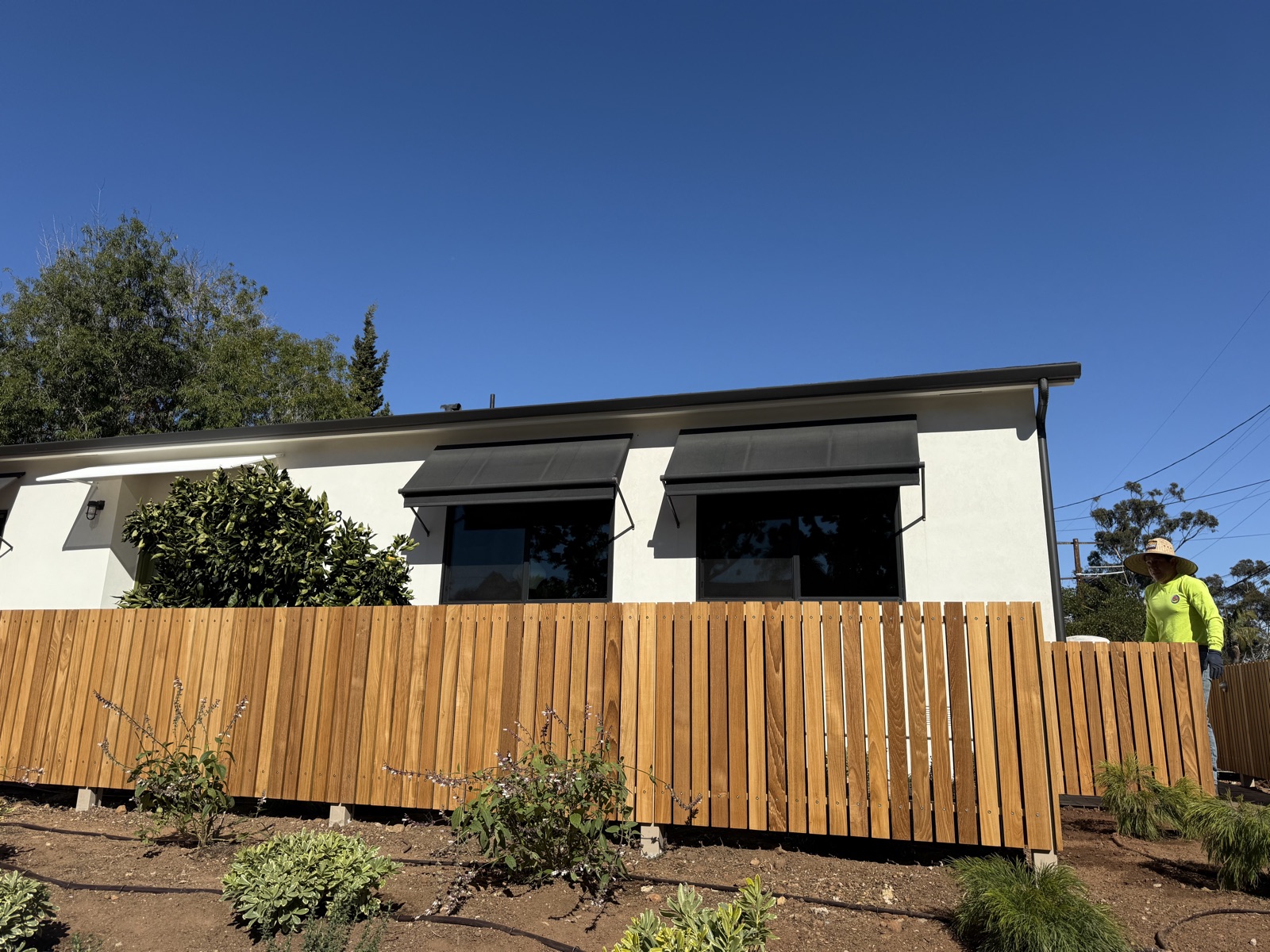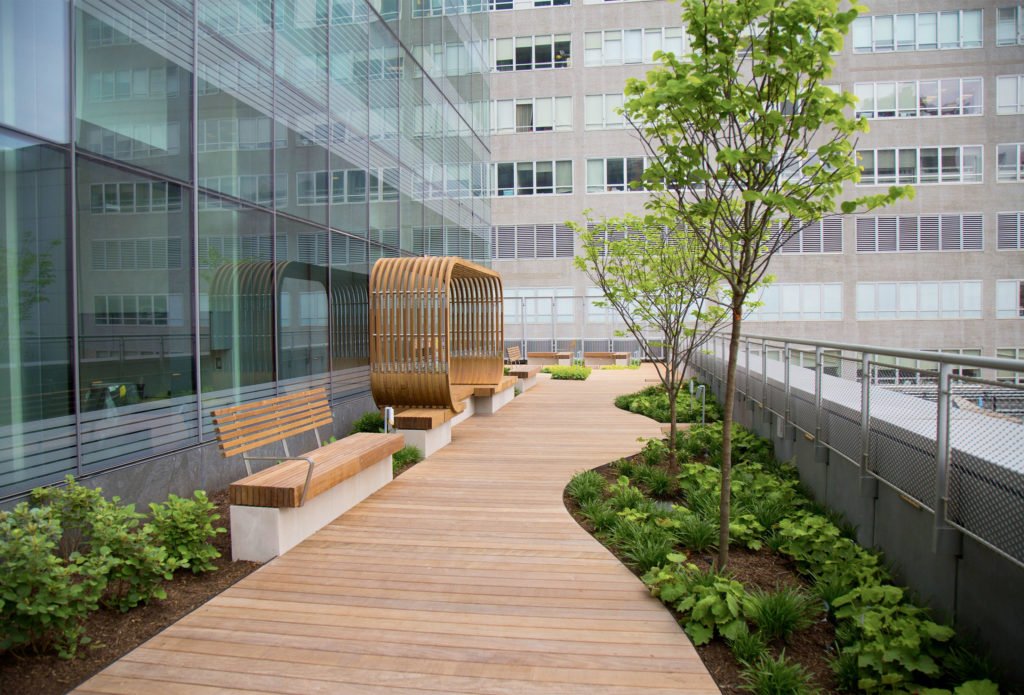
Two Modified Woods, Two Different Jobs
Abodo Vulcan belongs on the wide, flat, coated components of a balcony or entry, and Thermory belongs on the narrow components that take wear, impact and a heel. Both are thermally modified. Both are carried. They are not interchangeable, and the reason sits in the feedstock rather than in the process.
Abodo Vulcan is a modified softwood. The Thermory material that comes up on architectural exteriors is modified ash, a ring-porous hardwood with real density behind it. Heat treatment does similar things to both, driving off bound water, degrading hemicellulose and leaving a board that absorbs far less moisture than it did green. What heat treatment does not do is change the basic character of the raw stock. A modified softwood is still a softwood. A modified hardwood is still dense, still hard on tooling, still the better choice under a shoe.
Specifiers pick the wrong one when they pick on color. Both darken through the full thickness to a brown that photographs beautifully, and both weather to silver if nothing is put on them. Under the moulder and out on the building, they diverge fast. ICD, the architectural millwork division of J. Gibson McIlvain, builds balcony and entry components in both, and the assignment gets made component by component rather than once for the whole package.
The Process Is Shared, the Raw Stock Is Not
Thermal modification is a kiln cycle rather than a chemical treatment, and it buys decay resistance and stability at the cost of toughness. The material goes into a low oxygen chamber and runs up into a temperature band well above a normal drying schedule. Hemicellulose breaks down. The sugars that fungi feed on are largely gone by the time the board comes out, which is where the decay resistance originates, and the cell wall loses much of its ability to take water back on. Equilibrium moisture content drops. Shrinkage and swelling drop with it.
The trade is strength. Modified wood is more brittle than the same species unmodified, with a measurable loss in impact resistance and bending capacity. The USDA Forest Products Laboratory has published extensively on how heat treatment shifts the mechanical properties of wood, and the short version is that nobody should be carrying load on modified material without engineering behind the decision. That one fact settles a large share of the questions that come in about balconies and pergolas.
Acetylated wood sits in a different category and deserves a seat at this table. Accoya is chemically modified rather than heat modified, which is why it keeps far more of its strength while getting the same stability benefit. Accoya runs a Janka figure around 1,600 lbf, above Sapele at roughly 1,410 lbf and above Hard Maple near 1,450 lbf, and its acetylation gives dramatically reduced shrinkage and swelling. On an entry or balcony specification, Accoya is the third product in the conversation and sometimes the correct one.
Width and Length Are the First Filter, Not the Last
Thermally modified ash is not available wider than 8 inches, and every modified product tops out around 16 ft because of kiln size. Run those two numbers against the takeoff before anyone argues about appearance.
A balcony rail cap at 5 quarter by 6 inches sits comfortably inside the ash range. A 10 inch entry pilaster face does not. A 12 inch water table under a door surround does not. When a drawing calls for a wide board in a modified product, the answer is Abodo Vulcan or Accoya, and that is worth settling before the elevations get drawn around a width nobody can supply.
Length is the harder constraint. Modified stock is sold on metric lengths that land just under 16 ft, since the kilns are built to metric chambers and nothing longer fits inside one. A continuous 18 ft balcony cap in modified wood does not exist. The component either gets a designed joint, a scarf with a stainless spline or a deliberate break at a post, or it moves to an unmodified species where J. Gibson McIlvain can pull long lengths straight off the rack. Over seven million board feet of exotic and domestic lumber sits at the Maryland yard, and Sapele in particular comes in a wider range of sizes and longer lengths than most people expect, which is exactly why it takes the long components modified wood cannot cover.
Density Decides Every Horizontal Surface
Anything a person steps on, leans on or drags a bag across should be the modified hardwood rather than the modified softwood. Thermory modified ash carries the density for stair treads on an entry stoop, for bench slats, for a balcony rail cap and for the top surface of a landing. Abodo Vulcan carries width and light weight, which is a different virtue entirely and just as useful in the right place.
The failure mode on an under-specified horizontal is not rot. Modified material resists decay well on both sides of this comparison. The failure mode is denting and edge crush, a soft nose on a tread that goes fuzzy in three seasons, a rail cap showing every ring the last owner left with a planter. Dense stock resists that. Low density stock does not, however stable it is.
Vertical surfaces flip the logic completely. Cladding, shutter stiles and rails, panel fields, entry surrounds, frieze boards and soffits take almost no mechanical abuse, so density buys nothing there and light weight buys plenty. A wide Abodo Vulcan board hangs easier, moves less across the width than a plainsawn unmodified board of the same size, and gives the painter a calmer substrate to work on. Comparative density and hardness figures are easy enough to check species by species, and the gap between a modified softwood and a modified hardwood is not subtle.
Coating Life Is Where Both Products Earn Their Place
Modified wood outlasts unmodified wood under paint for a reason that has almost nothing to do with the wood and everything to do with what the coating film is sitting on. A paint film fails when the substrate underneath it swells and shrinks faster than the film can stretch. Cut the moisture cycling and the film stops cracking at board edges and around fasteners.
Both products deliver that benefit. Abodo Vulcan delivers more of it on wide boards, simply because a wide board has more width to move and therefore more movement to eliminate. Modified ash is open grained, and that is where a real priming schedule starts to matter. J. Gibson McIlvain primes exterior trim in three levels, in both oil-based and water-based systems, with a fungicide additive on anything going outside. Open-grained and oily species absorb a great deal of finish, so a primer coat evens out the eventual painted surface, and a sanding or buffing pass after priming knocks back grain raising while keeping the moulded detail crisp.
Dark surfaces get hot. A south-facing component in a deep brown finish will run surface temperatures that stress a coating film, which is one good argument for a lighter topcoat on an entry door or a balcony cap in full exposure. Building Science Corporation has useful material on solar loading and cladding assemblies, and the same back-ventilation logic applies to millwork. Cupping on an exterior board is driven by installation and back ventilation, not by species.
Machining, Gluing and Fasteners Change With the Product
Modified stock is brittle, mildly acidic and abrasive on tooling, and all three facts show up in how a component gets built. Sharp arrises chip when the knife is dull. Thin sections snap where unmodified stock would flex. Pre-drilling is not optional at board ends, and a fastener set too close to an edge will split a piece that would have taken it green without complaint.
Stainless fasteners are the rule and not an upgrade. Thermal modification leaves acetic acid behind in the wood, and that acidity will chew through a plated fastener and bleed a black streak down a painted surface inside a season or two. Type 304 is the baseline and Type 316 belongs anywhere near salt air. ASTM International publishes the relevant fastener material standards, and the specification should name one rather than leave the choice to whoever is holding the gun.
Gluing is workable but deliberate. Modified wood sits at a low moisture content with a changed surface chemistry, so the shop uses adhesives suited to it and keeps clamp pressure and open time under control. That matters directly on box beams and on lock-mitered column wraps, where the entire appearance of the finished component depends on a glue line holding. ICD builds box beams three ways. Butt joints give the most minimal profile, the fastest turnaround and the easiest on-site assembly, but they leave visible seams and visible end grain and are the weakest of the three. Dado joints are strong and still easy to assemble on site, though they still show seams and end grain. Lock miter joints show no visible seams and are the strongest, and on an exposed balcony beam or a wrapped entry column that is the joint worth the extra shop time.
Where Each One Belongs, Component by Component
The cleanest way to specify a balcony or entry package is to assign every component to a material by what that component actually does all day. The table below is how the assignment falls on a real exterior package, with the last column naming the move when neither modified product fits.
| Component | Abodo Vulcan | Thermory | When neither fits |
|---|---|---|---|
| Balcony rail cap | Only on a protected balcony with light traffic | Preferred, within the 8 inch width ceiling | Sapele or Iroko for caps wider than 8 inches or longer than 16 ft |
| Guard infill and balusters | Good, light weight helps on long runs | Good, better where impact is likely | Afrormosia or Utile where a code-driven section must stay slender and strong |
| Entry door stiles and rails | Not preferred, hardware pull-out and load | Not preferred, brittleness at mortises | Accoya, Sapele or Genuine Mahogany for a true custom door |
| Entry surround, casing, pilaster faces | Preferred, wide stable boards under paint | Limited by the 8 inch width ceiling | Sapele for painted exterior trim, better paint holding and longer lengths |
| Stoop treads and landing boards | Not preferred, dents and edge crush | Preferred, density carries the wear | Ipe, Cumaru or Red Balau where it is genuinely decking, accepting that high oil content makes them difficult to glue and poor for milled components |
| Bench slats and seat tops | Acceptable on low-use benches | Preferred for seating that gets used hard | Teak where the bench is the design feature |
| Pergola rafters, purlins, rafter tails | Non-structural tails and fascia only | Non-structural tails and fascia only | Iroko or Afrormosia where the member spans and carries |
| Box beams and wrapped columns | Preferred, wide faces and light assemblies | Faces limited to 8 inches, works on narrow wraps | Sapele or Utile for wide lock-mitered faces and long runs |
| Exterior shutters | Preferred for panel fields and wide stiles | Workable for louvers and narrow rails | Species matching for historic districts, commonly Genuine Mahogany or White Oak |
When the Right Answer Is Neither One
Modified wood solves stability and decay, and it solves nothing about strength, width beyond its ceiling, length beyond 16 ft or a historic species match. Those are the four exits from this comparison, and a specifier who knows them will not burn a revision cycle finding out the hard way.
Strength comes first. A large driveway swing gate is an engineering problem before it is a craftsmanship problem, since the size and the weight determine whether the thing still hangs true in five years. Modified stock is the wrong frame material for that gate. A structural pergola beam that genuinely spans is the same story. The American Wood Council maintains the design standards that govern load carrying wood members, and modified material does not carry published design values the way framing species do. Guard height and infill spacing come from the adopted building code, which for most of the country traces back to the International Code Council family of codes, and those numbers do not bend for a material choice either.
For the millwork itself, the palette a millwork house reaches for is Sapele, Iroko, Afrormosia, Teak and Utile. Sapele runs a Janka around 1,410 lbf, machines predictably, holds a profile cleanly and is the preferred choice over Genuine Mahogany for painted exterior trim because it holds paint better and comes in a wider range of sizes and longer lengths. One caution worth stating plainly is that Sapele is not milled 1x8 for exterior use, since that width is too wide to stay stable in that thickness. Iroko and Afrormosia bring natural durability and hold up outside with a sane coating schedule behind them. Teak remains Teak, and it still belongs on the bench that everyone will touch.
What a millwork house does not reach for is the tropical decking palette. Ipe, botanically Tabebuia spp, along with Cumaru, Garapa, Jatoba and Red Balau, are extremely hard and carry high oil content, which makes them difficult to glue and slow to machine. They belong on a deck surface. They do not belong as a default for milled, glued or machined components, and a balcony package drawn around them will fight the shop at every glue line and every moulder pass.
Warranties, Documentation and What Travels With the Order
Warranties exist on modified products and nowhere else, which is a real and often decisive difference between these two products and a solid unmodified species. It is not possible to warranty solid wood. Wood is an organic material responding to its environment, and any supplier promising otherwise is promising something the material cannot deliver.
Abodo Vulcan and Thermory both carry manufacturer warranty coverage on the modified material itself, subject to the terms the manufacturer publishes and to the installation and coating conditions written into them. Read those conditions closely. Coverage assumes correct fastening, adequate ventilation behind the board and a maintained finish, which means the warranty is only ever as good as the installer's work and the owner's maintenance. Thermory publishes its coverage terms, and Abodo Vulcan publishes its own, and those terms belong in the submittal package rather than in somebody's inbox.
Sourcing documentation runs on a separate track. J. Gibson McIlvain is an FSC certified importer and miller, which matters the moment a project carries a sourcing requirement or a certification target. Where a CITES-listed species is involved, documentation and chain of custody travel with the material, and CITES paperwork is part of the order rather than an afterthought at the loading dock. On restoration work inside a designated district, the review board will want species and profile evidence, and the National Park Service Technical Preservation Services standards are the common reference point for what counts as like-for-like.
Linear Runs, True Custom Work and One Packaged Delivery
A balcony and entry package is never only one kind of millwork, which is why splitting it across two vendors is where the color and profile problems usually start. An entry needs linear trim, a surround, sometimes a curved head casing, a door and a set of shutters. A balcony needs a cap, infill, a fascia, box beams and rafter tails. In most of the industry those are different shops with different lead times and different lots of lumber.
J. Gibson McIlvain runs a full millwork shop on site at the lumber yard for linear trimwork, finished cladding and primed trim, and ICD as its architectural millwork house handles the true custom side, rafter tails, gates, box beams, custom doors, radius trimwork and radius millwork, pergolas, shutters, benches and railings. The floor carries moulders, custom knife grinders, straight line and gang rip saws, band resaws and trimming saws. The profile library holds thousands of ground knives and new knives get ground every week, so a profile that is not already on file gets matched rather than substituted with whatever is closest. That covers difficult historical restoration profiles and contemporary ones alike.
"The calls that go sideways are the ones where somebody picked a material off a rendering and nobody checked the width and the length against it. We would rather have that conversation while the elevations are still moving. Once the drawings are set around a 10 inch modified board or an 18 ft cap, somebody is eating a redesign, and it is never the person who drew it."
Norm Moton, Director of Sales, J. Gibson McIlvain
Continuity matters on phased work. J. Gibson McIlvain has been family run and in business since 1798, now in its seventh generation, and the knife and the record stay on file so a second building or a later phase matches the first. That is not sentiment. It is the difference between a matching cornice in year three and a close approximation nobody is happy with.
A primed, moulded exterior component is also at its most vulnerable between the mill and the wall, and how it gets packaged and delivered is part of the specification. Modified stock is brittle at the edges. A crisp arris on a cap or a shutter rail will not survive being dragged off the back of a flatbed.
J. Gibson McIlvain runs its own fleet of trucks and dedicates a section of the mill to packaging, which is what lets a finished surface arrive the way it left. Delivery goes nationwide, regularly to California. Finished millwork can also be stored for inventory control, so a package milled for a spring install does not have to sit on a job site through the winter waiting on a framing schedule that slipped.
Scope is worth being clear about. J. Gibson McIlvain supplies and mills. It does not install, coordinate installation or take field measurements. The shop delivers components milled to the dimensions on the approved drawings, primed as specified and packaged for the trip, and the installer or the buyer's own fabricator handles field fit, flashing, back ventilation and fastening. Write that division into the submittal so nobody assumes otherwise on the morning the truck shows up.
How J. Gibson McIlvain Would Specify This
Assign the material component by component, confirm width and length before the elevations lock, and write the fastener and the priming level into the specification rather than leaving either to the field. That is the whole method. It takes one conversation instead of three revisions.
Start with the horizontals. Treads, landing boards, bench tops and rail caps go to Thermory modified ash when they fall inside 8 inches wide and under roughly 16 ft long. Anything wider or longer moves to Sapele, Iroko or Accoya, with Sapele the default where the component is painted. Then move to the verticals. Surrounds, pilaster faces, panel fields, shutter stiles, soffits and fascia go to Abodo Vulcan where width and a long coating life matter most, and to Sapele where length rules the decision instead.
Take the structural members out of the modified column entirely. Pergola beams that span, gate frames, and anything carrying load get an unmodified species, and a large driveway swing gate gets engineering behind the design rather than craftsmanship alone. Then specify the assembly itself. Call the box beam joint by name, lock miter where the seam must disappear, dado where strength matters and a seam is acceptable, butt where speed and a minimal profile win. Name Type 304 or Type 316 stainless. Name the priming level and the system, oil-based or water-based, with the fungicide additive on exterior work.
Send the elevations, the section details and the takeoff. ICD mills the custom components to the approved drawings and matches the profile off the library or grinds a new knife for it, J. Gibson McIlvain mills the linear trim and primes it on the faces the specification calls for, and both go out on the same packaged delivery. Interior millwork is milled to an in-service moisture content near 6 to 8 percent and exterior work near 12 to 16 percent, so components arrive at a moisture content suited to where they are going rather than where they were made. Start with the J. Gibson McIlvain millwork service for linear trimwork, finished cladding and primed trim, and with ICD exterior millwork or the ICD working process for the custom balcony and entry components. Call 800-638-9100 with a drawing set and a species question, and the width and length conversation happens while the drawings are still soft instead of after they harden.
Frequently Asked Questions
Can I get an 18 ft balcony rail cap in Abodo Vulcan or Thermory?
No. Every thermally modified product tops out around 16 ft, and most of it is sold on metric lengths that land just under 16 ft, because the kilns that run the modification cycle are built to metric chamber sizes. There are three honest options. Design a joint into the run, usually a scarf with a stainless spline or a deliberate break at a post. Shorten the run by adding a post. Or move the cap to an unmodified species where long lengths exist, which usually means Sapele or Iroko. J. Gibson McIlvain holds over seven million board feet at the Maryland yard, and long Sapele is one of the reasons that inventory matters on a balcony takeoff.
How wide can a Thermory ash component be, and what do I use if I need wider?
Thermally modified ash is not available wider than 8 inches. That rules it out for wide pilaster faces, wide water tables, wide panel fields and wide box beam faces. When the drawing genuinely needs a wide board in a modified product, the answer is Abodo Vulcan or Accoya. When it needs a wide board that also carries wear or load, the answer leaves modified wood altogether and goes to Sapele, Iroko, Afrormosia or Utile.
Which of the two takes paint better on an entry surround?
Abodo Vulcan, in most cases. It comes in wider boards, it is lighter to hang, and its lower density and closed surface give a calmer substrate for a paint film. Thermory modified ash is open grained, so it absorbs a great deal of finish and needs a real priming schedule to level out. J. Gibson McIlvain primes exterior trim in three levels, in both oil-based and water-based systems, with a fungicide additive on exterior work, and a sanding or buffing pass after priming knocks back grain raising while keeping moulded detail crisp.
Do Abodo Vulcan and Thermory components need stainless fasteners?
Yes, and this is not an optional upgrade. Thermal modification leaves acetic acid in the wood, and that acidity corrodes plated fasteners and bleeds black streaks down a finished surface. Type 304 stainless is the baseline and Type 316 belongs in coastal or de-icing salt exposure. Pre-drill near board ends in both products, since modified fiber splits more readily than unmodified stock of the same species.
Is there a warranty, and does it cover the unmodified parts of my package?
Warranties exist only on modified products. Abodo Vulcan, Thermory and Accoya all carry manufacturer coverage on the modified material, subject to published conditions around fastening, ventilation and finish maintenance. There is no warranty on solid unmodified wood from anyone, because wood is an organic material responding to its environment and no supplier can promise how it will behave in a given exposure. Put the manufacturer terms in the submittal package so the general contractor and the owner both know what the coverage actually requires.
Can I use Abodo Vulcan or Thermory for a pergola beam or a driveway gate frame?
Not for the members that carry load. Thermal modification costs the wood toughness and impact resistance, and modified material does not carry published structural design values the way framing species do. Use modified stock for rafter tails, fascia, purlin infill and other non-structural exposed pieces, and put the spanning beams and the gate frame in an unmodified species. A large driveway swing gate is an engineering problem before it is a craftsmanship problem, since size and weight decide whether it hangs true years later.
Why not just use Ipe for the whole balcony instead of either modified product?
Ipe, botanically Tabebuia spp, along with Cumaru, Garapa, Jatoba and Red Balau, is decking lumber. It is extremely hard and carries high oil content, which makes it difficult to glue and slow to machine, so it is a poor default for milled, glued or moulded components like box beams, surrounds, shutters and profiled caps. Use it where the subject is genuinely a deck surface. For the milled components of a balcony and entry package, a millwork house reaches for Sapele, Iroko, Afrormosia, Teak and Utile.
Does J. Gibson McIlvain install the components it mills?
No. J. Gibson McIlvain supplies and mills. It does not install, coordinate installation or take field measurements. Components arrive milled to the approved drawings, primed to the specified level and packaged for the trip on the company fleet, and the installer or the buyer's own fabricator handles field fit, flashing, back ventilation and fastening. Naming that split in the submittal keeps everyone honest on delivery day.