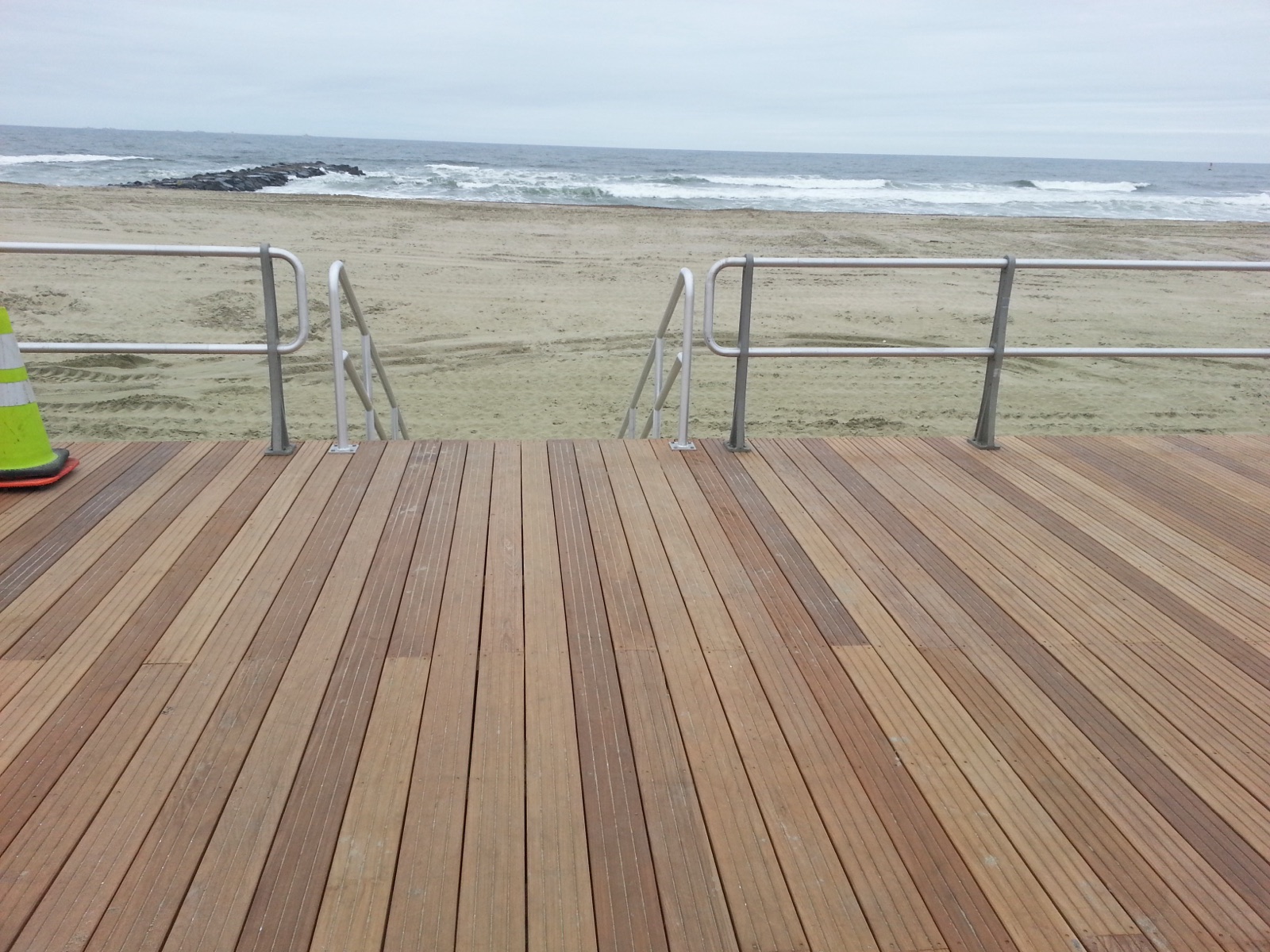
Heavy foot traffic on a commercial deck calls for 2x Ipe, a board that nets out at a full 1.5 inches of thickness.
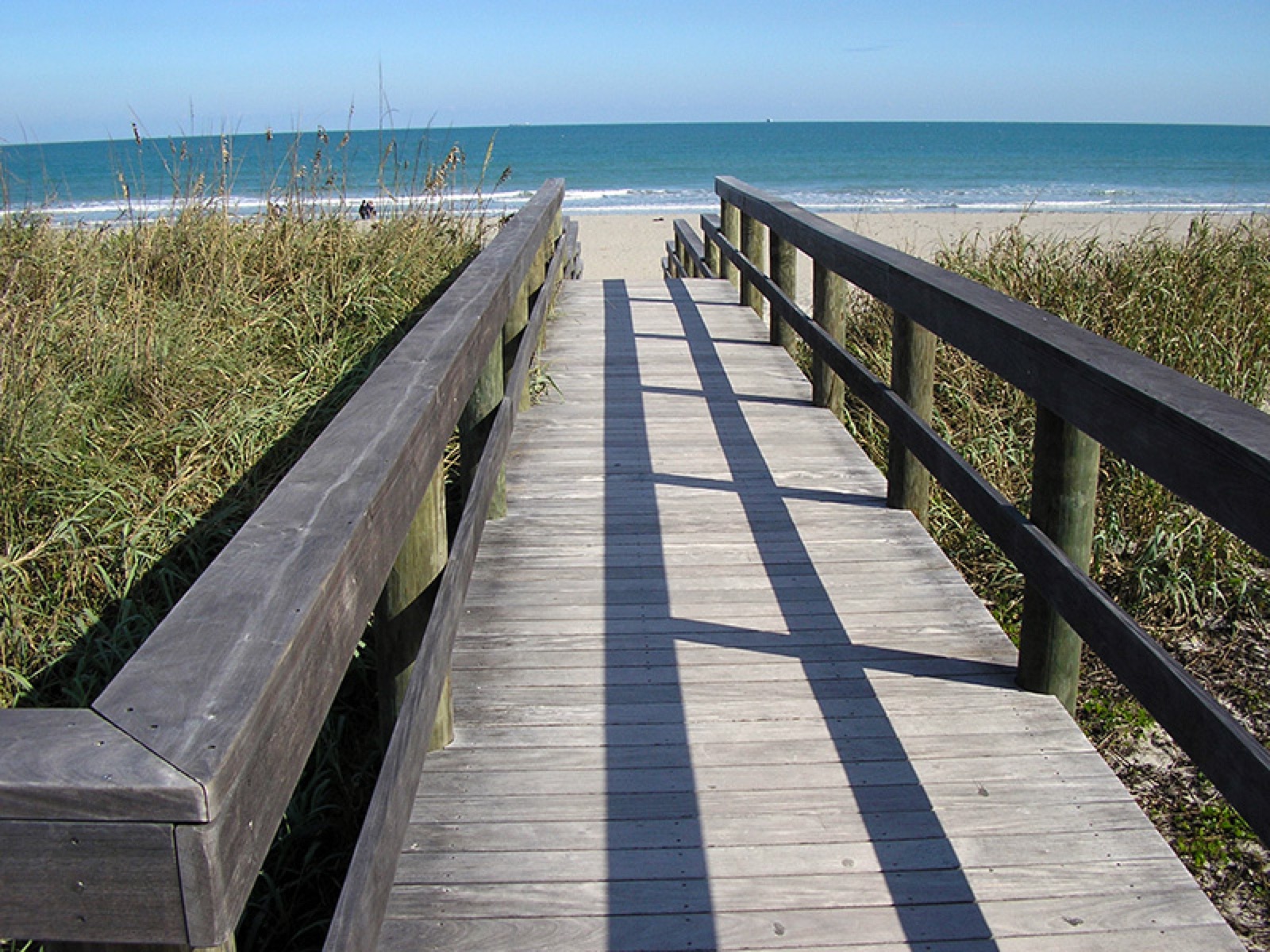
Write that number down first and work backward from it. A nominal 2x6 Ipe deck board measures 1.5 inches by 5.5 inches after milling, and that 1.5 inch net section is the standard on municipal boardwalks, ferry piers, waterfront plazas, hotel and restaurant roof decks open to the public, and park structures that see crowds every day of the season. Thinner Ipe exists. A 5/4x6 nets around 1 inch and does honest work on residential decks. On public jobs it stays in the truck.
You will not find a single code sentence that says a boardwalk plank must be 1.5 inches thick. The 2x standard lives in specification practice, in the deflection behavior engineers actually check, and in the load cases a public deck has to survive for forty years. This article walks through each of those in turn, since a specifier who understands why the convention exists writes a tighter deck section and defends it in review without breaking stride.
Strength math will approve a thinner board on paper, and commercial specifiers write 2x anyway, for reasons that hold up under scrutiny.
Run a bending check on 5/4 Ipe over joists at 16 inches on center and it passes with room to spare. Ipe carries a Janka hardness around 3,680 pounds force and a modulus of elasticity near 3,200,000 psi according to the Wood Database entry for Ipe, numbers that embarrass every domestic softwood on the market. The math is not the problem. The service environment is.
A public deck takes concentrated point loads from hand trucks, kiosk legs, scissor lifts and stage feet. It gets sanded and recoated on a maintenance cycle for decades, and every resanding removes wood. Its fasteners need deep purchase to survive tens of thousands of wet and dry cycles without working loose. And it must never feel springy underfoot, since pedestrians read any perceptible bounce on a public walkway as a defect and sometimes as a hazard worth reporting. The 2x section answers all four conditions at once.
Then there is the professional reality. No engineer of record signs a thinner plank on a public deck when the entire specification community around them writes 2x, and no design professional wants to stand alone in a deposition explaining why they departed from settled practice on a boardwalk that cracked. The convention reinforces itself, and it does so for sound engineering reasons.
When a boardwalk or pier package crosses my desk, it is already written at 2x before anyone talks to us. I have watched value engineering try to walk a public deck down to 5/4 maybe a handful of times over the years, and it never survives review. The engineer will not sign it, and they are right not to. On commercial work, the 2x board is the deck.
Norm Moton, Director of Sales, J. Gibson McIlvain
Commercial decks are designed for assembly live loads and wheel loads that no residential deck ever sees.
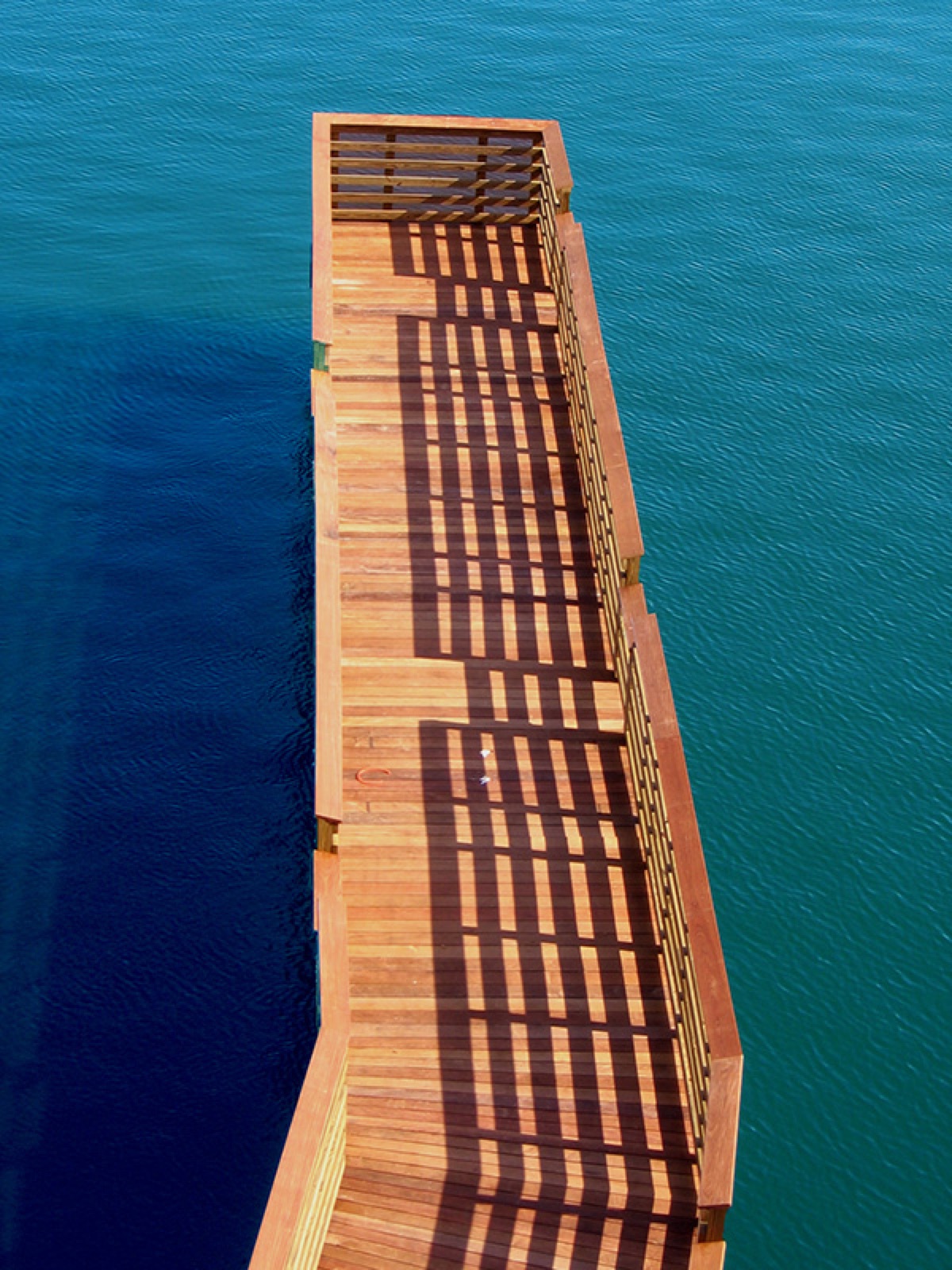
The International Building Code assigns exterior decks the live load of the occupancy they serve, and public assembly occupancies carry 100 pounds per square foot. A residential deck is designed for 40. That gap alone reframes the thickness question, but the uniform load is not even the demanding case for the deck board itself. Joists and girders handle crowd load. The plank spanning between joists is governed by the concentrated load.
Picture a loaded utility cart crossing a boardwalk on a maintenance run. One wheel puts several hundred pounds on a contact patch smaller than a playing card, landing mid span between joists. Now add sweepers, mobile vendor carts, trash haulers, and the occasional emergency vehicle a pier deck must accept in its design brief. Design values and adjustment procedures for wood under these cases come from the American Wood Council's codes and standards program, and the plank-level result on project after project is the same. The board that shrugs off a wheel load at mid span, year after year, is the 2x board.
Plank stiffness rises with the cube of thickness, so the step from 5/4 up to 2x roughly triples the board's resistance to deflection.
This is the arithmetic that makes the whole argument concrete. A deck board acts as a small beam spanning joist to joist, and a beam's stiffness varies with the cube of its depth. Take the 5/4 board at a net 1 inch and the 2x board at a net 1.5 inches. Cube the ratio and you get 3.375. Same species, same span, same wheel load, and the 2x board deflects to roughly a third of what the 5/4 board allows.
Strength grows too, with the square of thickness rather than the cube, so the 2x section carries about 2.25 times the bending capacity. Deflection is still the number that matters here. Dense tropical decking on a properly framed deck almost never fails in bending. It fails in feel. The mechanics behind these relationships are laid out in the USDA Forest Products Laboratory Wood Handbook, which remains the reference engineers pull when they need published property data for a species submittal. Ipe's stiffness is already exceptional for a decking material. The 2x section multiplies it into a walking surface that reads as solid as pavement.
The 2x requirement eliminates most tropical decking species from a commercial spec before hardness or durability ever comes up.
Here is the part of the thickness question that catches specifiers off guard. Choosing 2x sets more than a dimension. It sets the species list, because only Ipe, Cumaru and Jatoba can be sourced consistently in 2x decking thickness at commercial volume. Red Balau and Garapa are legitimate decking woods with real track records, and both live in 1x and 5/4 programs. Neither shows up in dependable 2x supply, and a public project cannot ride on opportunistic lots that may not repeat when the change order or the phase two package lands.
| Species | Janka hardness (lbf) | Natural durability | Reliable 2x supply | Commercial heavy-traffic verdict |
|---|---|---|---|---|
| Ipe (Tabebuia spp.) | ~3,680 | EN 350 Class 1 | Yes, all standard widths and lengths | The default. Class A flame spread adds code value on assembly occupancies. |
| Cumaru | ~3,540 | EN 350 Class 1 | Yes | Strong alternate that costs less than Ipe. Interlocked grain demands careful drying. |
| Jatoba | ~2,690 | Very durable | Yes | Sound third option where its red brown color suits the design. |
| Massaranduba | ~3,190 | Very durable | No, scarce in North American distribution | Comparison species only. Screens out on 2x availability. |
| Red Balau | ~1,700 to 2,000 | Durable | No, 5/4 and 1x programs | Residential and engineer-approved 5/4 work, not public decks. |
| Garapa | ~1,700 | Durable | No, 5/4 and 1x programs | Same position as Red Balau. Golden color, residential duty. |
Massaranduba deserves a note since it appears in overseas boardwalk literature. It is hard and heavy, and the published record shows it can move aggressively through wet and dry cycling. In North American distribution it is scarce in 2x, which settles the question for a commercial spec regardless of its other merits. J. Gibson McIlvain does not run a Massaranduba program, and the three species it mills for 2x commercial work, Ipe, Cumaru and Jatoba, cover the performance range a public deck demands. Property data for the alternates sits alongside Ipe at the Wood Database entry for Cumaru for submittal backup.
5/4 Ipe is a residential and weight-limited answer with a defined place, not a downgrade waiting to fail.
None of this makes 5/4 a compromise product. On a residential deck framed at 16 inches on center, 5/4 Ipe outlasts the fasteners holding it down. It also earns its spot on rooftop amenity decks where the structural engineer is fighting dead load and signs a 5/4 span calculation to save weight, and on private courtyard or multifamily work where an engineer has reviewed the traffic case and approved the thinner section in writing. Red Balau and Garapa belong in exactly this territory as well.
For estimating, a 5/4x6 board covers about 2.1 linear feet per square foot of deck, a figure that carries over to 2x6 since the face width is the same. The line to hold is simple. The moment a deck becomes public, or takes wheeled maintenance traffic as part of its brief, the 5/4 conversation ends and the 2x section goes in the spec.
2x thickness is not a license to widen joist spacing on a heavy-traffic deck.
The temptation is obvious. A board three times as stiff should span farther, and in a purely residential span table it can. Commercial practice resists the trade. Joists stay at 16 inches on center as the baseline for dense hardwood decking, and they tighten to 12 inches where carts run daily routes, where boards lay diagonally across the framing, or where the engineer's concentrated load case says so. The stiffness the 2x board gains over closer spacing is banked as feel and as reserve against decades of wear, not spent on lumber savings in the frame.
Detailing under the boards matters as much as the section above them. Air must move on all four sides of every board, which means open or vented skirting, clear space below the frame, and no decking laid tight against a membrane. Butt joints land on doubled joists so each board end gets full bearing. On piers and waterfront structures the substructure hardware gets specified in 316 stainless alongside the deck screws, since a heavy deck board is only as permanent as the frame carrying it.
Commercial 2x Ipe gets face fastened with 316 stainless screws, and every hole gets drilled on site against the frame as built.
Face screwing is the commercial standard for 2x work. It gives inspection a visible fastener schedule, it clamps the full thickness of the board to the joist, and it makes future board replacement a maintenance task instead of a demolition project. Specify 316 stainless on any coastal or deiced site. Plugged and countersunk heads are available as an architectural upgrade where the owner wants a clean field.
Do not ask for the boards pre-drilled, and be suspicious of anyone who offers it. No competent mill drills fastener holes before shipping, and the reason is practical rather than economic. Hole layout depends on the frame as it was actually built, on field cuts, on board shuffling during installation, and a factory pattern is invalid the moment the first joist lands a half inch off the drawing. Drilling Ipe is site work with a settled technique. Pilot every hole, no exceptions at this density. Use a self centering combination bit that drills and countersinks in one stroke. Set two fasteners per board at every joist, hold about 3/4 inch of edge distance, run full depth pilots near board ends where splitting risk peaks, and land every butt joint on doubled bearing.
Surface checking in dense tropical decking cannot be prevented, and a thicker board does not change that physics.
Set this expectation with the owner before installation, not after the first summer. Checking is the wood releasing tension as its surface heats and dries faster than its core. In a board as dense as Ipe that gradient is unavoidable in exterior service, and small surface checks do not weaken the board. They are normal, and even a sign of properly seasoned stock. A 2x board carries more core mass under the same sun exposed face, so the gradient is real there too.
What a supplier can do is slow the surface exchange. J. Gibson McIlvain factory coats its tropical decking with Cutek, a penetrating oil wood stabilizer that significantly reduces checking by moderating how fast the face gives up moisture. Site practice keeps checks small from there. Confirm the material arrives at its exterior service range of 12 to 16 percent moisture content, let it acclimate on site with air on all faces, seal every fresh end cut the day it is made, and maintain the ventilation detailing described above. Managed this way, checking stays cosmetic for the life of the deck.
2x Ipe clears the code checkpoints that stop many decking materials at the door of a public project.
Fire performance comes first on assembly occupancies. Ipe achieves a Class A flame spread rating under ASTM E84, meaning a flame spread index of 25 or less, without any treatment. Few exterior walking surfaces of any material match that untreated, and on boardwalks threaded through wildland interface zones it can decide the material selection by itself.
Accessibility rules shape the gapping. The ADA Accessibility Standards require that openings in a walking surface reject a half inch sphere, with elongated openings oriented perpendicular to the dominant direction of travel. Standard Ipe deck gaps sit far inside that limit, and running boards across the main path of travel satisfies the orientation provision while also putting every wheel load across the boards rather than along them.
Sourcing documentation rounds out the submittal package. Ipe is available with FSC chain of custody certification for projects pursuing certification credits. And when using a CITES-listed species, export documentation must travel with the material under the CITES convention. An importer that manages its own supply chain clears that paperwork before the wood ever reaches the yard, which is exactly the kind of detail a public agency's procurement office will ask about.
How J. Gibson McIlvain Would Specify This
For a commercial deck under heavy foot traffic, the specification is 2x6 Ipe, net 1.5 by 5.5 inches, face fastened over joists at 16 inches on center. Write the deck section this way. Decking shall be Ipe (Tabebuia spp.), 2x6 nominal, air dried for exterior service at 12 to 16 percent moisture content, factory coated with Cutek penetrating oil stabilizer, laid perpendicular to the primary path of travel. Fasteners shall be 316 stainless steel deck screws, two per board per joist, installed in field drilled and countersunk pilot holes with 3/4 inch minimum edge distance and full depth pilots at board ends. Butt joints shall bear on doubled joists. Joist spacing shall not exceed 16 inches on center, reduced to 12 inches at diagonal layouts and designated cart routes. Substructure shall provide free air movement on all faces of the decking.
Substitute 2x Cumaru where the budget wants relief, or 2x Jatoba where the palette calls for it, and hold every other line of the spec unchanged. Do not accept a substitution to any species that cannot document consistent 2x supply, whatever its hardness number says.
J. Gibson McIlvain stocks 2x Ipe decking in a vast inventory covering every standard and custom dimension, along with 2x Cumaru and Jatoba, and ships commercial packages nationwide from its own yards, with California deliveries a regular part of the schedule. The company has worked lumber since 1798 and imports and mills its tropical decking itself, which is why the CITES paperwork, the FSC option and the Cutek factory coating all come from one accountable source. Review the decking program at mcilvain.com/ipe-decking, or call 800-638-9100 with your board footage and framing plan and a sales rep will build the takeoff with you before the spec goes out for bid.
Frequently Asked Questions
Why do commercial specs call for 2x Ipe when 5/4 passes the strength calculations?
Bending strength is not the governing condition on a public deck. The 2x section exists to control deflection under concentrated wheel and point loads, to leave wear allowance for decades of resanding, and to give fasteners deep purchase through years of wet and dry cycling. A 2x board is roughly three times as stiff between joists as a 5/4 board of the same species, and stiffness is what makes a boardwalk feel solid under crowds. On top of the mechanics, no engineer of record will sign a thinner plank on a public job when settled practice across the profession writes 2x.
Can 2x Ipe handle maintenance carts and light vehicles on a boardwalk?
Yes, within the limits the project engineer sets. 2x Ipe over joists at 16 inches on center routinely carries utility carts, sweepers and vendor carts, and joists tighten to 12 inches on center along designated cart routes. Anything heavier, such as an emergency vehicle a pier must accept, is a framing design case first, since the deck board is rarely the weak point once the 2x section is in place. Running boards perpendicular to the path of travel puts every wheel load across the boards, which is how the system is meant to work.
Which species besides Ipe are available in 2x commercial decking thickness?
Only Cumaru and Jatoba can be sourced in 2x decking thickness with the consistency a commercial project needs. Cumaru comes close to Ipe in hardness and durability and costs less. Jatoba is the third option where its red brown color fits the design. Red Balau and Garapa are sold in 1x and 5/4 programs and belong in residential and engineer-approved 5/4 work, and Massaranduba is scarce in 2x in North American distribution, so none of the three belong in a public deck spec.
Does a thicker Ipe board check less than a 5/4 board?
No supplier can promise that, and thickness does not change the physics. Checking is the surface releasing tension as it heats and dries faster than the core, small surface checks do not weaken the board, and they are normal in properly seasoned dense hardwood. The effective mitigation is a penetrating oil stabilizer. J. Gibson McIlvain factory coats its tropical decking with Cutek, which significantly reduces checking, and site practice such as end sealing fresh cuts and keeping air on all faces of the board keeps checks small.
What fastener specification goes with 2x Ipe on a pier or waterfront deck?
Face screws in 316 stainless steel, two per board at every joist, with the substructure hangers and hardware in 316 as well. Every hole is drilled on site with a self centering combination bit that pilots and countersinks in one stroke, holding about 3/4 inch of edge distance with full depth pilots near board ends. Butt joints land on doubled joists. Boards are never pre-drilled at the mill, because hole layout depends on the frame as built and on field cuts made during installation.
Does J. Gibson McIlvain supply 2x Ipe for commercial projects outside its region?
Yes. J. Gibson McIlvain is a commercial and contractor-volume supplier that ships nationwide from its own yards, with California deliveries a regular part of the schedule. The Ipe inventory is vast and covers every standard and custom dimension, including the 2x sections commercial decks call for, alongside 2x Cumaru and Jatoba. Call 800-638-9100 with the framing plan and board footage and the sales team will build the takeoff before the project bids.
Sources and Standards Referenced
- The Wood Database: Ipe
- The Wood Database: Cumaru
- USDA Forest Products Laboratory, Wood Handbook: Wood as an Engineering Material (FPL-GTR-190)
- 2021 International Building Code, ICC Digital Codes
- American Wood Council: Codes and Standards
- U.S. Access Board: ADA Accessibility Standards
- ASTM E84, Standard Test Method for Surface Burning Characteristics of Building Materials
- Forest Stewardship Council
- CITES, Convention on International Trade in Endangered Species