What Drives Prefinished Cladding Lead Time
Prefinished lead time is milling plus finishing plus cure, and each step takes real time a raw lumber order skips. Knowing the pieces lets a project set the order date with some accuracy.
- Milling: the profile gets run to the specified face width and reveal. A custom profile adds knife-grinding and a first-article approval.
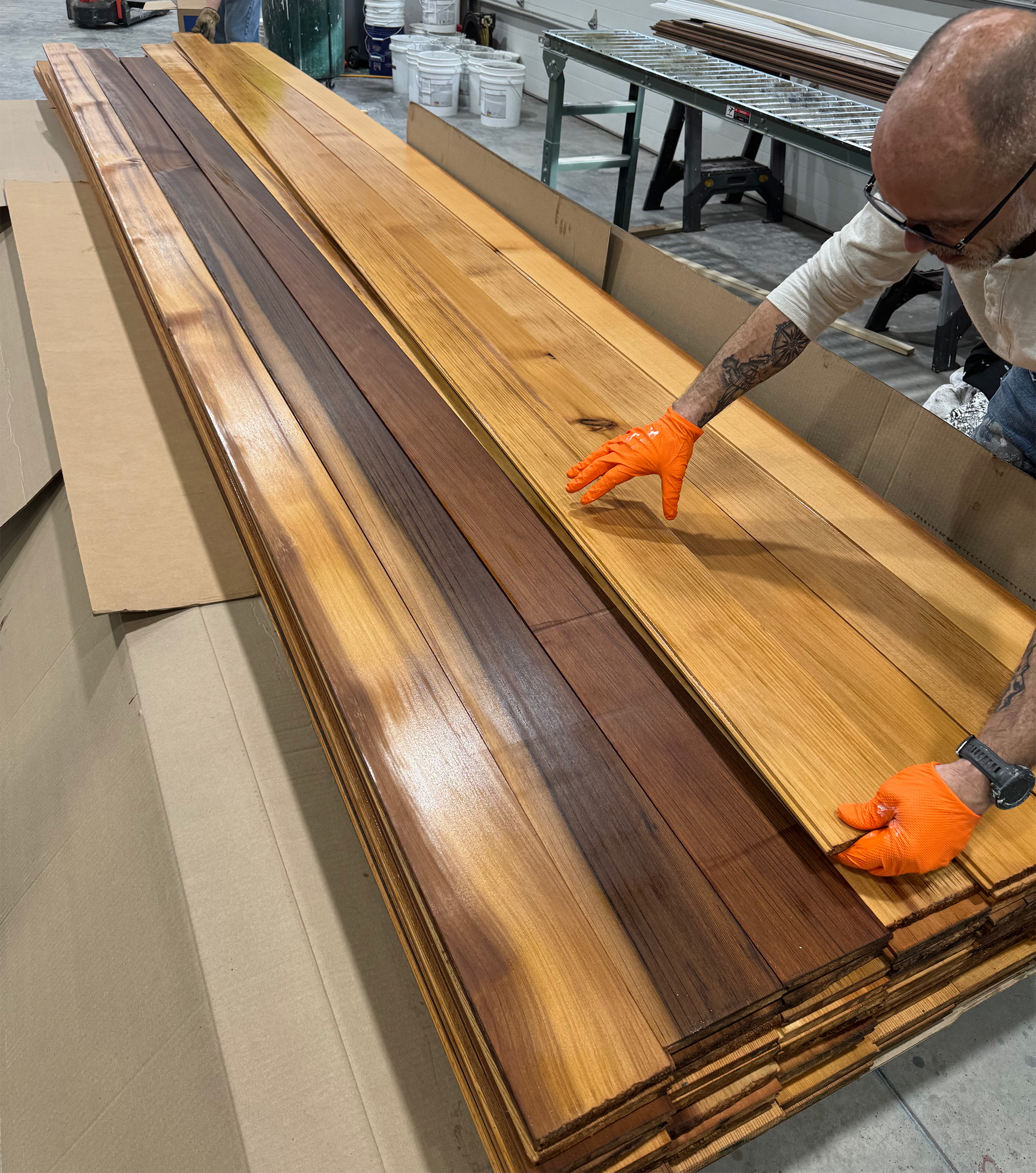
- Finishing: all six faces get sealed in a controlled shop, which is the reason prefinished cladding outruns field finishing.
- Cure: the finish cures in a controlled environment before the boards bundle and ship, so the coating reaches full integrity.
Because the finish goes on in a shop instead of on site, the schedule risk of waiting for a dry weather window leaves the jobsite and turns into predictable production time up front. For why factory finishing wins, see our oil vs. film finishes guide.
Order Backward From the Install Date
Place a prefinished order by starting at the install date and working back through delivery, cure, finishing, milling, and material, with a buffer. A last-minute prefinished order cannot be milled, finished, and cured overnight. It just cannot.
| Step (in reverse) | What it needs |
|---|---|
| Install date | The fixed target |
| Delivery window | Sequenced freight to the jobsite |
| Cure | Controlled cure before shipment |
| Finishing | Six-side sealing in a controlled facility |
| Milling | Profile run; custom profiles add first-article approval |
| Material and mockup | Species procured, mockup approved before release |
Approve the mockup and submittal before the order releases, since that is what locks grade, profile, and finish. For the full procurement sequence, see our guide on commercial wood cladding sourcing.
What Extends and What Shortens Lead Time
Lead time grows with a custom profile, a modified-wood species, or a specific finish, and it shrinks when the profile and species are already stock. Knowing which choices add time lets a project plan around them or adjust.
- Custom profile: grinding knives and running a first-article adds time over a stock profile.
- Modified woods: Accoya, Thermory, and Abodo Vulcan run in modification batches and cap near 16 feet, which touches availability and detailing.
- Finish specification: a specific factory color or system adds finishing and cure time over unfinished stock.
- Stock species and profile: a species held in depth, like Ipe, on a standard profile shortens the milling step.
Installing near the in-service equilibrium moisture content still matters whatever the lead time; see our moisture content guide.
Release-Based Ordering for Long Schedules
On a long or weather-dependent schedule, a release-based order lets the supplier produce and hold the material, then ship on call as the install moves. Finished boards stay out of the weather on site while still being ready the day the crew needs them.
A supplier that mills, finishes, and stocks in-house can run this, staging production to the schedule and shipping nationwide. J. Gibson McIlvain can sequence a prefinished order to the install or hold it for release-based call-offs, so a project on a moving timeline is not stuck taking a single early delivery. For delivery logistics, see our guide on custom siding profile milling and national jobsite delivery.
"The mistake is treating prefinished cladding like something you grab off a shelf the week you need it. It has to be milled, finished on all six sides, and cured, and that takes time up front. Plan the order backward from the install date and give it a buffer. We mill and finish in-house and ship nationwide, and on long jobs we hold the material and release it as the crew moves. The planning is the easy part if you do it early."
Camden Zacker, Sales Director, J. Gibson McIlvain Company
How J. Gibson McIlvain Plans a Prefinished Order
A prefinished order at J. Gibson McIlvain gets planned backward from the install date. The team confirms the species and profile, checks the design against real length limits, mills the profile in-house, finishes all six faces, cures the boards, and sequences delivery nationwide, holding material for release-based call-offs where the schedule needs it. Milling, finishing, and inventory all sit in-house, so the lead time is predictable and the order does not hang on outside shops.
Stock species like Ipe, held in a full range of dimensions, and standard profiles keep the milling step short. Custom profiles and specific finishes get planned with the added first-article and finishing time built in. Touch-up sealer ships with the order so crews seal field cuts as they install, and FSC documentation comes along where required.
Lead-Time Planning Checklist
| Item | Why it matters |
|---|---|
| Install date and buffer | The order is planned backward from it. |
| Stock vs custom profile | Custom adds knife-grinding and first-article approval. |
| Species availability | Modified woods run in batches and cap near 16 ft. |
| Finish specification | A specific finish adds finishing and cure time. |
| Mockup approval | Approve before release to lock the order. |
| Delivery mode | Sequenced or release-based call-off for long schedules. |
Where Lead-Time Planning Usually Fails
- Ordering too late: prefinished cladding cannot be milled, finished, and cured overnight.
- Ignoring custom-profile time: knife-grinding and first-article approval add to the schedule.
- Assuming long modified-wood boards: modified woods cap near 16 feet; detail accordingly.
- Releasing before mockup approval: locks the wrong grade, profile, or finish.
- Taking one early delivery on a long job: finished material sits exposed; use release-based call-offs.
Ordering Information to Resolve Before Pricing
- Schedule: install date, phasing, and buffer.
- Profile: stock or custom, face width, reveal.
- Species and finish: availability and finish specification.
- Delivery mode: sequenced or release-based call-off.
- Logistics: square footage, lengths, touch-up quantity, freight destination.
Related J. Gibson McIlvain Guidance and Next Steps
Frequently Asked Questions
How much lead time does prefinished wood cladding need?
Prefinished cladding needs production lead time, because the boards get milled to profile, finished on all six faces, and cured before they ship. The exact time turns on whether the profile is stock or custom, whether the species is stocked or run in batches, and the finish specified. Order backward from the install date with a buffer. J. Gibson McIlvain mills and finishes in-house and ships nationwide, so the lead time is predictable.
How should I schedule a prefinished cladding order?
Start from the install date and work back through delivery, cure, finishing, milling, and material, add a buffer, and approve the mockup before releasing the order. That keeps the facade on the critical path instead of waiting on material. On long or weather-dependent schedules, a release-based order lets the supplier produce and hold the material and ship on call. J. Gibson McIlvain can sequence delivery or hold stock for call-offs.
What makes prefinished cladding lead time longer?
A custom profile adds knife-grinding and a first-article approval, modified woods such as Accoya, Thermory, and Abodo Vulcan run in batches and cap near 16 feet, and a specific factory color or system adds finishing and cure time. Lead time is shortest when the profile and species are stock, like Ipe held in a full range of dimensions on a standard profile. Planning around these keeps the schedule honest.
Can a supplier hold prefinished cladding and ship it as I need it?
Yes. On long or phased schedules, a release-based order lets the supplier produce and hold the finished material, then ship on call as the install moves, which keeps finished boards off an exposed site. J. Gibson McIlvain mills, finishes, and stocks in-house, and can sequence a prefinished order to the install or hold it for release-based call-offs, shipping nationwide so the material is ready when the crew needs it.
Why is prefinished cladding worth the lead time?
Prefinished cladding trades jobsite work and weather risk for predictable production time up front. Because the boards are finished on all six faces in a controlled shop, the finishing trade and the wait for a dry window leave the jobsite, and the wall goes up in one pass. The only field finishing step is sealing cut ends. For a project on a schedule, moving the finish into predictable production time is usually the deciding advantage.
Sources and Standards Referenced
- USDA Forest Products Laboratory - Finishing and moisture content
- Accoya - Acetylated wood production and length constraints
- Thermory - Thermally modified wood documentation
- Abodo - Vulcan thermally modified radiata pine specifications
- American Wood Council - Wood construction standards
- Forest Stewardship Council - Chain of custody certification